

Jafar Panahi’s 2025 Cannes victory for It Was Just an Accident cements his legacy as a defiant auteur. Despite decades of Iranian state censorship, imprisonment, and filming bans, Panahi continues to shoot clandestine, innovative cinema. His work remains a powerful tool of political resistance, demanding freedom and national unity.

Click here to play & learn.
Back Story
Jafar Panahi: cinema as resistance
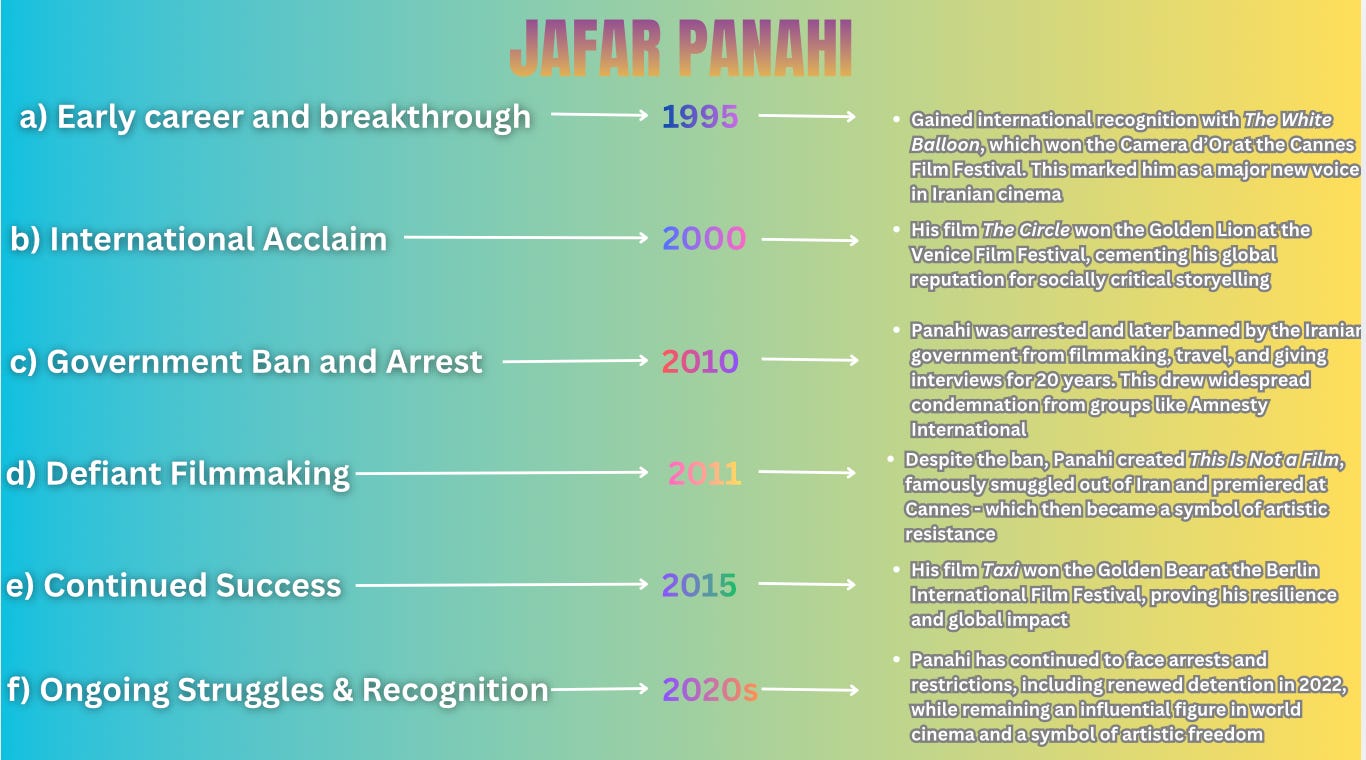
“It is very difficult to speak,” Jafar Panahi confessed, standing on stage at the Cannes Film Festival last year. Indeed, when the director came to be awarded the Palme d’Or for his 2025 film It Was Just an Accident (Yek tasadof-e-sade), the audience’s reaction made up for his own reticence. The 65-year-old was met with an almost eight-minute standing ovation - to which he responded by basking in the moment with his hands behind his head.
To the many Iranians watching, both in the Grand Théȃtre and across the world, the applause was the recognition of, not simply a single film, but a broader struggle against decades of censorship after the 1979 Islamic Revolution. Following the inauguration of the Islamic Republic, many predicted that new restrictions would kill Iranian cinema. Instead, it is recognised today as one of the most innovative and distinctive film industries - formed of adversity and necessitating extraordinary measures in order to escape the deadening hand of state repression.
For this we have Jafar Panahi - and his illustrious forebears, such as Abbas Kiarostami and Mohsen Makhmalbof - to thank. Of the world’s currently active filmmakers, only he has won the Golden Bear at Berlin (Taxi, 2015), the Golden Lion at Venice (The Circle, 2000), and now the 2025 Palme d’Or at Cannes. Yet not only does Panahi boast creative mastery, but political zeal too, having participated in virtually every anti-government movement in Iran and been imprisoned several times.
Much of Panahi’s acceptance speech struck an activistic tone, as he urged his compatriots to unite: “What’s most important now is our country and the freedom of our country,” he said, “Let us join forces. No-one should dare tell us what kind of clothes we should wear, what we should do, or what we should not do.” This demand carries the weight of Panahi’s own resistance, exhibited throughout his career, and reflects his own defiance of Iran’s authorities.
Unsurprisingly, this stance is maintained in the darkly absurdist fable, It Was Just an Accident. “It really begins,” Panahi explains, “with a small sound: a prosthetic leg tapping against the outskirts of Tehran.” Vahid (Vahid Mobasseri), a diffident mechanic and former political prisoner, stiffens. He recognises the limp as belonging to the interrogator - dubbed ‘Peg Leg’ because of the distinctive squeak of his prosthetic limb - who once tortured him in captivity. Or so he believes - the rest of the film captures his anxious attempts to determine whether this is true or not.
It is really the final scene which lingers, long after you have left the dark enclosure of the auditorium and returned to reality. We see Vahid’s van parked somewhere remote. We hear the sound of a prosthetic leg. Is it the oppressor’s? Real or imagined? Has he escaped? As we ponder, the film cuts. Vengeance collapses under its own weight, and the film refuses to resolve - instead settling into an ambiguity that sets up more universal questions about the peace after bloody vengeance.
The Cannes-winning film, Panahi’s first since he was released from the notorious Evin Prison in 2022, was shot without an official permit and filmed almost entirely in secret. It also contains scenes with women who aren’t wearing the hijab, outward defiance against a mandatory dress code established after the 1979 Iranian Revolution.
Panahi’s connection to Cannes is long-standing. His debut feature, The White Balloon (1995) won the Camera d’Or at the Cannes Film Festival, conferring the early recognition that enabled him to bear and nourish the dual status of auteur and democracy campaigner. In a 2018 interview with Jamsheed Akhrami, he spoke about the incompatibility between independent filmmakers and the Iranian state authority: “We have always”, he said, “tried to avoid the government and shield ourselves from its interference. But the hardliners have failed to silence independent filmmakers. When they’ve kicked us out the door, we’ve jumped back in through the window to do what we needed to do.”
In 2009, Panahi’s incarceration while shooting a film about Iran’s street protests provoked international uproar, forcing the government to release him. In 2010 he was arrested again, with the court issuing a six-year prison sentence along with a 20-year ban on filmmaking and travel outside of Iran.
Far from being deterred, Panahi has recrafted his practice under these new penalties. Since the ban, he has completed six feature-length films and several shorter works; under varying degrees of restriction, they often use confined interiors, nonprofessional actors and skeleton crews. This Is Not a Film (2012) - shot on a digital camcorder and iPhone for just €3200 - and Closed Curtain (2014) were filmed entirely indoors, while Taxi (2015) unfolds solely within the confines of a car. Nowadays, all of Panahi’s films released after 2000 have been effectively banned from official release in Iran; he now works clandestinely to find channels for international exhibition - one being smuggling films out of the country on a USB thumb drive.
In December 2025, the government sentenced Panahi “in absentia, to one year of imprisonment, two years of prohibition from leaving the country, and a ban on membership in any political or social groups or organizations, on the charge of propaganda against the regime,” his lawyer said in a statement on X. However, he still vows to return to Iran - where both his mother and son still live. During last year’s Cannes Film Festival, he told EL PAÍS: “I will return home. It may sound strange to you, but the Iranian people have much more at stake. The most important thing is our country and achieving its freedom.”
So, when Jafar Panahi confesses, “It is very difficult to speak,” his remark resonates beyond the nerves of an awards stage. Rather, he speaks for a nation enduring a wave of merciless destruction - a nation whose true representatives are not in the corridors of power, but in the society that their art reflects.
In this post Camille highlights the arty refugee experience of Marwan Mousa She is a citizen journalist on a placement with us organised by Oxford University Career Services. She also organised the micro game to make the journalistic experience interactive.
Thank you for reading an A4R 🎨 Post. Don’t forget to visit our gaming art here. Every purchase scales our impact and pays our bills.
