


Click here to play & learn.
Back Story
“I carry the banner of the trauma./War child, child without a mama,/still fighting in the saga.”
Framed by melodious vocal harmonies and driven by an Afro-hip-hop beat, these are the poignant lyrics of Emmanuel Jal’s ‘Forced to Sin’. In thirteen words alone, he creates a profoundly succinct, communicable, and yet moving summary of his life and work. His violent allusions create a tone of despair that contrasts with the joy of childhood. Unfortunately, for Jal, his own was filled with no such joy. He was born at some point around the start of 1980, entering a world of rising tension and conflict that peaked in 1983 with the Second Sudanese Civil War - an event that changed the course of his life and many others in ways hard to imagine. Since then Jal has lost family and friends, fled and faced war, and lived on the streets to fend for himself. However, despite this suffering he has achieved great things, winning awards for his music, playing alongside some of the biggest names in the industry, and being a prominent figure in political change and charity work for decades.
Emmanuel Jal was born to a Nuer family in the village of Tonj, Warrap State in the Bahr el Ghazal region of then Sudan. The exact date of his birth is sadly unknown, as it was undocumented, but Jal has taken the 1st of January 1980 to be his birthday. At this time, Sudan was an incredibly divided nation with a dictatorial leader (Gaafar Mohamed el-Nimeiri) who allowed economic failure and poverty to take a grasp of the nation, as well as promoting religious instability between the largely Muslim population in the North and the largely Christian population in the South. Along with political turmoil surrounding the control of oil fields within the country, Gaafar Mohamed el-Nimeiri’s imposition of Sharia law upon the entirety of Sudan ignited the raging fire that was the Second Sudanese Civil War.
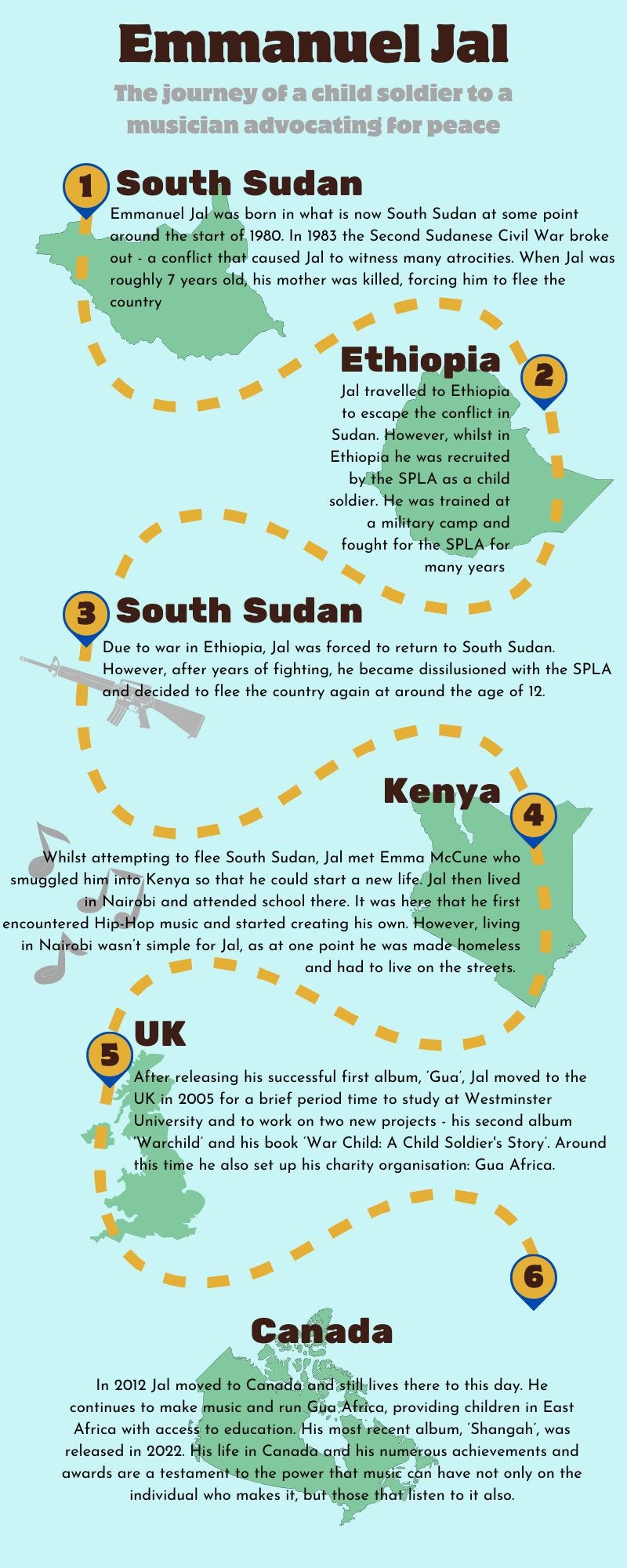
Jal’s story begins here. After the outbreak of war, his father joined the Sudan People’s Liberation Army (SPLA) to fight the oppressive Sudanese government. In the years that followed, Jal witnessed the horrors of war. He experienced the murder of his mother at the hands of the Sudanese government and saw terrible crimes committed against his aunt.
Following this emotional turmoil, Jal joined other Sudanese children in fleeing to Ethiopia in hopes of education, opportunity, and a better life. However, in doing so he was recruited by the SPLA and subsequently trained as a child soldier.
Reflecting on this, Jal has commented on the anger he felt at the time which led him to have faith in the SPLA’s cause. Much like the other children around him, he wanted revenge for what had happened to his family. The SPLA abused the trauma of these children and forced them into conflict. They were used as soldiers in Ethiopia until war broke out there, forcing the child soldiers to return to Sudan.
The return to Sudan did not give the children peace. They were forced to continue to fight the Sudanese government. Eventually, Jal and other child soldiers around him managed to escape the clutches of the SPLA and reach the Sudanese village of Waat. Here he was presented with what he considers to be the major turning point in his life: British aid worker, Emma McCune.
With her work, McCune helped over 150 Sudanese children escape the war-torn country, with one of them being Jal. She smuggled him into Kenya where he was able to live in Nairobi and access education, allowing him to lead a normal life away from war.
Unfortunately, this wasn’t the end of Jal’s obstacles. While living in Kenya, he was made homeless after the death of McCune in 1993, as her husband threw Jal out onto the streets. He was then forced to live in the slums of Nairobi, yet again a child alone having to fight for himself.
But Nairobi was not only a place of hardship for Jal; in many ways, it was the key to his later success. It was at this stage in his life that he discovered hip-hop. He was enthralled by the story telling nature of American hip-hop music and was inspired to use it to tell his own story. It was in Nairobi that he began to make his own music, collaborating with the people around him and sharing his story with his audiences.
Simultaneously with his musical journey, Jal became involved in his local community, doing charity work raising money for children and refugees. This charity work demonstrates a fundamental element of music for him, with Jal believing that the key agenda of his music is to help others through raising awareness of the horrors of war and the part that children all too often play in it. Taking this philosophy of charity and helping those who are in need, he soon rose to a small level of fame, largely thanks to the release of his first single “All We Need Is Jesus” that came out in 2005. From then on Jal’s music career took off.
He released his first album ‘Gua’ in 2005. In Sudanese Arabic, ‘Gua’ means peace or power, symbolising Jal’s mission: There is power in music and the stories we tell with it, so we should use this for good. Upon listening to Gua, Jal’s American Hip-Hop influence is very apparent through some of the beats he uses and the tone of voice in which he raps. However, the melodies he incorporates throughout, in addition to the multiple languages in which he delivers his lyrics, make his musical background in African countries clear to the listener. This fusion of styles is a defining characteristic of his music. In addition to this, his lyrics display his ambition for creating a better world, with a verse in the song ‘Gua’ encapsulating this sentiment: “I can’t wait, I can’t wait for that day/When I see no more tears, no more fear, no cry/No tribalism, nepotism and racism in my motherland”.
Ever since the release of his first album, Jal has been on an upward trajectory. His music has spread further, become more popular, and given him tremendous success. In 2005 he won an award for best international artist at the American Gospel Music Awards, and then in 2008 he played at the Nelson Mandela 90th Birthday Tribute concert, held in Hyde Park, alongside A-list artists such as Amy Winehouse and Sam Smith.
However, music is far from his only success. During 2006, Jal founded an informal charity group that later in 2009 became the registered charity organisation Gua Africa. The organisation aims to improve educational opportunities for people that are affected by war and conflict in East Africa. Gua Africa has carried out a range of amazing projects over the years, from providing children with scholarships to actually building schools. Jal’s charity work has led to him winning numerous international awards such as: Vaclav Havel International Prize for Creative Dissent 2018, Desmond Tutu Reconciliation Award 2017, Hero in the global campaign against violent extremism – UNESCO 2016, The Hunt Humanitarian Award, The Dresden Peace Prize, The Common Ground Award and been recognised by Ban Ki Moon at the UN for his activism.
Jal moved to Toronto in 2012 and still lives there today, having now become a citizen of the country. Talking on the topic, he has been quoted as saying “I grew up in a warzone in South Sudan and became a child soldier, wielding an AK-47 at seven years old. But here in Canada, I don’t feel like I have to purchase a gun to feel safe…I came to Canada with nothing, and now I have so much.”
After such a perilous journey from war in South Sudan, to the streets of Nairobi, and finally to a music studio in Toronto, Emmanuel Jal has finally settled and made a home. When looking at this story, there is one clear factor that has allowed him to make so much of his life despite his desperate beginnings: music. Jal’s journey tells us how important art is, not just in how it can bring an individual money and fame, but through how it can cause happiness and lead to opportunity in others.
One article cannot encapsulate Emmanuel Jal’s life, and neither can it encapsulate the extent of his achievements, but in writing this I want to demonstrate the power of the arts, and I hope to be a part of the message that he is trying to convey. This being said, no one can put it better than Jal himself, so I want to leave you with a comment from a TED Talk that he did in 2009: “So one thing I know about music: music is the only thing that has power to enter your cell system, your mind, your heart, influence your soul and your spirit, and can even influence the way you live without even you knowing.”
Resources list
Jal, E. (2009). Transcript of ‘The music of a war child’. TED. Available at: https://www.ted.com/talks/emmanuel_jal_the_music_of_a_war_child/transcript.
Emmanueljal.com. (2022). Emmanuel Jal – South Sudanese-Canadian artist, actor, former child soldier, and political activist. [online] Available at:
https://emmanueljal.com/
.
Afropop Worldwide. (2025). Afropop Worldwide | Emmanuel Jal: Life Lessons From a Survivor. [online] Available at: https://www.afropop.org/articles/emmanuel-jal-life-lessons-from-a-survivor [Accessed 19 Dec. 2025].
World Economic Forum. (2024). Emmanuel Jal. [online] Available at: https://www.weforum.org/people/emmanuel-jal/.
In this post Baybars highlights the arty refugee experience of Emmanuel Jal. He is a citizen journalist on a placement with us organised by Oxford University Career Services. He also organised the micro game to make the journalistic experience interactive.
Thank you for reading an A4R 🎨 Post. Don’t forget to visit our gaming art here. Every purchase scales our impact and pays our bills.
