


Click here to play the game.
“Norbert Brainin-Wheels of Songs” is an interactive music game that allows you to first learn the history of the very talented musician. You also get to spin to hear his work, creating a fun way to listen to his work while also understanding his story.
-Nimrit Boparai, UC San DiegoBack Story
In this game we can learn about the musician and his story of success against adversity. First we learn about his background, before spinning a wheel to hear some of his most famous music.
-Miranda Dorkins, Oxford University
🎧 listen to Rayne's backstory here - she discusses her motivation & research as well.
📹 watch a short intro video by Rayne here - she used Ai to introduce Norbert to you.
Backstory -
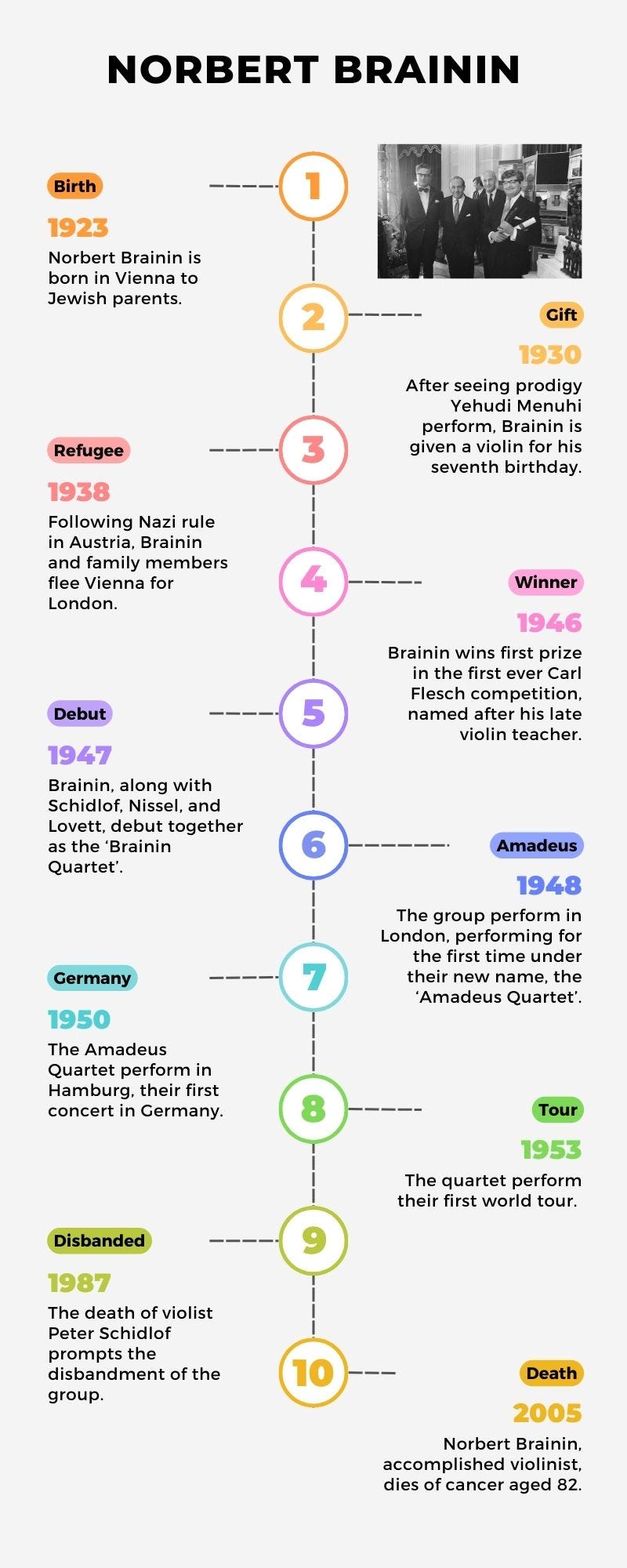
Norbert Brainin, 1923-2005, was one of the most accomplished and celebrated classical musicians of his day. Born in Vienna to Jewish parents, he was raised with a passion for music, being gifted a violin for his seventh birthday. In 1938, Hitler’s Anschluss with Austria posed a threat to Austrian Jewish communities, and, like many, Brainin was forced to flee. With his siblings and uncles (who had raised them since their parents’ deaths) he fled to London.
Here, Brainin took up studies with violinist Carl Flesch, although this would be cut short. During the Second World War Flesch fled to Rotterdam where he was later killed, and Brainin himself was forced to spend time in a British internment camp as an ‘enemy alien’. After leaving the camp, he resumed his studies with Flesch’s assistant, Max Rostal, along with Peter Schidlof (violinist, later violist) and Siegmund Nissel (violinist). Like Brainin, Nissel and Schidlof were also Viennese Jewish refugees.
In 1946, Brainin became the first person to win the Carl Flesch competition, an international competition for violinists. In 1947, Brainin, Schidlof, and Nissel, along with Martin Lovett as cellist, debuted as a quartet. In 1948, the quartet played their first concert in London, with their name changed from the ‘Brainin Quartet’ to the ‘Amadeus Quartet’. It was by this name that they would come to be known.
For the next forty years, the quartet would tour around the world playing classical music, becoming widely renown for their talent. This included Brainin’s receipt of the Order of the British Empire for his contributions to music. The death of Peter Schidlof in 1987 prompted the surviving three members to disband, though Brainin continued to perform as a soloist, including a concert in Alabama in 1993 in memory of Martin Luther King. Brainin is often remembered for both his commitment to music and his sense of humour. He died of cancer in 2005.

In this article Rayner Kilingbeck highlights the arty refugee experience of Norbet Brainin. She is a student journalist with us on a placement organised with Oxford University Career Services. This article was edited using Lex.page. and the video was made using Invideo.io The article was converted into a micro using Rosebud.ai by Constantin. He is a front end developer placed by Virtual Internships to build their Ai & Gaming Dev experience.

Thank you for reading an A4R 🎨 Post. Don’t forget to visit our gift shop here. Every purchase scales our impact and pays our bills.
