


In this episode Anna discusses Abbas Khadir. Anna is studying Arabic and German. She is a student journalist with us on a placement organised by the Oxford University Career Services. This article was edited by Cassia Jefferson, another student journalist from Oxford University. .
🎧 listen to Anna’s backstory here - she discusses her motivation & research as well.
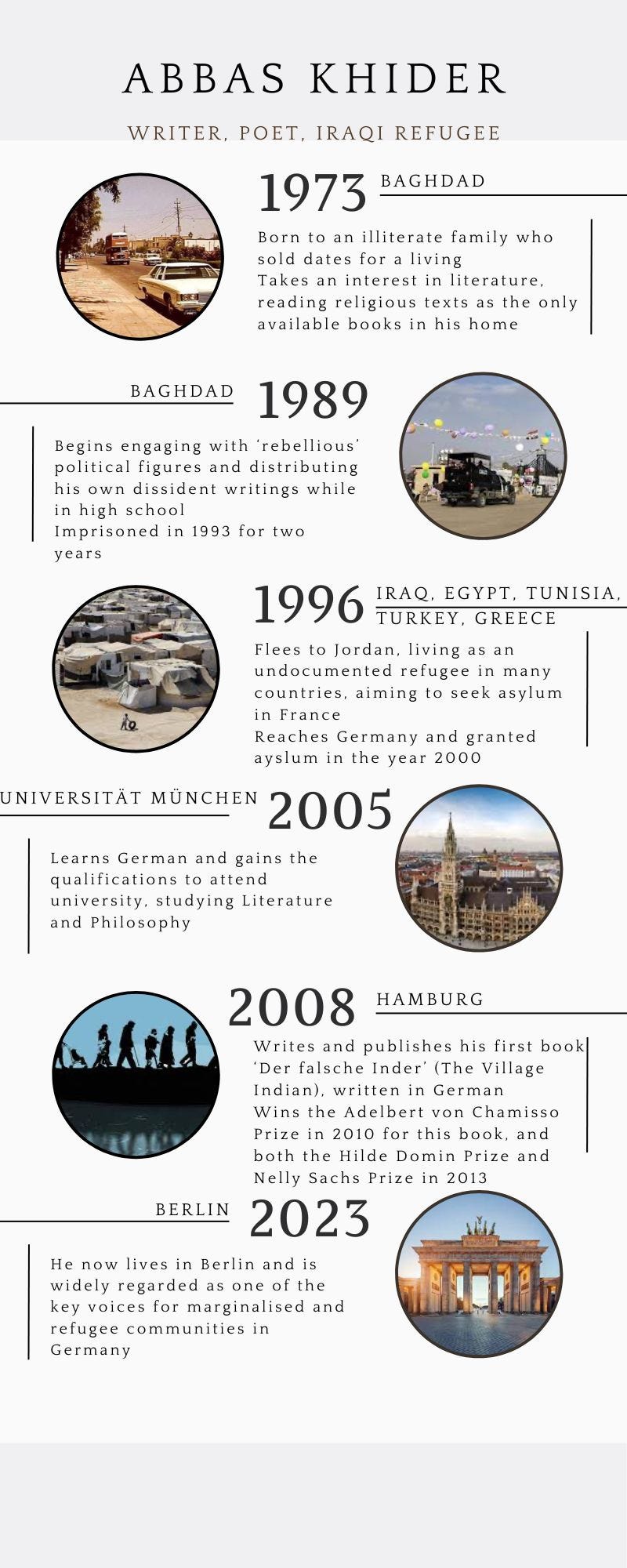
Anna also wrote a short article about Abbas Khadir with a summary inforgraphic - A quick 2 minute read.
Born in 1973 to a poor, illiterate family in Baghdad, Abbas Khider has made a name for himself in multiple respects. During his high school years, he was a vocal critic of Saddam Hussein’s regime. He rebelled in various ways, including engaging with banned political parties and selling illegal books. He sometimes attached his own writings to these books, having taken an interest in literature from an early age. After years of imprisonment and torture for dissident activities, he eventually fled Iraq in 1996. Khider made his way as an undocumented refugee through Egypt, Libya, Tunisia, Turkey, Greece, and Italy through temporary work, with the end goal of seeking refuge in France. Finally, in the year 2000, he found himself in Germany, unable to leave, and at the hands of the intrinsically drawn-out German asylum system.
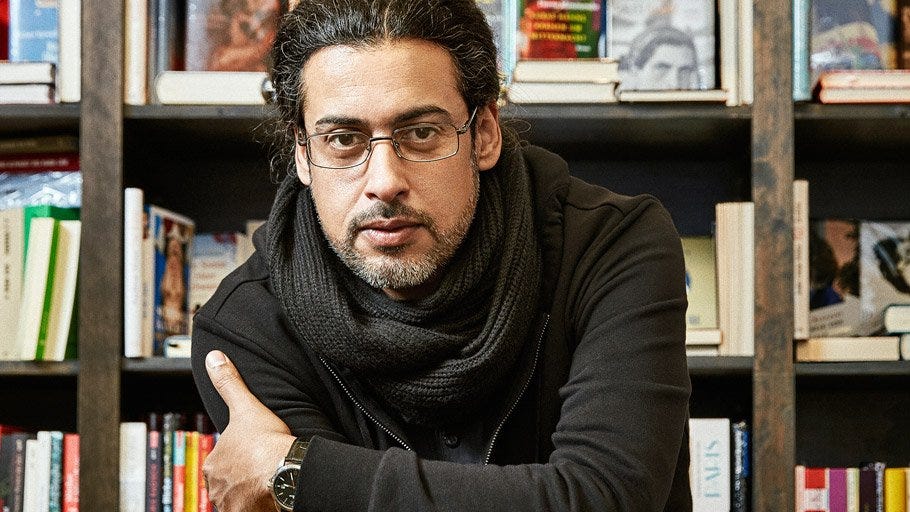
In the face of adversity, Khider was eventually able to attend university. He studied literature at the University of Munich and philosophy at the University of Potsdam, before embarking on a career in writing. Ironically, he now writes solely in German despite his devotion to labelling the German language as an ‘Ungeheuer’ (‘beast’). He narrates the process of learning this language through light-hearted anecdotes and grammar lessons in his book Deutsch für alle (German for All). Before moving to Germany, the only words he knew were ‘Hitler, Scheiße, (and) Lufthansa’. Now writing in fluent German and communicating more eloquently than most native speakers, he overcame barriers of alienation and outsider-status to master it. To be accepted as a citizen of Germany, both on the legal and the social front, mastery of the German language was a necessity. Ohrfeige (‘A Slap in the Face’), for which he was awarded the Adelbert von Chamisso Prize, relates the stage of migration between fleeing and being granted asylum. Yet the most pertinent impression of the novel is the humanity with which the protagonists are presented. Challenging stereotypes about forced migration and the formation of refugee identity, he is one of the leading voices for refugees and marginalised communities in Germany today.
Thank you for reading a A4R 🎨 Post. Don’t forget to tell your friends and family.