


Click here to play & learn.
Back Story
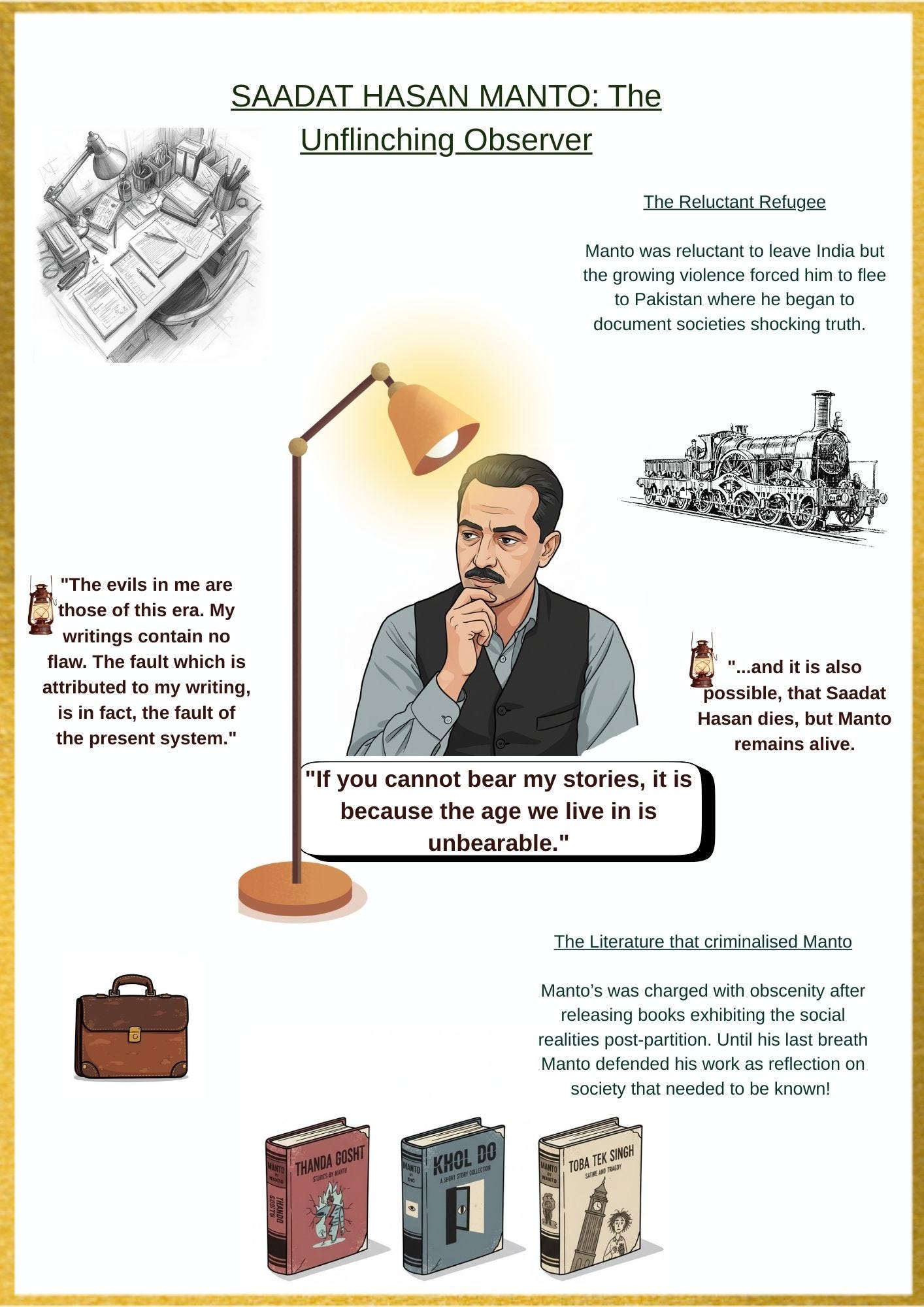
Saddat Hassan Manto was arguably the most influential yet controversial writer during the time of the India and Pakistan partition. Although Manto did not want to leave his residence in Bombay, the growing pressure around being muslim forced him to migrate to Pakistan in 1948. The involuntary migration was due to fear surrounding political violence. Through his literature he voiced the harsh yet truthful experiences of being a refugee during the partition amidst the violence. The displacement of millions is somewhat unheard of to the western world, however through Manto’s explicit work, political violence and pain are outlined clearly. The most controversial book Manto wrote, that I will discuss, is called ‘Thanda Gosht’ which translates to cold flesh. The harrowing pain exhibited in Manto’s fictions through his characters embody the social realities of the post-colonial rule.
After a traumatic partition and growing tensions, Manto decided to leave Bombay India and catch a train to Lahore Pakistan where he was one of the millions of people who had become ‘muhajirs’ which translated to migrant. Manto was originally reluctant to India but the pain and brutal absurdity which came in the forms of murder waves against the minorities, led him to leave in hopes of a safer life. The feeling of displacement and witnessing of brutality was weaved into Manto’s fictions as he shared the shocking truth through stories. Manto lamented the millions of lives lost as a moral tragedy rather than a death toll, which he argued dehumanised them from the essence of life. Manto challenged the narrative of there being a pride in suffering and explicitly states throughout all his literature that millions of lives were violently lost for ‘nothing’.
Manto situated his frustrations and pain into literature. One of his most famous pieces called ‘Toba Tek Singh’ was set in a Lahore mental asylum a couple of years after the partition. The authorities or arguably totalitarians decided to switch Hindu and Sikh patients with Muslum patents from Indian Asylums. The story criticises policy makers and politicians through a satire approach as the inmates exhibit more sanity through questioning the arbitrary borders and loss of identity and belonging. Another book written by Manto is called ‘Khol Do’ which shows an elderly man named Sirajuddin who is panicking and searching for his daughter in a refugee camp. Some workers promise to find her and they eventually bring an unconscious girl to the hospital. The father asks the doctor to open (khol do) the window to let in fresh air but Sakina responds to the command and repeats khol do so that the trauma and violence she has faced can be known and witnessed.
One of the most controversial pieces to have been written and published in Pakistan is a book by Manto called, ‘Thanda Gosht’ which translates to cold flesh. This story led to obscenity charges. The story is that a Sikh man returns home to his mistress after participating in riots. He is dismissive of her and is physically unresponsive. The mistress suspects infidelity and stabs him with a dagger. As he slowly dies he confesses to brutal crimes. He has abducted a young muslim girl during the riots and attempted a terrible act only to discover she was dead. The grim reality of attempting to violate a corpse made him unable to act physically with his mistress. The cold flesh symbolises both the girl’s dead body and the death of his own morality and humanity. Manto outlined the loss of human empathy and how communal hate allows people to unlock a monster identity that cannot see between life, desire and death. The themes of sexual violence and necrophilis were considered a breach if public morality during post-partition. Even though the cases were financially draining for Manto, he defended his work through arguing that they were social reality and that all he has done is trapped the truths of reality into a book so that no one can forget the atrocities. As a writer Manto argued until his last breath that a writer’s duty is to expose the truth no matter how daring or uncomfortable.
History has always been a fictitious argument of whose story is more credible or legitimate in certain circumstances. When we look at who holds knowledge that is accessed globally comes back to the Global North, in other words it is western legitimised knowledge. Many view the partition between India and Pakistan as a victorious occasion where everyone supposedly ‘got what they wanted’ and happily boarded trains to enter their news homes. Manto gives us a reality which is far from the Global North perspective. His literature gives us a portal to delve into the realities of partition and witness alongside him in his displacement journey what he has encountered from both sides of the border. Murder, violence and attacks on the vulnerable were normal everyday occurrences as people battled to survive in a society stimulated by hate. Death trains were common, which were massacres on innocent families trying to cross the border and all their valuables were stolen. No justice prevailed and society hid and ran to protect themselves of the dehumanised society that partition had formed,
Manto is remembered as a humanitarian who has written history from an uncomfortably truthful lens. His displacement was a journey of witnessing horrendous crimes against humanity and living in a society that had created monsters, pain and violence. Manto exhibits how even though literature can be fictional it can also be the closest thing we have to the truth. Even today as we read about Manto and his brave stances in a controlling society, we feel uncomfortable by the graphics of such fictions but simultaneously grateful for such a voice that has portrayed the truth not a tinted version. The millions that were murdered and displaced were people with voices and thoughts not facts and figures. Saadat Hasan Manto was a brave figure who accounts for intimate knowledge known of the India and Pakistan partition. Manto’s displacement has allowed millions across the globe to witness the reality of the crimes and atrocities during the partition.
In this post Numra highlights the arty refugee experience of Sadat Manto. She is a citizen journalist on a placement with us organised by Oxford University Career Services. She also organised the micro game to make the journalistic experience interactive.
Thank you for reading an A4R 🎨 Post. Don’t forget to visit our gaming art here. Every purchase scales our impact and pays our bills.
