

In this article Kathryn discusses post conflict communities. She is a student journalist with us on a placement organised by the Oxford University Career Services. This article was self-edited . The image was created using NapkinAI by Amira Ismael, an Arts4Refugees intern.
🎧 listen to Kathryn’s backstory here - she discusses her motivation & research as well.
Traumatic responses in post-conflict communities – ‘what doesn’t kill you makes you stronger’?
This is a common saying from Friedrich Nietzsche that helps people remain motivated. It’s comforting to believe that once you make it through suffering, you build resilience and persevere in the face of future challenges. Adversity may turn your world upside down, yet as long as you grit your teeth and make it out alive, only bright futures lie ahead. This mentality that tragedy is beneficial for character growth is prevalent in our society, but do traumatic experiences really make us stronger? By looking at experiences of displaced persons in post-conflict communities, we can see that this mantra may be misleading. Unresolved trauma lingers and affects teenagers who have not experienced the conflict first-hand. The path to strength requires more than survival.
What does PTSD look like in post-conflict communities?
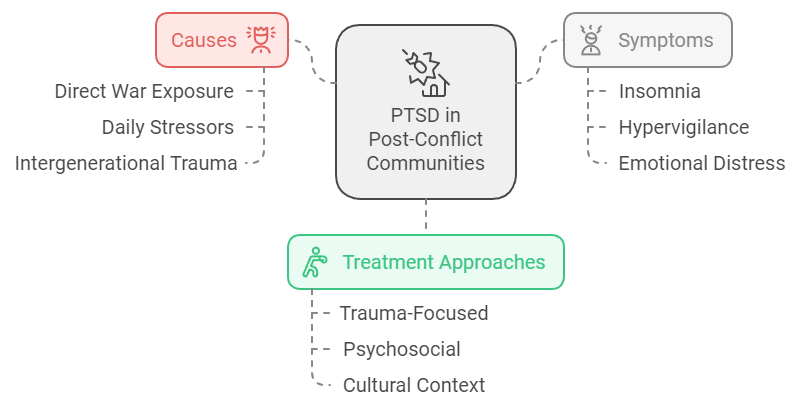
Post Traumatic Stress Disorder (PTSD) is an ‘abnormal reaction suffered from exposure to a traumatic event that the individual was a victim of, witnessed, was confronted with or learned about a loved one’ (Akanni et al., 2024), and affects one’s Quality of Life. Symptoms include insomnia and hypervigilance (Silove, 2004). PTSD can stem from direct war exposure, which is said to ‘resolve spontaneously’ after the acute phase has passed (Yehuda, 2022), or from ‘daily stressors’ (Miller and Rasmussen, 2010). Daily stressors such as poverty and marginalisation among refugees in post-conflict communities. These stressors lead to helplessness and are unfortunately pervasive in most conflict-affected populations (Macksoud and Aber, 1996). Extreme daily stressors may include violence and abuse, which can lead to PTSD. Vulnerable populations with PTSD have an increased risk of stroke, heart disease, depression and alcoholism (Wipfli et al., 2023).
Vietnamese refugees in Australia show PTSD improvement under ‘optimal resettlement conditions’ (Silove, 2004). They got permanent residency and access to services in the 1970s-80s, but a decade later restrictions were imposed again. Global immigration policies have a large influence on PTSD among refugees. Silove (2002) emphasized administrative obstacles perpetuate trauma reactions and cause long-term disability.
In recent years, Colombia has experienced internal displacement due to socio-political reconstruction after over 60 years of armed conflict. More people face emotional distress as they were forced to leave the comfort of their households to provide for family members back at home. The lack of affordable healthcare in Colombia has only worsened with the COVID pandemic, and it is becoming very clear that mental health is just as important as physical health (Giebel et al., 2022).
Putting these facts into true stories may give us a better idea of why PTSD is so widespread in post-conflict communities. When Burgess and Fonseca (2020) asked Colombians of different ages to share their experiences, Carolina expressed how being forced to settle into a new place was disorienting: “We didn’t know what to do, where to go. We didn’t know that we could declare ourselves as victims.” Displaced peoples also face stigma: Gustavo described how “when someone arrives to ask for a job, then [the people from the municipality] start saying that we arrive to take their jobs”. Adolescents are especially affected, where Lucia said, “my emotional distress is that I can’t study – I’ve been out of school for a year and I haven’t been able to go to university because I don’t have the money.” These are sentiments that many of us may connect with, but the state of limbo between leaving school and finding a university is greatly amplified when your country is still rebuilding from the ground up.
Impact of war trauma on adolescents
Thus, Gen Z’s living in post-conflict communities face complex issues that many of us may not fully empathise with. This is because the effects of war don’t just vanish. They stick around, displaying themselves in the form of abuse and neglect. Even if teenagers didn't experience the conflict, they may have memories of the immediate aftermath and be raised by adults who were exposed to it. Intergenerational trauma affects children of dysfunctional families, and a lack of awareness about mental illness makes it harder for adolescents to handle PTSD and similar disorders.
Uganda experienced a decades-long conflict between the Lord’s Resistance Army and the government. This affected children and adults, with the former being made child soldiers. Mental health risks from early childhood have been noted to be especially detrimental (Nelson et al., 2020). According to Wipfli et al.(2023), 20% of adolescents from community-based participatory research reported alcoholism and abuse by parents or guardians, and nearly all believed some of their peers did drugs. Almost half had high Adverse Childhood Experience scores, varying by sub-counties due to differing access to mental health services. Trauma also differs by gender: during COVID, societal gender roles were strengthened, limiting girls' social activities and wellbeing. Support is limited, with 8 out of the 9 health facilities of Wipfli et al.’s (2023) study not offering mental health services, although 7 have confidential spaces for students who need help. But many adolescents attributed their traumatic responses to witchcraft and God, while most are unsure about mental health issues come to be. This has led to stigmatisation of mental health, making adolescents reluctant to seek professional help.
Adolescents in Ambon, Indonesia face a lack of support due to the conflict between Muslim and Christian communities from 1999-2002. This conflict still affects them today, as evidenced by the latest outbreak in 2011, where 7000 people were displaced (Fausiah et al, 2019). Similar to Ugandan adolescents, those in Ambon have mostly not experienced the initial conflict, but still have to live through community transformations due to it (Miller and Rasmussen, 2010). Violence is culturally accepted, and corporal punishment is widely used in parenting. An old Indonesian saying goes, ‘there are love and education at the tip of a rattan’ (Fausiah et al, 2019). Also like in Uganda, trauma responses in girls and boys are different, with more adolescent girls in Ambon willing to disclose their worries (‘curhat’, or pouring their heart out), which allows them to receive better support from adults. Exposure to community violence affects adolescent mental health, impeding academic performance and physiological functioning, often leading to PTSD.
Treatment: not too late
There are two main approaches to tackle PTSD and similar trauma-related disorders: trauma-focused and psychosocial. The former involves clinical treatment and alleviating direct war trauma symptoms to help people cope with ongoing stressors, while the latter involves altering conditions to improve recovery from lingering effects of war (Miller and Rasmussen, 2010). Trauma-focused approaches are widely used in research, but viewing mental health through the lens of Western psychiatry may not be suitable for countries like Colombia and Indonesia, which have their own cultural knowledges. Burgess and Fonseca (2020) critiqued western approaches and advocated for a deeper understanding of how local communities understand mental health recovery; cultural context is very important.
Final thoughts: How can we help?
One common theme in many studies was the importance of a social circle. Support from family and friends can reduce negative psychological effects for refugees and post-conflict communities, fostering a sense of belonging (Akanni et al., 2024). Returning to Burgess and Fonseca’s interviews, Jose believed recovery comes from “going to university, to school, by studying, moving forward with our family, fighting for a household.”
We never know what people are going through, especially with mental health being such a sensitive topic. What we can do is be present for our peers and support them on their road to recovery. Recognising post-conflict populations' experiences is an important first step.
Thank you for reading an A4R 🎨 Post. Don’t forget to visit our gift shop here. Every purchase scales our impact and pays our bills.
