


Click here to play & learn.
Back Story
The revolution is an idea and ideas never die”: the Syrian filmmaker whose lens became a window to the world
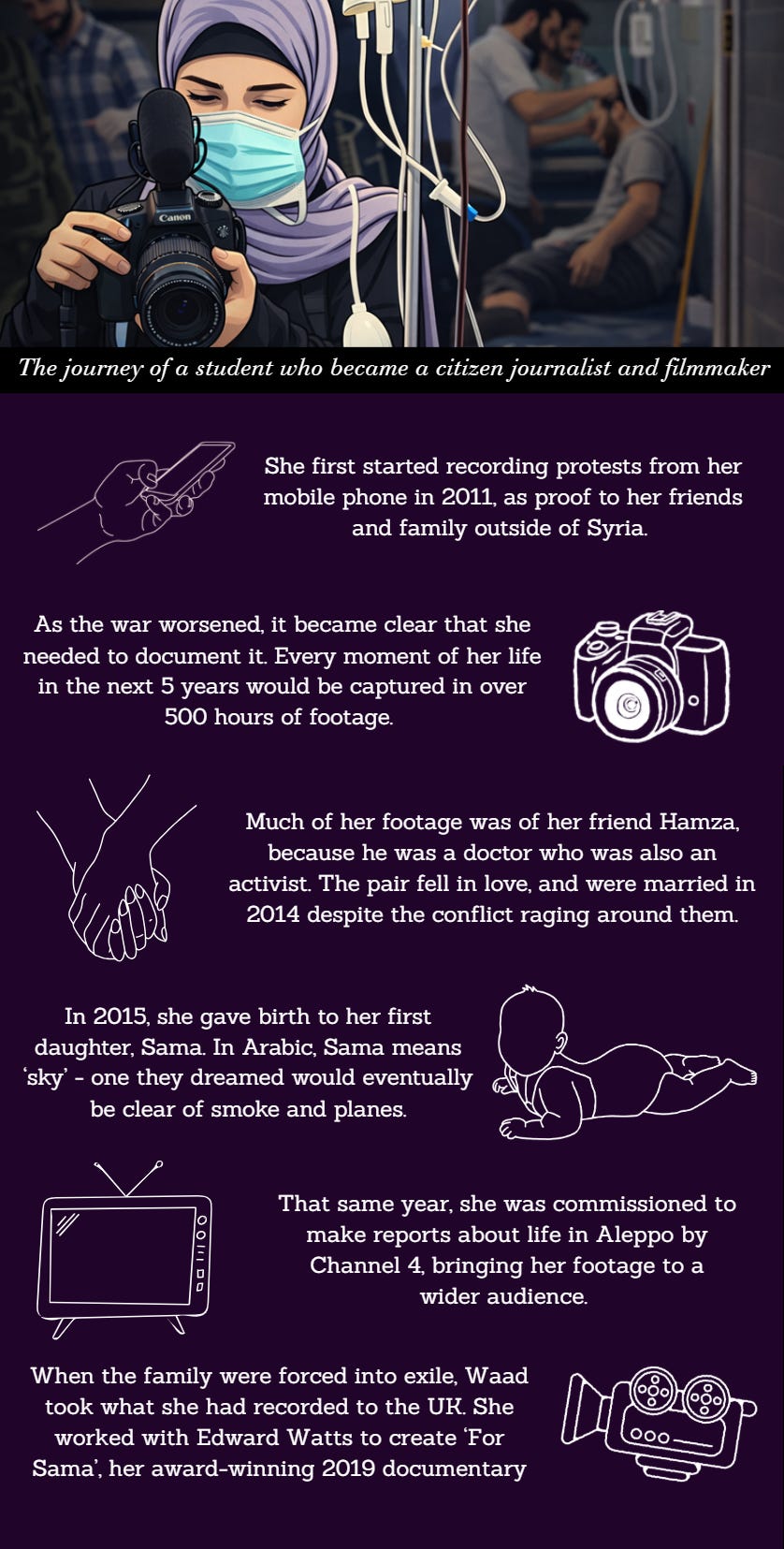
The year is 2019, and the crowd at the Cannes Film Festival is on its feet – it has just given a 6-minute standing ovation to the winner of the Prix L’Œil d’or for best documentary. A special showing of the piece has drawn smiles and applause around the world, but tears also glisten on the faces of many. They are, as I am now, incredibly fortunate to have seen the brilliantly moving work For Sama, which takes almost 500 hours of Waad al-Kateab’s footage from war-torn Aleppo and uses it to tell her remarkable story. Sama is the name of al-Kateab’s first daughter, and in Arabic it means ‘sky’ – one which her parents dreamed of seeing clear, blue, and free of the marks of war.
As her work explains, Waad was not always a filmmaker. Even her name is a pseudonym, adopted as she started posting online to protect her family from the regime. When the Syrian revolution erupted in March 2011, she was in her final year as an economics student at the University of Aleppo, filming peaceful protests against the Assad government from a mobile phone camera. By the time she was forced into exile in 2016, she had captured her entire life in the war – falling in love, getting married, giving birth to Sama and becoming a mother, all amidst the atrocities of the regime. So how did a student become a citizen journalist, and make her way from a makeshift hospital to a global platform? And why was it so necessary?
In an article written for the Financial Times she describes the early days of recording via phone and a small Sony Handycam, given to her by a friend because it was small enough to get footage from the safety of her bag. She wanted to provide proof to friends and family outside Syria of the protests taking place – the existence of which was denied by the Assad government. As time went on, however, the importance of documenting what was happening to her people became ever clearer; Waad had no choice but to stay and continue to resist the oppression. The camera became her defiance. Speaking years later at the 2021 Geneva Summit for Human Rights she explained that “everything Assad did was meant to silence us, to make it as if we never existed. And we will never give him that privilege.”
This, perhaps, was the greatest achievement of a film which accomplished so many extraordinary things. The vital humanity both undeniable and unforgettable in all those who cross the screen places the viewer right in the centre of a conflict they might have considered distant; every face lingers long after it has moved on. Waad takes you with her to watch her life unfold: how she falls in love with the smile of her husband Hamza, the choice they made every day to stay, the birth of her daughter, and the move from living in one hospital to another when the first was bombed. She allows you to see her world through her own eyes as the situation in Aleppo worsens: the massacre of January 29th 2013, losing her friends Gaith and Omar to shelling, the children who knew what a cluster bomb was. The people she sees every day are the ones for whom the her work bears witness, epitomised by the moment where a grieving mother recognises the camera and reacts not with anger but with a shout of: “Film this!”.
Al-Kateab told the Guardian that in that moment, for that mother, the lens of the camera “was, for her, the world outside.” It was for this reason that it became so important she stayed and continued her work – to give testimony to the grief inflicted on those around her. That testimony would later gain a much broader reach, thanks to her commission by Channel 4 in 2015 to make short reports about life in her city. They reached massive audiences online, and continued to cover her days under siege in 2016 – by which time Hamza was one of just a handful of doctors remaining in East Aleppo. Their roles as medic and journalist meant that the couple continued living and working around the clock in the city’s last remaining hospital. Sama was only a year old. The risk to Waad and her family was growing ever greater, and yet the couple believed their work would always be the greater cause, even if it meant sneaking back across frontlines to return to their broken city.
The final moments of al-Kateab’s documentary capture the days when, offered no choice, the family was forced to leave Aleppo for a life of exile. She described this later as ‘the moment which really broke her’ – being forced to say goodbye to her home, the hospital, and the people they knew: everything they had stayed for. Even now, she can watch all of her film except the end, where she whispers the heartbreaking questions to an infant Sama: “Will you blame me for staying here? Will you blame me for leaving now?”
Waad and Hamza remained for a year in Turkey – where their second daughter, Taima, was born – before moving to the UK. There she would begin to work through the countless hours of footage with British director Edward Watts, helped by her contact with Channel 4 and the content she had already produced for them. Together they undertook two difficult years of editing, which culminated in her documentary For Sama, now the most nominated in BAFTA history. Al-Kateab also co-founded the charity ‘Action For Sama’ to bring attention to the bombing of hospitals in Syria, and continues to campaign for human rights and accountability.
Her most important message, however, is the one told in the story put together with Watts. The first cut they made was chronological – it read as a descent from hope into desperation, with its images growing increasingly devastating. This wouldn’t do. Instead, the editing process was adapted to show what it became clear was a powerful love story, able to repeatedly break from the despair using Sama as a lifeline. Rather than a recounting of atrocity, the documentary tells a tale of marriage and motherhood, of friendship and human resolve in the face of tragedy. An hour or so of watching reminds you that the Waad and the citizens of Aleppo are not just victims but people, and that it is vitally important to see them as such. It reiterates the need for those responsible to be held to account, and to remember what happened. And it realises the power of a refugee’s story – just one amongst millions.
With the Assad regime finally falling in 2024, Waad has no doubt in her desire to return. She told UN News that she had “thought the ending of her story was dying in exile, not being able to go back, never being able to see this beautiful day”- a nightmare thankfully never realised. She will continue to fight to ensure transitional justice and the acknowledgement of what her community has experienced, using the skills she has learned as a journalist and filmmaker. The emotions in the audience at Cannes and around the world are a testament to the power of her story and its portrayal, but they are not enough. Waad al-Kateab herself will tell you: “I don’t want your tears, I want you to do something, you can make a difference.”
Links:
https://primetime.network/features/waad-al-kateab/
https://genevasummit.org/speech/waad-al-kateab-speaks-at-2021-geneva-summit/
https://www.actionforsama.com/home-2
https://news.un.org/en/story/2025/03/1161116
https://www.theguardian.com/film/2019/aug/25/for-sama-documentary-interview-waad-al-kateab
https://www.alphavillejournal.com/Issue20/HTML/ArticleMincheva.html
https://www.channel4.com/news/theres-now-hope-to-get-our-country-back-says-syrian-filmmaker
https://intimacies-of-remote-warfare.nl/media/documentary/for-sama/

In this post Finbar highlights the arty refugee experience of Waad al-Kateab. He is a citizen journalist on a placement with us organised by Oxford University Career Services. He also organised the micro game to make the journalistic experience interactive.
Thank you for reading an A4R 🎨 Post. Don’t forget to visit our gaming art here. Every purchase scales our impact and pays our bills.
