

AT A GLANCE:
A Gen Z Viber made a reminder card with a simple data point from a global ecological assessment: 3.2 billion people are currently living on land that is actively losing its capacity to support them. Underneath the image sits a sobering structural reality—that systemic choices compound into physical crisis, and ecological debt always demands to be paid in human displacement. This is not just an environmental report. It’s not an unchangeable tragedy either. It’s a trend line, and it’s worth naming precisely.
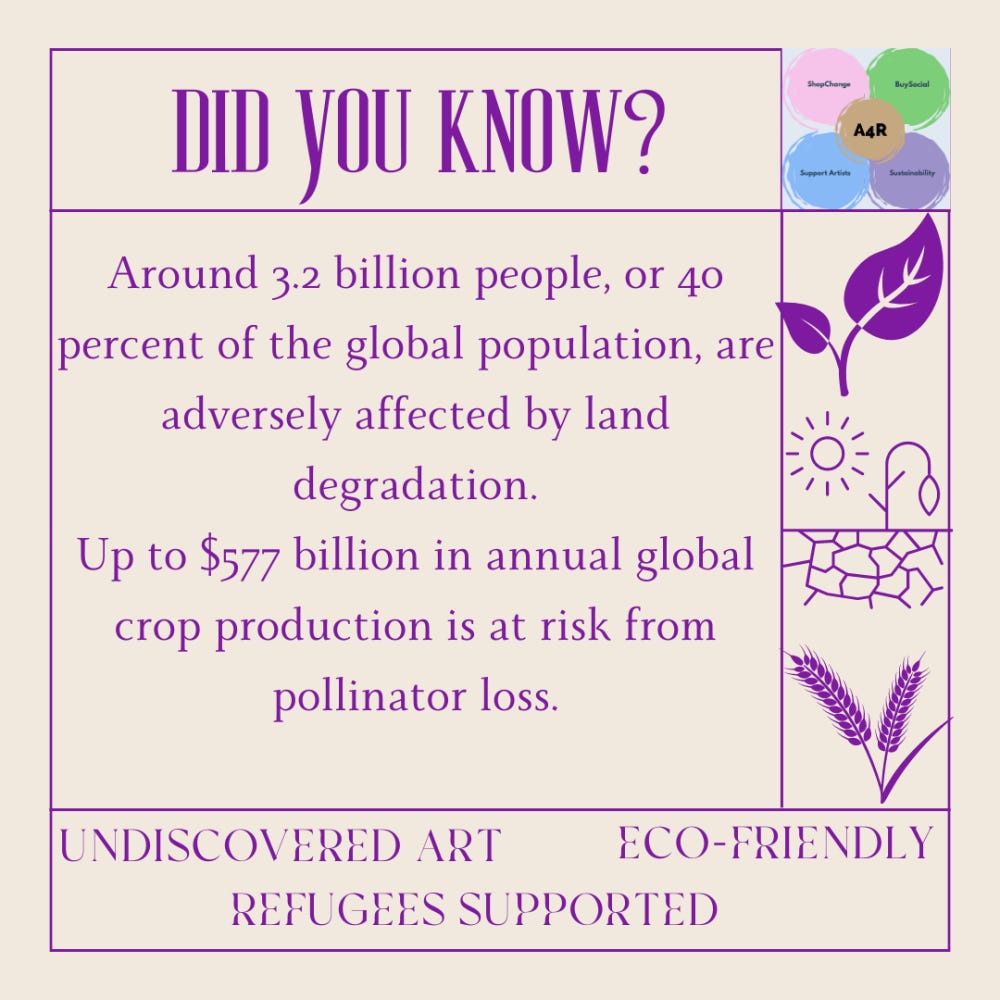
Same notification format as everything else competing for your attention this morning. Same rounded card, same clean presentation, same purple line borders enclosing a heavy piece of global data. But the message underneath asks something almost nobody else in your feed is asking—to look past the surface-level politics of migration and trace the invisible, compounding fracture of the earth beneath our feet.
The numbers themselves are staggering, verified by the Intergovernmental Science-Policy Platform on Biodiversity and Ecosystem Services (IPBES). Over 40 percent of the human population is adversely affected by land degradation. Up to $577 billion in annual crop production hangs in the balance due to pollinator loss.
That is a bigger structural crisis than it sounds.
Not a simple natural disaster. Not a calculation either.
It’s worth being explicit about what the imgae is not saying, because both wrong readings are easy to slide into.
This is not a message about temporary misfortune or an isolated natural disaster. Framing displacement as a sudden, unpredictable act of nature asks for reactive charity—a temporary band-aid, emergency aid packages, expecting nothing in return except the relief of having managed a crisis. That model has its place, but it is not A4R’s operating logic. A4R is not asking Vibers, or anyone reading this, to view climate displacement as an unpredictable flash flood. Ecological collapse is slow, structural, and predictable.
But the opposite reading is just as wrong, and arguably worse. This is not a cynical instrumental calculation—an attitude that says we can treat the biosphere like a transactional line item, optimizing carbon offsets on a spreadsheet while ignoring the people forced to abandon their homes when the topsoil turns to dust. Reduce human food security to a financial transaction, and you lose the very baseline of trust and predictability that allows a community to exist in one place. A strategy that treats environmental resilience as a mere marketing column isn’t an environmental solution anymore. It’s a transaction wearing sustainability’s clothes.
So what is it? Somewhere in between—a harder, more honest place to stand than either extreme.
Compound interest for our landscape.
Here’s the part that is genuinely closer to economics than to traditional environmentalism, even if it sounds strange to put it that way.
Environmental neglect doesn’t just produce a single, bad harvest. It builds into systemic degradation. Mismanaged soils lose their structure. Fragile ecosystems lose their pollinators. This ecological debt compounds—the same way financial debt does, except the interest payments aren’t cash; they are failing water tables, vanishing insects, and collapsing yields. The interest payments on our mistreatment of the earth are paid out in human displacement. When the baseline deposit of a landscape is entirely depleted, people do not move because they want a lifestyle change; they move because the land can no longer yield a return on the labor they invest.
That’s a reasonably literal description of how systemic displacement actually works. It is a trend that has grown relentlessly since the regional droughts of the mid-1980s, expanding to a global scale that impacts how we live, where we live, and what we eat.
The part a spreadsheet can’t capture.
Here is the metaphysical residue of our current era, and it deserves to be named rather than quietly dropped.
When a community’s land degrades to the point of non-viability, the cost returns to someone else entirely—often to a neighboring city, a stranger across a border, or a future generation inheriting a fractured culture of resource competition. If we only pay attention to environmental destruction when it visibly hits our immediate personal balance sheet, we miss the entire point of global interconnectedness.
The young journalists and creators who keep going have made peace with that reality. They understand that to heal the future, we have to start making different systemic deposits today. Look deeply at the root causes today, so our peers can navigate tomorrow with clarity. That’s the part compound interest can model, but a balance sheet can never fully resolve.
Where you make your first deposit.
This is where the A4R Media Hub becomes relevant—not as a metaphor, but as an actual place where this plays out.
For many of the 480+ Vibers who’ve passed through the programme over the past five years, the hardest part was never understanding that systemic trends compound. It was finding the time, the space, and the environment to actually process an overwhelming wave of global bad news. The world expects Gen Z to have immediate, fully formed opinions on complex global crises, while simultaneously bombarding them with transactional noise.
A4R changes that equation. It gives young people—many carrying their own complicated, lived histories of displacement—the training and opportunity to pause, think deeply, and unpack these massive macro-issues. It provides a dedicated environment where they can investigate root causes, like the ecological failures highlighted in the image and learn how to articulate these structural truths clearly to their own peer groups.
That’s not charity either. The Vibers aren’t given a platform for nothing. They’re given an account to invest in, and the tools to start making deposits—in their own integrity, their own journalistic capability, and their own deep research into the baseline causes of global crises long before the rest of the media ecosystem catches up. They are learning how to speak to their peers, not in the language of panic or outrage, but with the clarity of systemic understanding.
They’re investing anyway. That’s the whole article, in one sentence.
This is what A4R looks like.
Every Viber who comes through the Media Hub makes something real—and underneath the published article, the recorded story, the card designed to interrupt a feed with something true like this image, there is a quieter accumulation happening. Knowledge compounding into peer-to-peer awareness. Systemic storytelling compounding into genuine empathy. Good work, done consistently, compounding into a generation that refuses to look away from the root causes of our changing world.
It’s never too late to open the space for big ideas. Build the understanding today. Change how we talk about tomorrow.
Join the conversation The A4R Media Hub is co-created by Gen Z, for Gen Z—on the issues that matter most, made by young people who refuse to look away. 🔗 Explore our latest work at arts4refugees.com
This piece was produced as part of the Ink & Ashes series at the Arts4Refugees Media Hub, in collaboration with the BizGees community and the Gen Z Vibers co-creating it.
Thank you for reading an A4R 🎨 Post. Don’t forget to visit our gaming art here. Every purchase scales our impact and pays our bills.
