


Click here to play & learn.
Back Story
Laila Ajjawi, a young Palestinian artist and activist, is making waves with her murals in Jordan. Her colourful designs bear social commentary on women’s rights and refugee conditions. She was born and raised in a Palestinian refugee camp outside the Jordanian city of Irbid. Although she was born and has lived her whole life in Jordan, she considers the Palestinian city of Jenin her home. Laila’s identity as a Palestinian refugee is a strong theme in her murals, stressing her connection to her homeland and her wish to return. Her work not only colours public spaces but sparks conversations about gender equality and refugee rights.
Palestinian Refugees in Jordan
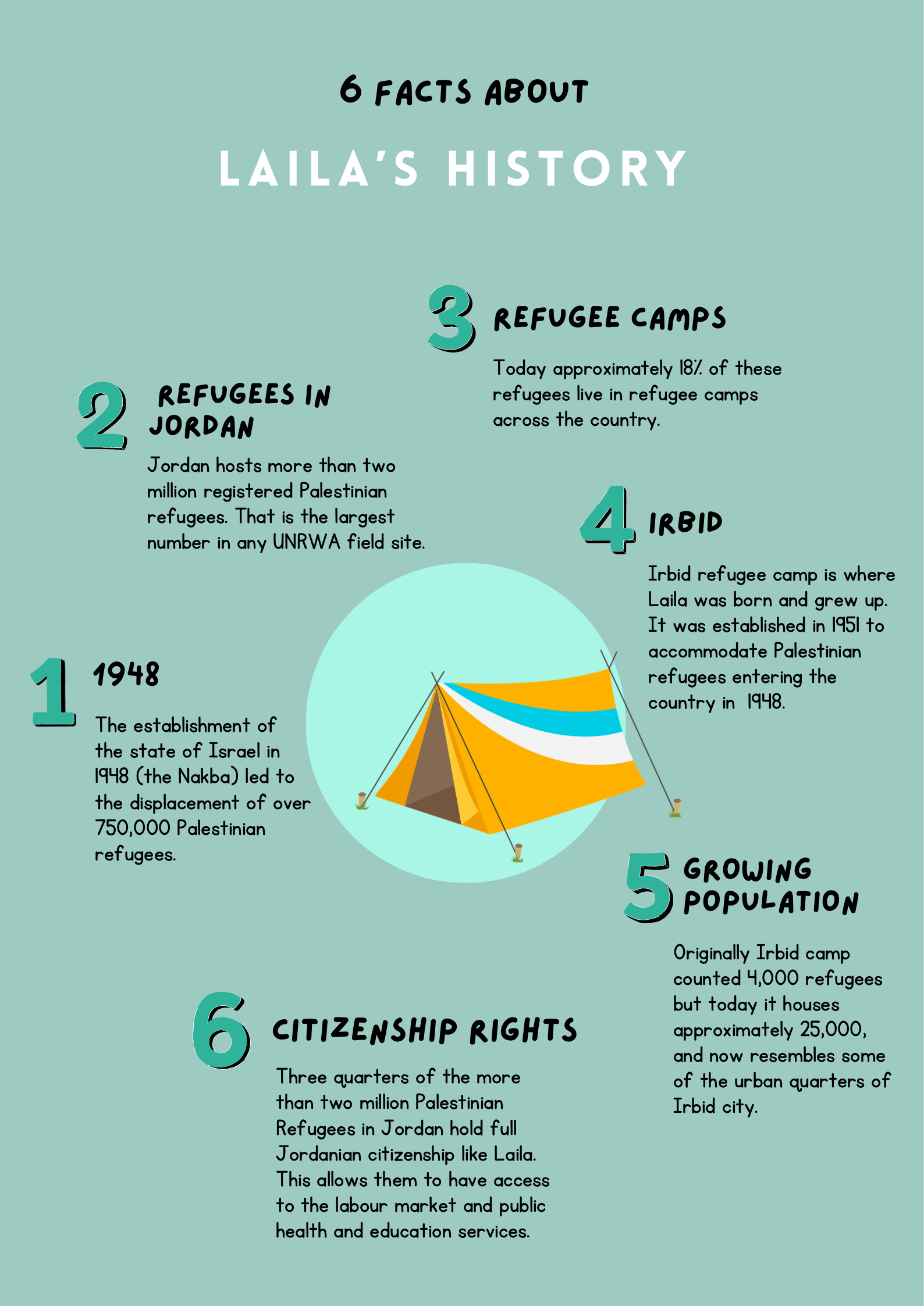
The establishment of the state of Israel in 1948 (or Nakba in Arabic meaning Catastrophe) led to the displacement of over 750,000 Palestinians, many of whom fled to neighbouring countries, namely Jordan. Jordan hosts more than two million registered Palestinian refugees, the largest number in any UNRWA (United Nations Relief and Works Agency) field site. Today approximately 18% of these refugees live in refugee camps across the country. Irbid refugee camp, where Laila was born, was established in 1951 and initially set up to house refugees displaced in 1948 (UNRWA 2016). In the beginning, Irbid refugee camp housed around 4,000 refugees but over the decades the camp has grown. Today it blends in with some urban quarters of Irbid city and houses around 25,000 refugees (UNRWA 2023). Palestinian refugees in Jordan face systemic discrimination. Whilst many have Jordanian citizenship, there are almost 370,000 who remain stateless, mainly Gazans who fled after the 1967 war. According to Human Rights Watch, since 1988 and particularly over the last few years, the Jordanian government have been taking away Jordanian nationality from its citizens without notice and arbitrarily making them stateless (Human Rights Watch 2010). As a result, these refugees do not have Jordanian identification numbers which excludes them from accessing health care, education and formal employment.
Jordan has one of the world’s lowest women’s representation in the workforce and faces significant inequalities, despite women having the right to vote and being enrolled at school at slightly higher rates than boys. Citizenship laws are complicated and disadvantage women, with citizenship rights only being passed down through men. This means that if a Jordanian woman marries a non-citizen, their children would not have access to basic rights such as education and public health care. Moreover, non-citizens need to obtain permits to live in the country as well as being barred from working in certain professions and most of the public sector (New Arab 2022). As with many countries, gender-based violence is a prevalent issue, and certain laws are particularly detrimental. Until very recently if a man rapes a woman in Jordan he can escape punishment if he marries her, and spousal rape is not considered a crime. This law was repealed in 2017, but it remains a controversial topic (Al Jazeera 2017).
Laila’s Story
For Palestinian refugees in Jordan and across the world, like Laila, the conflict in their home means existing in a state of limbo. There is a high chance that Laila may never be able to visit her homeland, but it remains an important part of her identity and history. Most Palestinian refugees are stateless, placing them in a dangerous position without legal protection or rights. Jordan is one of the exceptions to this; most Palestinian refugees have citizenship rights. According to Amnesty International, three-quarters of the more than 2 million Palestinian refugees in Jordan hold full Jordanian citizenship (Amnesty International n.d.). Whilst this provides Palestinian refugees with social protection and legal rights, they still face discrimination within Jordanian society. Thanks to Laila's Jordanian citizenship she was able to enroll in a Jordanian high school and later university. The first time she ever left the camp at 16 was to go to high school. However, being integrated into the Jordanian education system also brought about a clash of identity and discrimination. Some of Laila's teachers banned her from wearing the Palestinian flag or any other symbols, and she was made to feel ashamed of her heritage. Laila identifies this as the moment of her political awakening, in an interview with Cosmopolitan saying that her identity as a Palestinian refugee and living in the camp was frowned upon. "Some girls used to hide where they came from, but I'm not," she said. "I've been living here so what is the problem with that?" she said (Cosmopolitan 2015). The discrimination Laila faced in her life as a Palestinian refugee has enabled her to galvanize social change.
Laila’s Murals
Laila’s murals are powerful tools for advocacy, making public representations of social issues such as gender-based violence, lack of women’s representation in the workforce, and ongoing discrimination against Palestinian refugees. Her pieces are characterised by motifs of femininity, displacement and Palestine, and she strategically uses cool colours to promote a sense of calm. In a conversation with GQ Middle East, Laila talked about her reluctance to use red in her murals, which can evoke negative emotions anger, violence, and death, consciously wanting to cultivate a more peaceful tone in her pieces (Shafee 2024). Her first mural, titled “Look at my mind,” was made in Ras Al-Ain Gallery at a workshop organised by Women on Walls in 2014. The mural depicts a woman’s head cracked open, revealing a bird breaking free from its cage, waves of water, a rainbow and a lightbulb (Cosmopolitan 2015). The piece invites us to challenge the focus on women’s appearances, and instead to look at the creativity, knowledge and beauty that flows from their minds. When Laila has discussed her responsibility as an artist, she stresses the importance of her pieces being tied to the past and presence, and as being a means of protecting her Palestinian identity. Motifs relating to Palestine, and Laila’s status as a refugee are also very present in her work. She often paints children, elderly figures and women in traditional Palestinian dress, as well as includes symbols such as keys (representing the right to return), olive trees, oranges, and maps of historic Palestine. By marking the walls of her city, she makes sure that her homeland is not forgotten, a beautiful means of cultural resistance. Irbid refugee camp, where Laila was born and raised, is unofficially named Al Awda (roughly translating to return to the homeland). Whilst the history of Palestine remains strong, Laila admits in an interview with Cosmopolitan that she is scared that it is slowly being erased in schools. “We used to have national days where we celebrate, or remember, or are trying to make poetry or art gallery for Palestine [but] These activities are not being done anymore.” (Cosmopolitan 2015)
Laila Ajjawi’s murals do more than just beautify the streets. They are invitations to question how women and refugees are treated in Jordan. Through her work, she transforms public places into spaces for dialogue and reflection. Laila continues to inspire change one colourful mural at a time.
Sources:
Al Tahhan, Z. (2017). ‘Historic day’ as Jordanian parliament repeals rape law. [online] www.aljazeera.com. Available at: https://www.aljazeera.com/features/2017/8/1/historic-day-as-jordanian-parliament-repeals-rape-law.
Amnesty International (n.d.). Seventy+ Years of Suffocation | Chapter 2: Jordan. [online] Seventy+ Years of Suffocation. Available at: https://nakba.amnesty.org/en/chapters/jordan/.
Goussous, S. (2016). Artist channels feminist, Palestinian identity through graffiti. [online] Jordan Times. Available at: https://jordantimes.com/news/local/artist-channels-feminist-palestinian-identity-through-graffiti.
Gupta, P. (2015). This Woman Is Using Graffiti to Change the Way Her Country Thinks About Girls. [online] Cosmopolitan. Available at: https://www.cosmopolitan.com/politics/news/a50015/this-palestinian-refugee-graffiti-artist-empowers-girls-with-street-art/.
Human Rights Watch (2010). Stateless Again. [online] Human Rights Watch. Available at: https://www.hrw.org/report/2010/02/01/stateless-again/palestinian-origin-jordanians-deprived-their-nationality.
Mauvais, L. (2022). Jordanian women’s long struggle for nationality rights. [online] https://www.newarab.com/. Available at: https://www.newarab.com/analysis/jordanian-womens-long-struggle-nationality-rights.
Shafee, M. (2024). Artist Spotlight: Laila Ajjawi. [online] The Student . Available at: https://thestudentnews.co.uk/2024/01/31/for-print-artist-spotlight-laila-ajjawi/ [Accessed 26 Mar. 2025].
UNRWA (2016). Jordan | UNRWA. [online] UNRWA. Available at: https://www.unrwa.org/where-we-work/jordan.
UNRWA (2023). Irbid Camp. [online] UNRWA. Available at: https://www.unrwa.org/where-we-work/jordan/irbid-camp.
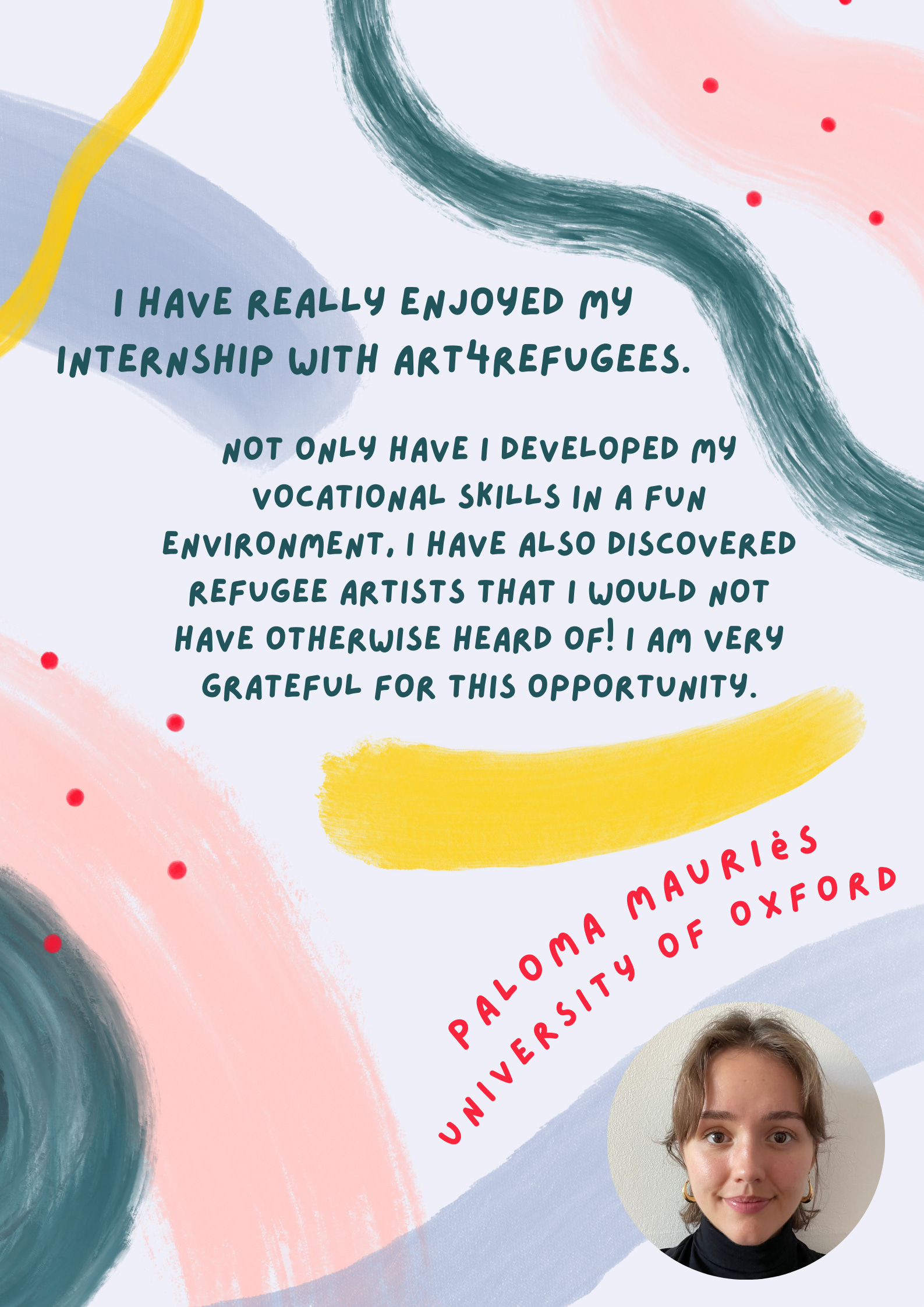
In this post Paloma highlights the arty refugee experience of Laila Ajjawi. She is a citizen journalist on a placement with us organised by Oxford University Career Services. She also organised the micro game to make the journalistic experience interactive.
Thank you for reading an A4R 🎨 Post. Don’t forget to visit our gift shop here. Every purchase scales our impact and pays our bills.
