

Ten-year-old Marjane Satrapi saw Iran transform overnight during the 1979 Revolution. Forced into the veil and eventually exiled to Vienna, she struggled with racism and lost identity. Satrapi reclaimed her story through Persepolis. Her graphic memoir uses stark art and humor to turn personal trauma into a global symbol of resistance.

Click here to play & learn.
Back Story
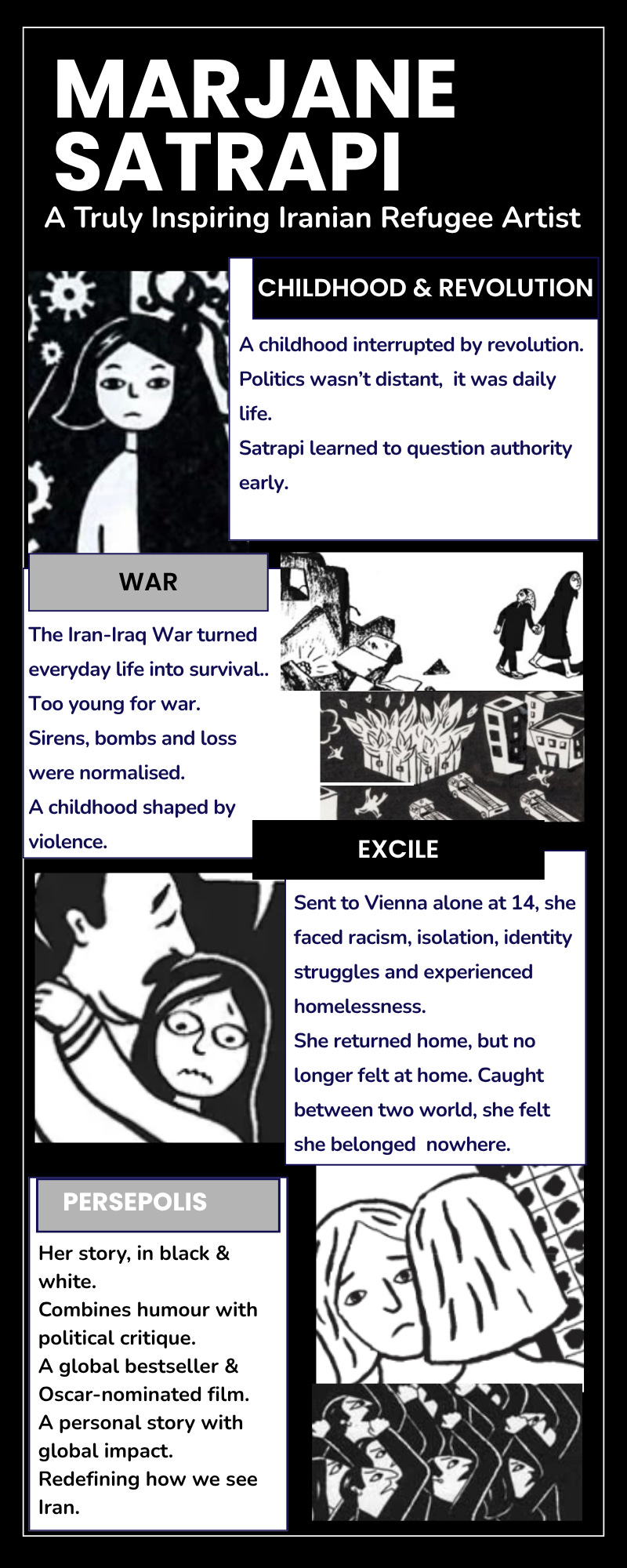
How Marjane Satrapi Turned Revolution into a Global Story
In 1979, as Iran erupted into revolution, a ten-year-old girl watched her world change overnight. Schools closed. Veils became mandatory. Friends disappeared. The rules of everyday life from what to wear, what to say, even how to think, shifted under the weight of a new regime.
That girl was Marjane Satrapi. Years later, she would transform those memories into Persepolis, a graphic memoir that would become one of the most recognisable accounts of revolution, exile and identity in the modern world.
Today, Satrapi is a globally celebrated artist, filmmaker and writer. At the heart of her work lies her personal experience of displacement- not just from a country, but from a sense of belonging.
Explore this story with AI by using this prompt -
Explain the Iranian Revolution to me from Marjane Satrapi’s perspective
Childhood, Rebellion, and the First Loss
Before she became the voice behind Persepolis, Marjane Satrapi was a child standing in a prison visiting room, saying goodbye to her uncle for the last time. He had been imprisoned for his political beliefs and had chosen Satrapi as his final visitor before he was executed. Satrapi was only ten years old.
It’s a moment that lingers in Persepolis- not dramatised, not exaggerated, just quietly devastating. And it marks the point where childhood, for her, begins to fracture.
Satrapi was born in 1969 into a politically engaged, middle-class family in Tehran. Her parents were outspoken critics of authoritarian rule, deeply embedded in political life, and committed to raising a daughter who would question everything. Dinner table conversations were rarely small talk; they were about revolution, justice, and what kind of future Iran could become.
When the Iranian Revolution began, there was hope. Like many families, hers believed it might bring freedom. Instead, it ushered in a regime that quickly tightened its grip on everyday life.
For Satrapi, this shift wasn’t distant or abstract, it showed up at school, on the streets, in what she was allowed to wear. Her bilingual French school was shut down. The veil became mandatory. Rules multiplied overnight.
But if the regime demanded conformity, Satrapi pushed back in the only ways she could.
At school, she developed a reputation for being outspoken, stubborn, and, in her own way, rebellious. She challenged teachers, questioned authority, and refused to quietly accept the version of the world she was being handed.
In Persepolis, she doesn’t present herself as a passive observer of history. She is argumentative, curious, sometimes naive, but always thinking for herself. One moment she’s dreaming of becoming a prophet; the next, she’s debating politics with adults.
That tension, between innocence and defiance, is what makes her story so compelling.
At such a young age, Satrapi was trying to figure out something so complex: where she belonged. In a country that was rapidly changing, in a system that demanded obedience, and in a childhood that was slipping away faster than it should have.
Through her eyes, history doesn’t feel distant. It feels immediate, confusing, and deeply personal.
And that is where Persepolis begins.
Growing Up Under Fire
The situation worsened with the outbreak of the Iran-Iraq War in 1980. Bombings, air raid sirens, and constant fear of death became part of daily life. In Persepolis, Satrapi captures this reality with stark, simple imagery: black skies, crumbling buildings, and silent figures absorbing loss.
One of the most haunting moments in the memoir is the death of her friend’s family in a missile strike, depicted through the shocking image of her friend’s hand wearing a turquoise bracelet in the rubble. It is a reminder of how suddenly life could be erased.
Fearing for her safety and future, Satrapi’s parents made a difficult decision, they sent her to Vienna at the age of 14. It was an act of protection, but also the beginning of exile.
Understand this in more detail with AI using this prompt -
Tell me more about the Iran & Iraq war and how it impacted Marjan Satrapi.
Sent Away at Fourteen
In Austria, Satrapi faced new struggles. Removed from her family, her language, and everything familiar, she found herself caught between worlds. At fourteen, she was expected to rebuild a life from scratch, navigating a culture that didn’t fully understand her and, at times, didn’t want to.
She faced racism, isolation, and the quiet pressure to assimilate. In Persepolis, she recalls hiding her Iranian identity to avoid judgement and then wrestling with the guilt that followed. If she distanced herself from where she came from, who did that make her?
This is where one of the central ideas of her work begins to take shape: identity is not something stable or fixed, but something constantly negotiated, especially in exile.
The reality of her life in Vienna was far from the idea of escape. She moved between unstable housing, experienced periods of homelessness, and struggled with depression. The freedom she had been sent to find often felt like abandonment.
Eventually, she returned to Iran. But home no longer felt like home.
Instead, she found herself in a space many refugees and migrants recognise- where home exists in two places, and yet in neither. Not entirely Iranian anymore, but never fully accepted as European either.
That in-between space- uncomfortable, unresolved, and deeply human- became central to Satrapi’s voice as an artist. It is what gives Persepolis its emotional depth, and what allows it to resonate far beyond her own story.
Persepolis and Humour in the Face of Oppression
Persepolis, first published in 2000, is not just a memoir, it is a political and cultural intervention.
At a time when Western narratives about Iran were dominated by headlines and stereotypes, Satrapi offered something radically different: a human story. Through black-and-white drawings and sharp, often humorous dialogue, she presented Iranians not as distant “others”, but as relatable humans living through extraordinary circumstances.
The visual style of Persepolis is deceptively simple. The bold, high-contrast illustrations strip scenes down to their emotional core. This simplicity makes the story accessible and universal. Readers are not overwhelmed by detail, instead they are drawn into the emotional truth of each moment.
Satrapi has said she chose the graphic novel format deliberately. mages, she believed, could communicate across cultures in ways words alone often could not.
One of the most striking aspects of Persepolis is its use of humour. Even in the darkest moments, Satrapi finds space for irony and wit.
She writes about buying illegal Western music on the black market, arguing with authority figures, and navigating the absurd contradictions of life under strict rule. These moments do not diminish the seriousness of her experiences, instead, they make them more real.
Humour becomes a form of resistance and a way of maintaining individuality in a system that demands conformity.
Explore Persepolis with AI using this prompt -
Tell me more about Persepolis and what impact Marjan Strapi feels it has made.
From Memoir to Global Impact
Persepolis has been translated into dozens of languages and is studied in classrooms around the world.
The success of Persepolis led to a film adaptation in 2007, which Satrapi co-directed. The film was nominated for an Academy Award and brought her story to an even wider audience.
Since then, Satrapi has continued to work across different media, including film and illustration. But Persepolis remains her most influential work, not only because of its artistic merit, but because of its timing and impact.
In a world increasingly shaped by migration and displacement, her story resonates with readers far beyond Iran. It speaks to anyone who has experienced the tension between home and elsewhere, between identity and expectation.
Why Her Story Matters Now
Satrapi’s work feels particularly relevant today. As tensions around Iran continue to surface in global headlines, conversations about the region are often reduced to politics, conflict, and statistics.
Persepolis pushes back against that, quietly, but powerfully, by restoring the human dimension.
In many ways, the world Satrapi writes about does not feel distant. The questions her work raises about freedom, control, belonging, and resistance, are still being lived in real time.
More broadly, global conversations around refugees and migrants continue to flatten lives into labels and numbers. Persepolis pushes back against that flattening of lives into labels, insisting instead on the messy, human reality behind them.
Importantly, Satrapi does not present herself simply as a victim. Her story is not one of passive suffering, but of agency. She questions authority, challenges norms, and ultimately tells her own story on her own terms.
By turning her life into art, Satrapi does something powerful; she reclaims control over how her story, and by extension the story of her country, is told. Instead of being spoken about, she speaks for herself.
That refusal to be simplified, to be reduced to a headline, is what gives Persepolis its lasting power.
Because while the context may evolve, the experience of displacement, of being misunderstood, of searching for home, remains strikingly unchanged.
And in telling that story, Satrapi asks readers not just to observe, but to understand.
Explore the Iranian Revolution from the lens of Persepolis with AI using this prompt -
Analyze Persepolis as a 'main character' to show how things like fashion and music became high-stakes political protests during the Iranian Revolution.
References -
Satrapi, M. (2003) Persepolis: The Story of a Childhood. London: Vintage.
Satrapi, M. (2004) Persepolis 2: The Story of a Return. London: Vintage.
Satrapi, M. and Paronnaud, V. (2007) Persepolis [film]. France: Sony Pictures Classics.
NPR (2008) ‘Marjane Satrapi: Persepolis, Politics And Art’, NPR. Available at:
https://www.npr.org
(Accessed: 25 March 2026).
Chute, H. (2010) Graphic Women: Life Narrative and Contemporary Comics. New York: Columbia University Press.
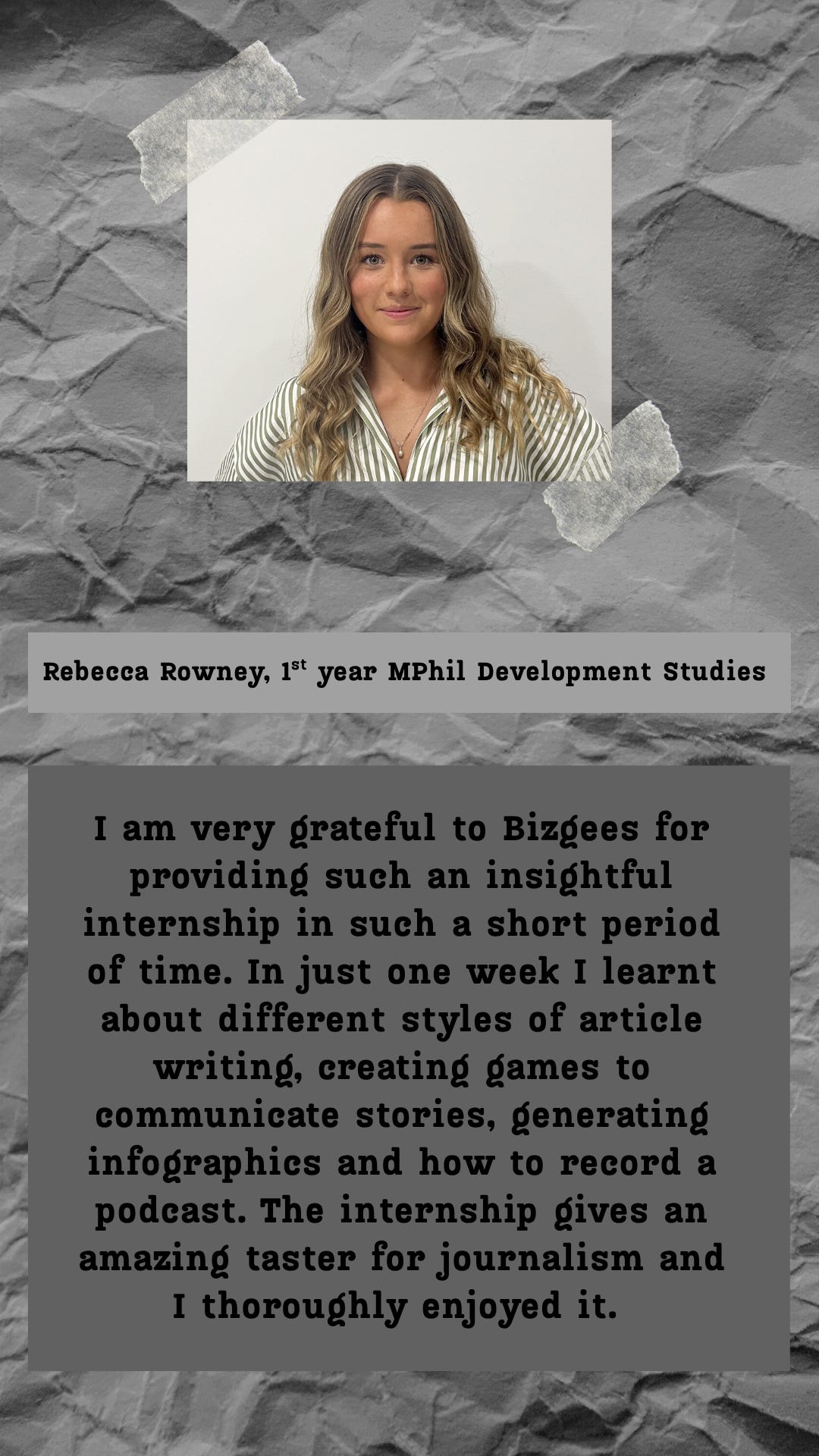
In this UGC post Rebecca highlights the arty refugee experience of Marjane Satrapi. She is a citizen journalist on a placement with us organised by Oxford University Career Services. She also organised the micro game to make the journalistic experience interactive.
Thank you for reading an A4R 🎨 Post. Don’t forget to visit our gaming art here. Every purchase scales our impact and pays our bills.
