


In this episode, Abigale Pole discusses Choman Hardi’s poetry. Abi is studying Classics & English. She is a student journalist with us on a placement organised by the Oxford University Career Services. This article was edited by Cassia Jefferson, a fellow student journalist from Oxford University.
You can listen to Abi’s self interview here
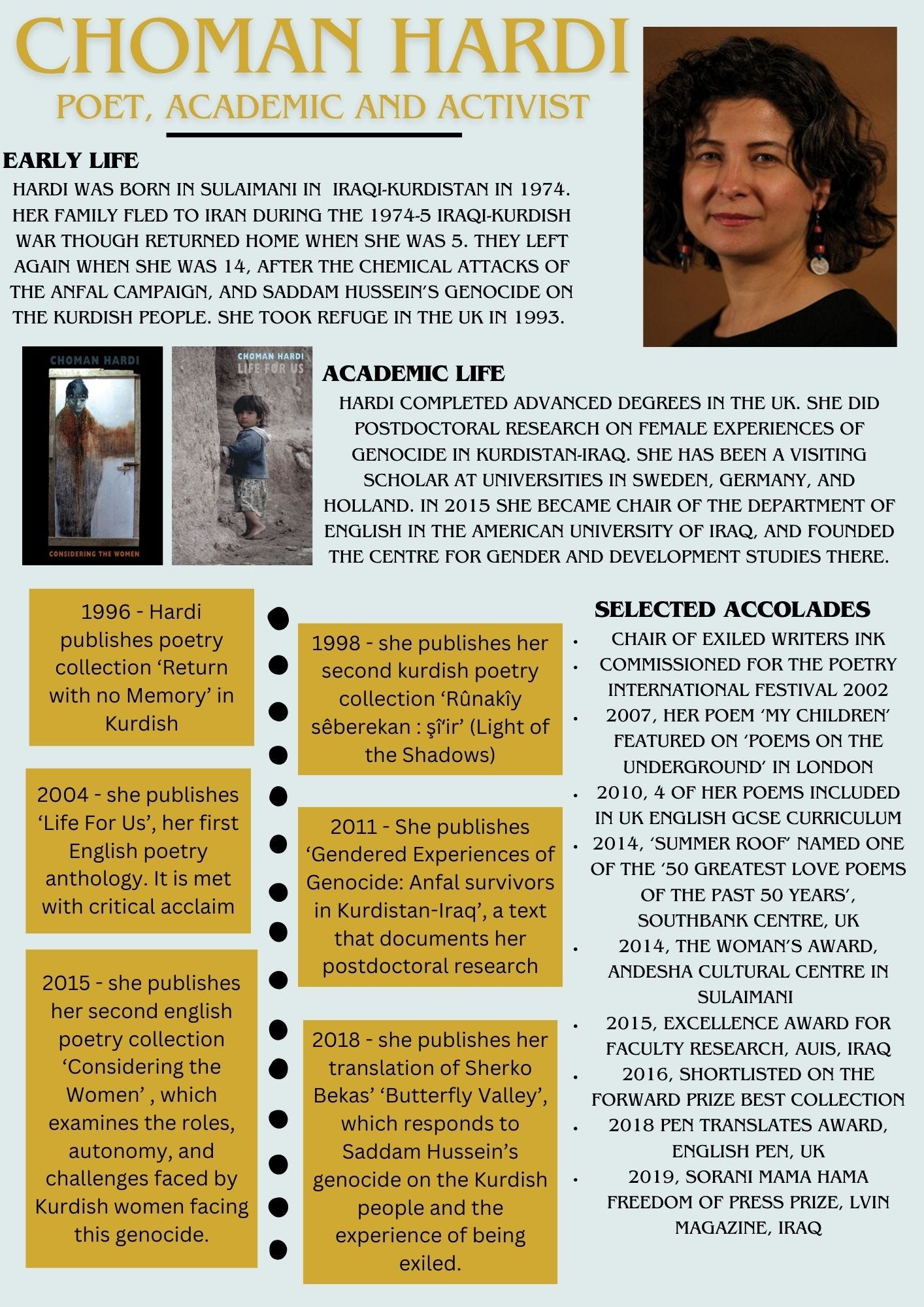
Abi also wrote a short article about Choman with an inforgraphic
Choman Hardi’s poetry predominantly discusses the long reaching consequences of the ‘Anfal’ attacks on the rural Kurdish people. Her work articulates devastating grief and anger while still retaining some sense of hope.
The word ‘Anfal’ means spoils or scourge in Arabic. Hardi uses it to refer to a series of eight military offensives launched in 1988 by the Iraqi government during Sadam Hussein’s Presidency. These attacks, which occurred in six areas and involved the use of chemical weapons, led to a mass dislocation of the Kurds. It is estimated that 2,600 villages were destroyed and 50,000-100,000 civilians were buried in mass graves.
Hardi reflects on this in her ‘Dropping Gas: 16th March 1988’, where she describes the notorious attack on the village of Halabja. She combines visceral visual and auditory images to place the reader into an observatory position, leading critic Zhila Gholami to describe Hardi’s work as “poetry of witness” (2023: 865). Her poetry is not only a reflection on atrocity but a voice that forces awareness of Kurdish defiance and resistance.
The poet also focuses on female suffering based on her own academic research. Her ‘Anfal’ sequence features 11 poems in the female voice, exploring aspects of the Kurdish genocidal experience such as the arrest and mass murder of sons, and life in ‘Dibs Camp, the Women’s Prison’. Her work ‘The Angry Survivor’ articulates the way in which Kurdish women are minimised into their victimhood and forced to relive their trauma for external satisfaction: “Long after you/ turn off your recorder I stay indoors and weep.” Hardi’s work acts as a witness to atrocity, and defiantly declines to forget it: “I sing my country for the silence that surrounds it” (‘My Country’).
The existence and persistence of Hardi’s poetic voice engenders hope. She refuses to be silenced despite the inhumane violence of the Kurdish genocide which led to her own displacement.
Thank you for reading a A4R 🎨 Post. Don’t forget to tell your friends and family.