


In this episode Daisy discusses Walid Siti. She is a student journalist with us on a placement organised by the Oxford University Career Services. This article was self edited.
🎧 listen to Daisy's backstory here - she discusses her motivation & research as well.
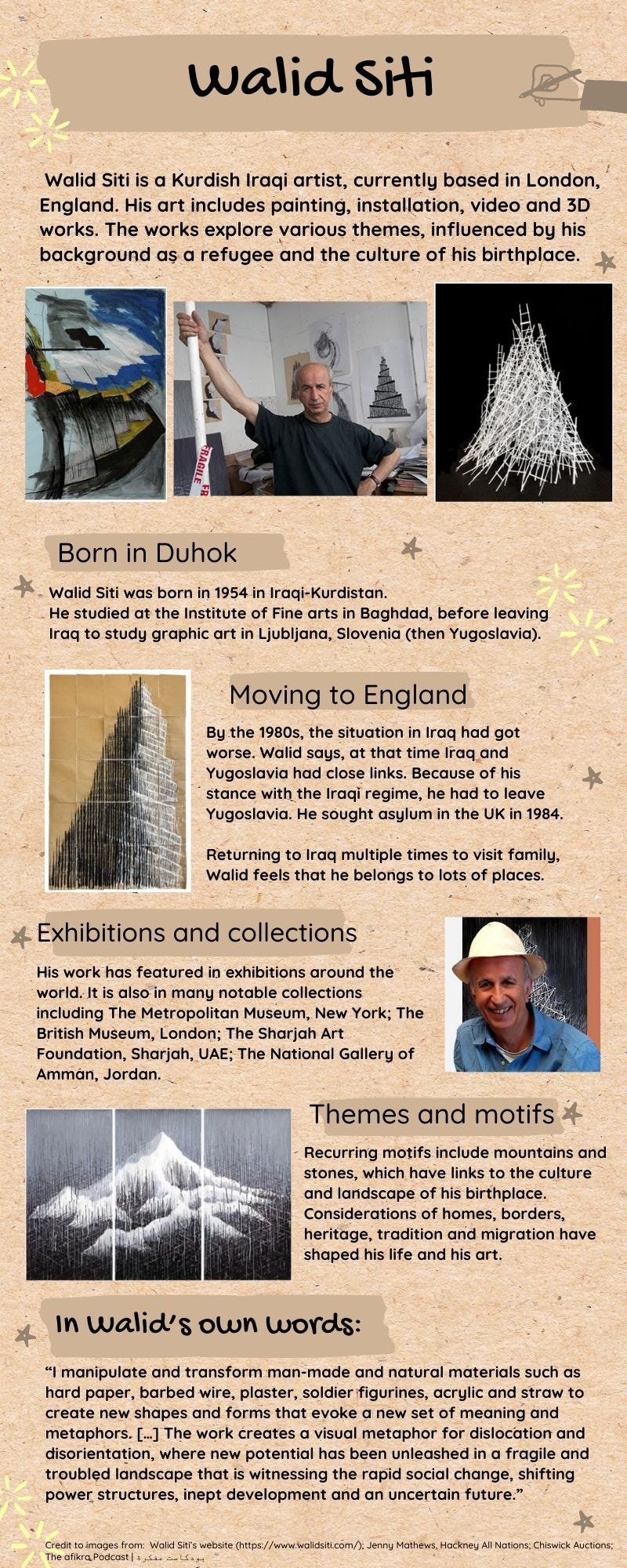
Daisy also wrote a short 2 min read article about Walid Siti with a summary inforgraphic.
Growing up among the mountains of Iraqi Kurdistan. A father involved in the Kurdish revolutionary movement, often absent and in prison. A mother dealing with the challenges of war, poverty and instability, whilst raising six children. Such was the background of the incredible artist and refugee, Walid Siti.
Born in 1952 in Duhok (then a small town), Siti’s family was Sunni Muslim and the region where they lived was frequently a point of military engagement between the central government and Kurdish liberation movement.
Encouraged by his father to pursue his artistic ambitions, Siti studied art at the Institute of Fine Arts in Baghdad before travelling to former Yugoslavia, where he studied graphic art. The situation in Iraq got worse in the 1970s and early 1980s and he was forced to flee because of his stance with the Iraqi regime. He arrived in the UK in 1984 and sought asylum.
At first, he found cultural and language barriers in the UK a challenge but now feels at home. However, he remains deeply attached to his birthplace and feels belonging to many places. His work is related to the experience of the Kurds and often features mountains, towers, stones and family ties. It combines elements of loss and memory with insights into a constantly changing world. Siti works with a range of mediums, from installation and video to painting and drawings. His work has been featured in prestigious exhibitions and collections worldwide, meaning it is increasingly accessible to various people in various countries.
Siti has contributed much to the art world and wider society, through artwork which innovates whilst encouraging considerations of power structures, social structures and identity. He believes in art which says something or questions something. Therefore, his work remains relevant for all generations - present and future.
Thank you for reading a A4R 🎨 Post. Don’t forget to visit our gifts shop here. Every purchase scales our impact and pays our bills.
