

Tiffanys is a member of the War Studies department at King’s College, London. She wrote this piece as part of her internship with Arts4Refugees. Her motivation was to help his peer group understand the unique experiences of post-conflict communities. This article was edited by Cassia Jefferson, a fellow student journalist from Oxford University. Bernadett from Swinburne University interviewed Tiffany for the podcast as well.
Backstory podcast
This year marks the 25th anniversary of the Good Friday Agreement that ended more than 30 years of violence and conflict in Northern Ireland, known also as ‘the Troubles’. Plenty of celebrations have been taking place, including a visit to Northern Ireland by US President Biden and former President Clinton. However, these events are occuring amidst ongoing political uncertainties in Northern Ireland. For anyone who assumes the Northern Irish Conflict is long-gone history, a walk through Belfast where political murals from the time of the Troubles still fill the city would remind any observer that the legacies of the conflict did not vanish overnight. The imagery on these murals often reflects the historical split between the nation’s different religious and political groups, echoed in the segregation of housing and education which persists even today.
When Ireland became a sovereign republic in 1922, the six counties of Northern Ireland remained part of the United Kingdom. This led to social and political divisions between the nationalists (predominantly Catholics), who wished to be part of Ireland, and the loyalists (predominantly Protestants), who believed that Northern Ireland should remain within the United Kingdom. Violent conflicts broke out in the 1960s when the Catholic civil rights movement faced harsh treatment from the police. An onslaught of violence ensued as paramilitary groups from both sides used tactics such as bombings, assassinations, and guerrilla warfare against their opponents. British armed forces were deployed to counter the paramilitary activities of the Irish Republican Army (IRA). Attempts at reaching a power-sharing agreement were futile until the Good Friday Agreement of 1998. This provided a framework for power-sharing between nationalists and unionists in the Northern Ireland Assembly, weapons decommissioning, and the release of paramilitary prisoners. It also allowed residents in Northern Ireland to choose to identify as British, Irish, or both.
Symbols and emblems from the Troubles
While the Good Friday Agreement has brought an end to the conflict, the core issue of sectarian division has not been resolved. To understand how identities and the expression of identity still matter to the people of Northern Ireland today, the murals may be a good point to start. While the imagery is fascinating to look at, their symbols and emblems may be puzzling to someone unfamiliar with nationalist and unionist traditions. The Red Hand of Ulster, one of the most iconic symbols in Northern Ireland, has roots in Celtic myths and is used by both Protestants and Catholics. However, its significance for these two groups is different: Protestants see it as a representation of the six counties of Northern Ireland while Catholics consider it representative of the nine counties of Ulster (the remaining three being in the present-day Republic of Ireland). More sectarian symbols include the Red Clenched Fist, often seen on unionist murals associated with the Loyalist Paramilitary, and the colours of the Irish flag, green, white, and orange, which are associated with the nationalists.

Red Hand of Ulster
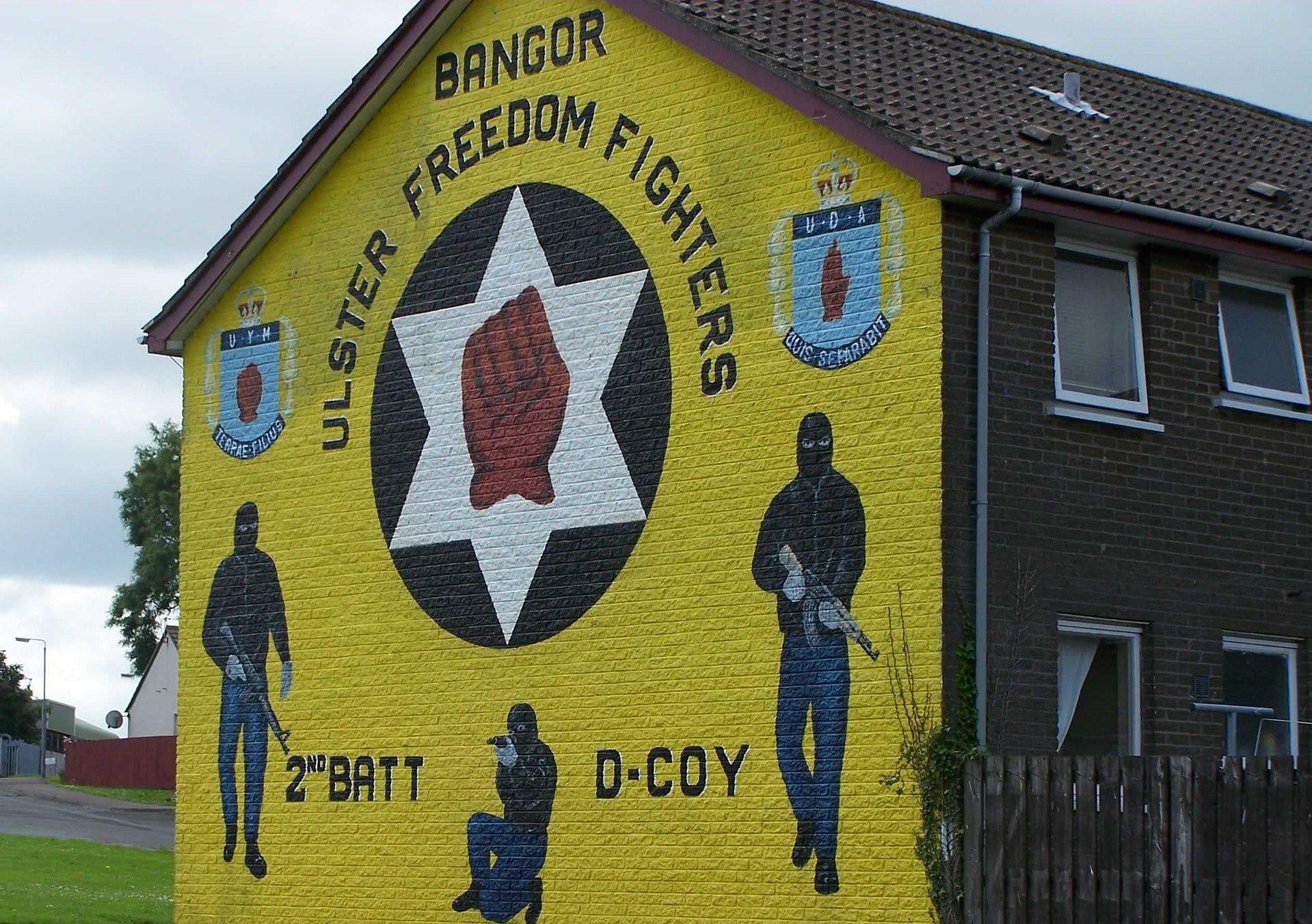
Red Clenched Fist on a mural in Bangor. By Kilcooleykingbilly (talk) - self-made, Public Domain, https://en.wikipedia.org/w/index.php?curid=15868378
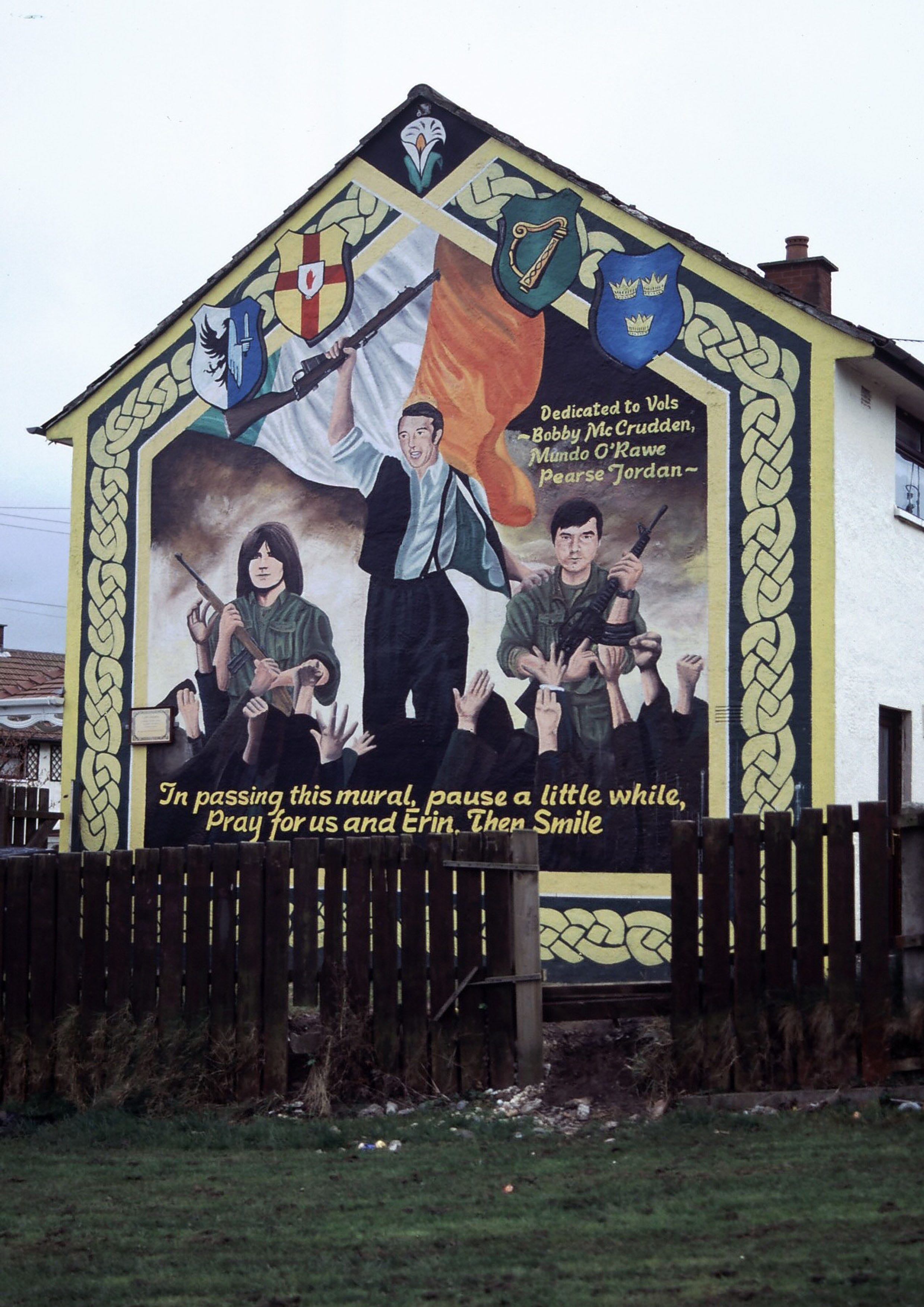
A Nationalist mural in Belfast. By No machine-readable author provided. Miossec assumed (based on copyright claims). - No machine-readable source provided. Own work assumed (based on copyright claims)., CC BY 2.5, https://commons.wikimedia.org/w/index.php?curid=19093261
Flags are also an important part of sectarian identity. They are seen not only on murals but are also flown in these respective communities on different occasions. Unlike other countries in the United Kingdom, Northern Ireland has not had its own flag since the dissolution of the Northern Ireland government in 1973. The flag that was in use before that, the Ulster Banner showing the Crown, the Star of David, and the Red Hand of Ulster, has since been considered a staunch unionist symbol because of its association with British rule. The Union Flag is also used by many unionists to this day as a demonstration of their British identity, while nationalists express their Irish identity with the flag of Ireland. The issue of flag flying is so central to sectarian division that when in 2012 Belfast City Council voted to only fly the Union Flag on 18 designated days of the year, unionist protests and riots broke out. Sectarian tension also often runs high during the marching season from April to August every year. Most of these parades are held by Protestants/unionists, celebrating the unionist identity and certain historical events. Catholics tend to view them as provocative, and Protestants see restrictions on parades as an unfair treatment of their culture.
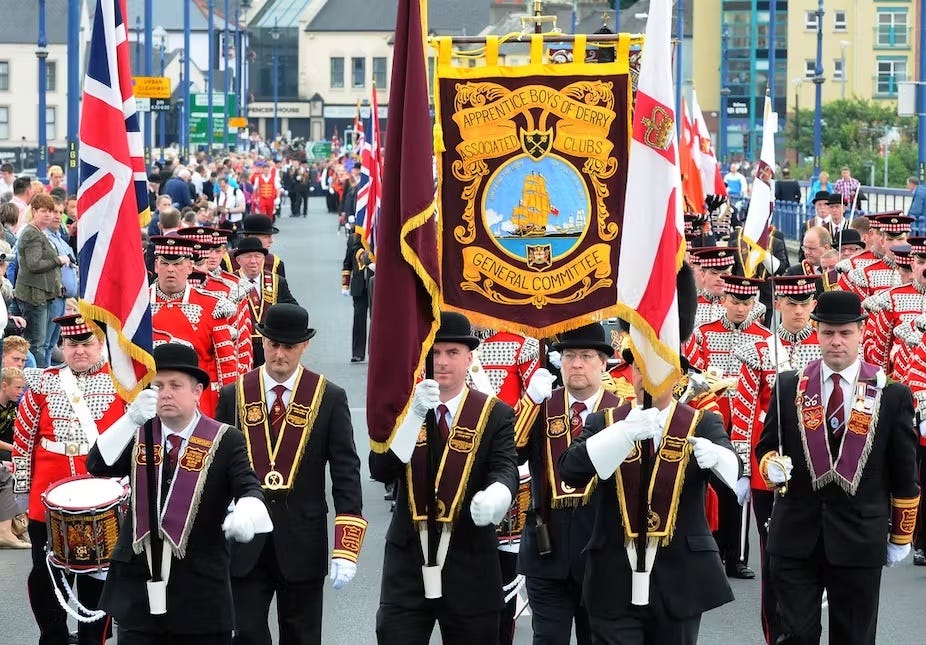
Traditional parade in Derry. Photo by Martin McKeown.
As the 2012 protest has shown, flags, emblems and parades continue to be sticking points in facilitating sustained peace in Northern Ireland. The use of flags and emblems and dealing with parade disputes were examined in the 2013 Haass Initiative, but negotiators could not agree on any mechanisms to handle these issues. Delays and stalemates in negotiations also plagued the 2021 Commission on Flags, Identity, Culture, and Tradition report. Not only are the use of these symbols in official contexts controversial, but their presence is also so strong in Northern Ireland that they continue to divide communities physically, and those which are more militant may even provoke antagonism. Even today, the Catholic and Protestant communities in Northern Ireland seldom mix. More than 90% of schools are segregated by religion, and many of the ‘peace walls’ which divided communities are still present. A study by the Queen's University Belfast found that children in Northern Ireland identify with religious and political symbols as early as the age of five. Symbols of sectarianism, clearly denoting the boundaries of each community and the incompatibility of their political stances, are not only reminders of the past but markers of current division.
The difficulty of compromising on some form of control over the use of different flags and emblems reveals how central the issue of identity is in post-conflict Northern Ireland. The Good Friday Agreement was successful partly because it gave official recognition to the Irish identity of nationalists without stripping off their political rights. After 30 years of violent conflict, the nationalist/unionist political identity is not only shaped by the religion one belongs to but also by memories of the lived experience of the Troubles. For a large part of their lives, those who lived through the Troubles understood the danger they might face if they crossed into the territory of a different community, and many had family and friends who fell victim to the conflict. The lack of procedures dealing with the legacy of the Troubles, whether for truth-finding or criminal justice, is another barrier to lessening the sectarian nature of identity. The identity of the older generation is shaped by distrust and hostility towards people of the other community, making any attempt to regulate the use of flags and emblems seem like a personal attack.
Identities and traditions form people’s understanding of who they are and where they belong. As the Troubles become a thing of the past, identities are being passed down to younger generations to different extents in different communities. Research has shown that younger people coming from the Protestant community are less likely to identify as unionist or British, but the transfer of identity has been quite successful for Catholics/nationalists. This may explain why unionist organisations are particularly vocal about keeping control over their traditions. Some of them view the Good Friday Agreement as a betrayal of their cause, and support for the Democratic Unionist Party has been dwindling.
With the devolved government in suspension since 2022, one may wonder if addressing the issues of flags, emblems, and parades would improve the political situation in Northern Ireland. Although there are initiatives attempting to encourage reconciliation in Northern Irish society and the cross-community Alliance Party made significant gains in the May 2022 Assembly election, many in Northern Ireland still express preferences to remain separated from the other community for safety and security reasons. Debates over how identities are represented only scratch the surface of how the past is remembered by both the people who personally experienced it and those who did not.
People may be born into a religion, but an identity means nothing without the ‘myth’ surrounding it. In Northern Ireland, flags, emblems, and parades are tangible manifestations of these histories, whether they evoke the origins of the land, the events of the Troubles, or the day-to-day experiences of living in Northern Ireland today. With the existing peace accord in place, these symbols may not incite an immediate, all-out war between the communities, but they are reminders that the peace in Northern Ireland is only a baseline. Will these symbols become a thing of the past or will they acquire different meanings? Only time will tell.
References
Archick, Kristin, Northern Ireland: The peace process, ongoing challenges, and U.S. interests § (2023). https://sgp.fas.org/crs/row/R46259.pdf.
FitzGerald, Ger. “Political Frustration in Northern Ireland Has Heightened Tension around ‘Marching Season.’” The Conversation, July 8, 2021. https://theconversation.com/political-frustration-in-northern-ireland-has-heightened-tension-around-marching-season-163397.
Grattan, Steven. “Northern Ireland Still Divided by Peace Walls 20 Years after Conflict” The World from PRX, January 14, 2020. https://theworld.org/stories/2020-
01-14/northern-ireland-still-divided-peace-walls-20-years-after-conflict.
Melaugh, Martin. “Key Issue: Identity: Protests and Violence Related to the Flag at the Belfast City Hall, 2012.” CAIN, February 8, 2013. https://cain.ulster.ac.uk/issues/identity/flag-2012.htm.
Meredith, Robbie. “Young Children Identify with Political Symbols - Research.” BBC News, June 30, 2022. https://www.bbc.co.uk/news/uk-northern-ireland-61985845.
Mulhern, Dara. “Symbols in Northern Ireland - an Introduction.” CAIN, 1999. https://cain.ulster.ac.uk/images/symbols/index.html.
Nagle, John. “A Tale of Two Cities - Marching Season in Northern Ireland.” The Conversation, June 8, 2023. https://theconversation.com/a-tale-of-two-cities-marching-season-in-northern-ireland-16912.
Savage, Claudia. “Segregation in Ni Is ‘obscene’ 25 Years on from Good Friday Agreement – Activist.” BelfastTelegraph.co.uk, March 21, 2023. https://www.belfasttelegraph.co.uk/news/northern-ireland/segregation-in-ni-is-obscene-25-years-on-from-good-friday-agreement-activist/402496202.html.
White, Timothy J. “Generational Change and Redefining Identities: Post-Conflict Peacebuilding in Northern Ireland.” Peace Research 45, no. 2 (2013): 95–117. https://doi.org/10.2139/ssrn.2483428.
Thank you for reading an A4R 🎨 Post. Don’t forget to share it with your friends and family.