


Click here to play & learn.
Back Story
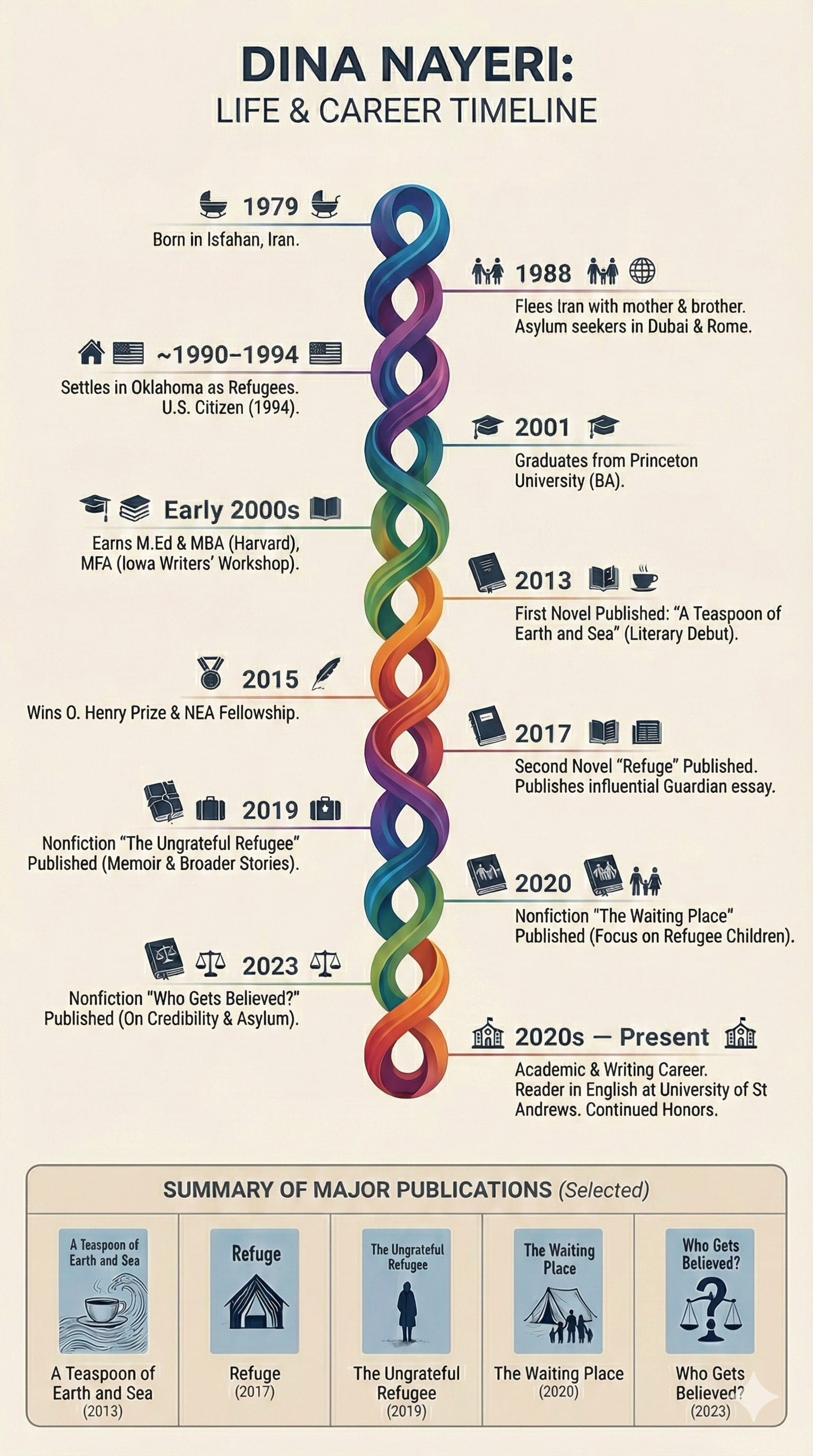
Dina Nayeri: Writer, Truth-Teller, and Essential Voice
Dina Nayeri is a writer whose work has become central to contemporary conversations about refugees, identity, and telling diverse stories. She was born in Isfahan in 1979 and left Iran as a child after her family faced religious persecution. She spent time in Dubai and Rome as an asylum seeker before arriving in the United States and spending time in refugee hostels before becoming an American citizen at age 15. Since then, Nayeri has lived in the Netherlands, England, and Scotland. This refugee experience and journey around the world undeniably forms how she understands who gets to tell their story, who gets heard, and who is dismissed. It is also the foundation of a body of work that has helped shift how readers think about displacement.
Nayeri completed her undergraduate degree at Princeton University and later continued her studies at Harvard. After several years in strategy consulting in New York, she turned from business to literary art, and entered the Iowa Writers Workshop. Her route into professional writing was built through rigorous craft training and a willingness to stay with difficult questions about power, truth, and representation. Her career has been supported and rewarded by major institutions including the National Endowment for the Arts, UNESCO and the Columbia Institute for Ideas and Imagination. Nayeri now shares and passes on her writing expertise by teaching at St Andrew’s University. She called this process of helping others find their voices, shape narrative, and build creative practices as “the point of everything.”
Dina Nayeri’s writing, including novels, short stories, essays, and plays, is distinct, moving, and thought provoking. She describes her love for “building tight, character-driven narratives, vanishing into other voices, and reading and writing stories with catastrophe at the centre.” Nayeri is widely recognised and taught in schools for her masterful storytelling about the refugee experience, but she writes about more than that. Her work tackles challenging and ambiguous topics like trust, power, vulnerability, pain and change. She particularly enjoys delving into the drama of the messy lives of flawed people.
Her published work spans novels, memoir, reportage and essays. ‘A Teaspoon of Earth and Sea’, her first novel, was published in 2013 and has been translated into fourteen languages. It introduced her interest in character driven storytelling and in the fractured identities that arise from political upheaval. ‘Refuge’, her second novel, arrived in 2017. It alternates between a daughter who left Iran and a father who stayed behind. The structure mirrors the emotional distance between them and also reflects the fragmented nature of migrant experience. Readers move between present day scenes and flashbacks across several cities. The novel is semi autobiographical and tracks closely with elements of Nayeri’s own life. It also looks outwards at the European refugee crisis and at how Iranian migrants navigate new cultures while trying to maintain ties to the past.
In 2019, she published ‘The Ungrateful Refugee’, the book that made her a widely recognised voice in public debates about asylum. It grew out of a Guardian long read that went viral and challenged the idea that refugees owe gratitude to the countries that accept them. The book mixes memoir, travel, interviews and analysis. It focuses on the expectations placed on displaced people to perform trauma or assimilation in ways that satisfy bureaucracies and public opinion. The book was shortlisted for major prizes, translated widely and taught in schools and universities. It also led many journalists and readers to rethink how refugee stories are framed in media and policy conversations.
Her next project, ‘The Waiting Place’ (2020), examined the experience of young refugees living in limbo in camps and transit zones. It took her back into spaces that she once occupied as a child and asked how temporary sites of survival become long term realities. The book is smaller in scale than her major works but expands her toolkit as someone who documents the lived consequences of political decisions.
In 2023 she published ‘Who Gets Believed?’, which investigates how institutions decide which stories are credible. The book looks at asylum interviews, courtrooms, hospitals and other systems where people must convince strangers of their own truth. It blends reporting with philosophy and personal experience and shows how disbelief shapes the lives of migrants, whistleblowers, survivors and anyone whose story does not fit expected templates. The book was shortlisted for the National Book Critics Circle Award in Nonfiction and received international attention for its clear analysis of how credibility is granted or denied.
Nayeri has also announced an upcoming book called ‘A Happy Death’.
Throughout this body of work, Nayeri refuses to simplify motives, emotions, truths, and questions. This approach resonates strongly with younger readers who want journalism and literature that avoids easy moral binaries. She writes with urgency but also with a critical awareness of how stories get constructed and consumed.
Her essays have appeared in leading publications including the New York Times Magazine, the New Yorker, the Atlantic, Granta, Vice, Marie Claire, Glamour, the Wall Street Journal and many others. These pieces often examine contemporary refugee policies, personal narratives from camps across Europe and the Middle East, and displacement. She is widely read not only because of her subject matter but because her voice is clear, grounded, and innovative.
There are various elements which make Nayeri’s writing distinctive. She finds the relatable elements of individual stories. For example, in ‘The Ungrateful Refugee’, she depicts how power is enforced by making people wait in immigration and asylum systems. She has explained how being subjected to this power-through-waiting experience is a universal experience, using the examples of waiting inside during the COVID-19 pandemic, and the pain of a waiting lover in Roland Barthes’s ‘A Lover’s Discourse’. Another strength of her work is the ability to combine real experiences, both hers and others, and adapt them into emotive fictional narratives. An example of this is how she adapted her own relationship with her father for her book ‘Refuge’. Her work also is defined by her awareness to the implications and roles of the written word. She has spoken about how some voices and heard while others are doubted, how some stories are more easily accepted, and what it takes for a story to be taken seriously. This awareness informs her approach to writing. Furthermore, her commitment to deconstructing misconceptions about immigrants and appealing to people’s empathy for a human narrative is central to her writing.
Dina Nayeri’s work explores the refugee experience across geography and diversity, while also exploring wide questions of human emotions and relationships. Her writing maintains a careful balance between specific personal experiences and broader themes, giving her stories both intimacy and universality. Her prose is clear, grounded in real lives, and combines compelling storytelling with insight into social and cultural realities, making her one of the most important contemporary voices on displacement, and belonging, and life in the modern world.

In this post Willow highlights the arty refugee experience of Dina Nayeri. She is a citizen journalist on a placement with us organised by Oxford University Career Services. She also organised the micro game to make the journalistic experience interactive.
Thank you for reading an A4R 🎨 Post. Don’t forget to visit our gaming art here. Every purchase scales our impact and pays our bills.
