


Click here to play & learn.
Back Story
From Kabul to California: Khaled Hosseini writes home away from home.
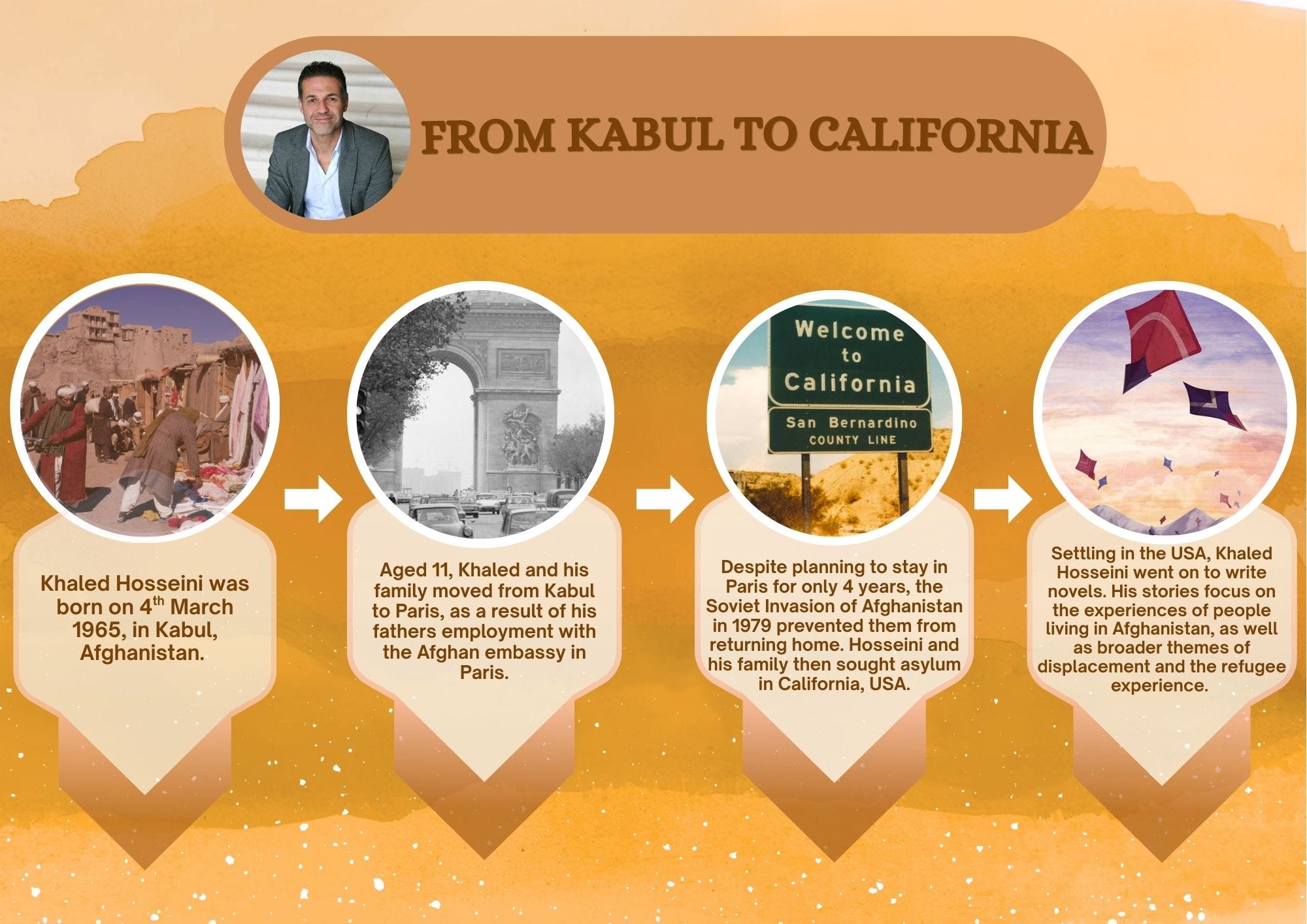
‘One could not count the moons that shimmer on her roofs, Or the thousand splendid suns that hide behind her walls’ — a Persian line quoted by Khaled Hosseini in his celebrated novel A Thousand Splendid Suns, to conjure an image of a Kabul he can no longer call home. Writing novels that primarily explore life in Afghanistan through time, Khaled Hosseini shares poetic visions of the country he was born into. The reality of his own experience however, has been one of separation and distance from his home nation. Being forced to seek asylum in the US as a teenager, Khaled Hosseini’s exile led him to pick up the pen and write his way back home. Today, he is an acclaimed author of four novels, raising awareness globally for the experiences of the people of Afghanistan, and displaced communities.
Khaled Hosseini was born on 4th March 1965, in Kabul, Afghanistan. The Afghanistan Hosseini was born into looks strikingly different from the Afghanistan we see in contemporary media today. At this time, Afghanistan was not engaged in any conflict, though this is not to say it was entirely stable. In 1973 the king was overthrown by prime minister and president Mohammad Daoud Khan, and Afghanistan became a non-democratic authoritarian republic. Between the sixties and early seventies, however, Kabul was considered a growing and liberated space. It was a popular destination for travellers, taking a spot on what was known as the ‘hippy trail.’ As a master of words himself, it is perhaps best to use his own to paint a picture of the country in 1965. In an interview with Radio Free Europe/Radio Liberty, Hosseini describes it as ‘a country at peace with itself [...] a growing, cosmopolitan city.’
In 1976, his father’s work at the Afghan Foreign Ministry prompted a relocation to the Afghan Embassy in Paris. At eleven, Hosseini found himself moving away from his home, expecting a temporary stay. Little did he know, a trip that was intended to last only four years, would result in the family never going back.
The Soviet Invasion of Afghanistan closed the door on any quick return. Beginning in December 1979, the Soviet Union took military and political control in Afghanistan, starting with Kabul and other parts of the country. The Soviet Union had become closely allied with the communist government in Afghanistan, and aimed to keep a communist grasp on the country in order to limit the influence of the US in the Middle East. However, the communist government was facing resistance from the largely Muslim anti-communist Mujahideen groups operating in rural regions. Fighting between these two groups produced one of the largest refugee movements of the twentieth century. For Hosseini’s family, it turned a temporary diplomatic posting into a permanent displacement.
The escalating tensions in Afghanistan made it impossible for Hosseini and his family to return home, and they had no choice but to divert their journey. Instead of heading to the Middle East, they swung west — Hosseini and his family sought political asylum in the US. Hosseini expresses in interviews that he believes himself and his family to have been more fortunate than many of the other Afghan refugees who fled the country at this time. Many of these individuals were placed in refugee camps in neighbouring Pakistan or given roles as labourers in Iran. Estimates for the era put total Afghan refugees and displaced persons in the mid-millions (commonly cited figures are roughly 5–6 million displaced overall, with around 2 million into Pakistan and about 1 million into Iran).
Hosseini settled in California, and found himself thrown into adolescence in a country where he couldn’t speak the language, and was forced to pick it up as he went. Moving into adulthood, Hosseini completed a BA in biology at Santa Clara University and later earned an MD from the University of California, San Diego. It was alongside his work as a doctor that he began storytelling. From speaking no English at 15, Hosseini not only picked up the language but mastered it, using it to give a voice to the experiences of people in Afghanistan.
Themes of displacement and diaspora remain central for Hosseini, and these find themselves becoming prominent in his work. His fiction career began with The Kite Runner (2003), followed by A Thousand Splendid Suns (2007) and And the Mountains Echoed (2013). Each of these explores themes of memory, connection, and the private costs of public violence. The Kite Runner focuses on the relationship between a privileged boy from Kabul and his friend against the backdrop of the tumultuous political climate of the country. The equally poignant A Thousand Splendid Suns takes a different perspective on life in Afghanistan: in this novel he turns to the female experience, a shift he later attributed to returning visits to Afghanistan in the early 2000s. His most recent novel about Afghanistan, And the Mountains Echoed, tracks similar themes through generations of an Afghan family. Looking at the entirety of his discography, Hosseini paints a vivid image both of the life he left behind in Afghanistan, and the aftermath of the various conflicts that have prevented him from returning home.
Using his pen to advocate not only for those living in Afghanistan, Hosseini has also engaged with refugee crises globally. In 2018, he published a short story titled Sea Prayer. This was inspired by the tragic death of Alan Kurdi, the three-year-old Syrian refugee who drowned in an attempt to cross the Mediterranean. Subsequently, this story takes the form of a letter from a father to a son, as they prepare to undertake a similar journey. Hosseini discusses the significance of this story with NPR:
“It speaks to the experience of so many refugee children, whether we’re talking about Syria or Afghanistan — an entire generation of children who are being raised amid turmoil and violence and war, and have no personal connection to the beauty and the richness of their country before all the turmoil began.”
With this text, Hosseini’s work has expanded from a sole focus on life in Afghanistan through time, to a wider reflection of the refugee experience. He frames displacement in a direct, accessible form aimed at a wide audience.
Beyond fiction, Khaled Hosseini works to change the lives of refugees through charitable means. Since 2006, he has been a part of the UN refugee agency, acting as a UNHCR Goodwill Ambassador. As part of this work, he has travelled globally to document the experiences of refugees, making field visits to Afghanistan, Lebanon, Italy, Uganda, Jordan, Chad, and Iraq. As well as this, in 2008 he established the Khaled Hosseini Foundation, an organisation dedicated to giving humanitarian aid to vulnerable groups in Afghanistan. Taking a particular focus on the protection of women and children, this foundation works to provide healthcare, education and shelter for families. Khaled Hosseini has both written stories demonstrating the need for global attention both to Afghanistan and the refugee experience more widely, and he continues to make efforts to enact this aid through his various humanitarian commitments. His humanitarian work and his books operate in tandem: the novels humanise large-scale suffering for international readers while his advocacy supports direct aid on the ground.
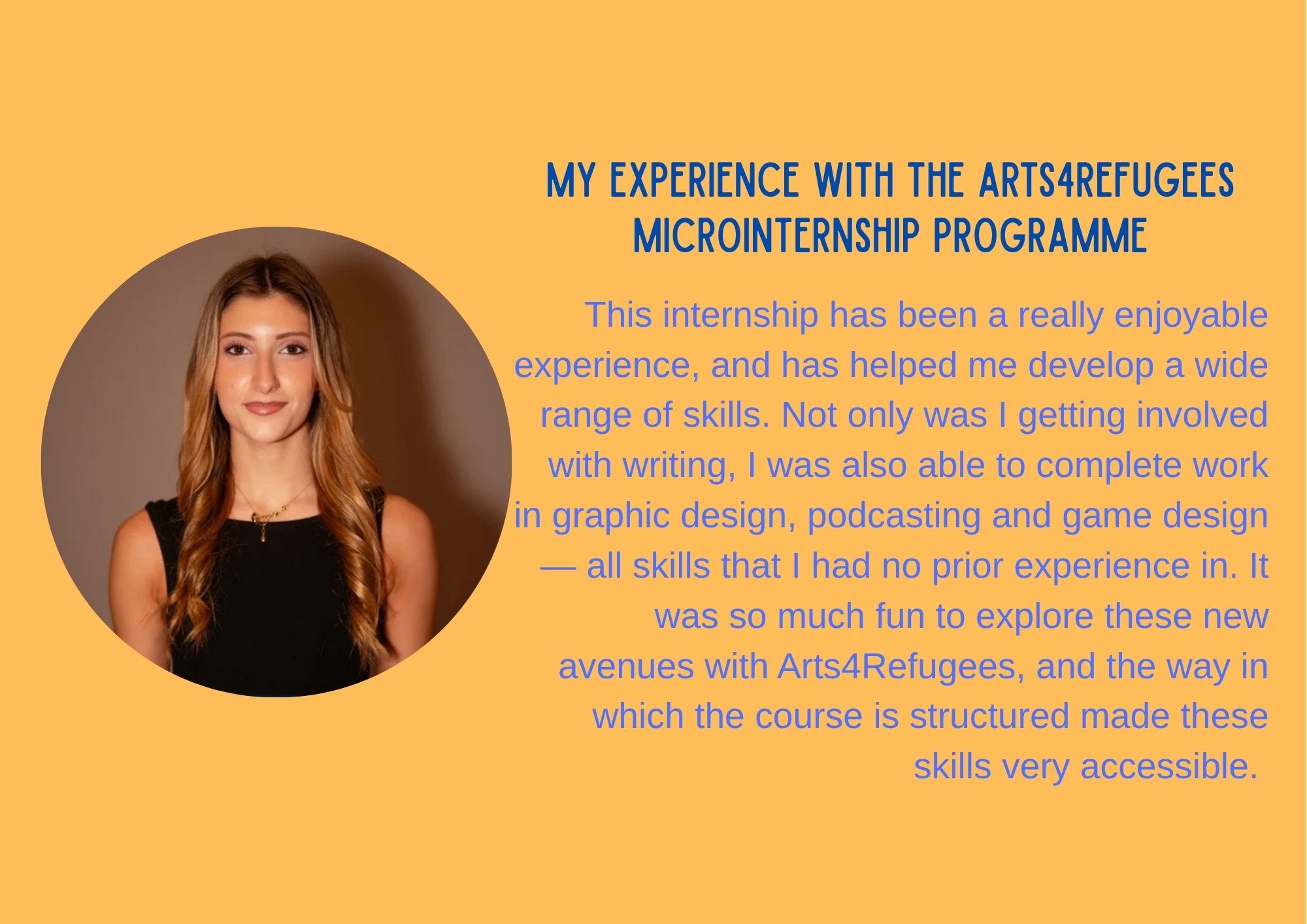
In this post Leya highlights the arty refugee experience of Khaled Hosseini. She is a citizen journalist on a placement with us organised by Oxford University Career Services. She also organised the micro game to make the journalistic experience interactive.
Thank you for reading an A4R 🎨 Post. Don’t forget to visit our gaming art here. Every purchase scales our impact and pays our bills.
