


Click on image to play the game
"Bob Marley - From Refugee to Legend" is an interactive chat box that allows you to speak to an AI version of Bob Marley, allowing you to ask questions and understand his background. The game also has a portion of unpacking for you to get fun facts about him and his popular music.
-Nimrit Boparai, UC San Diego
“Bob Marley - From Refugee to Legend” starts with a fun game. You click on boxes to learn about Bob Marley’s life, such as which of his songs were inspired by Marcus Garvey. Then you can use the chat box to discover even more.
- Miranda Dorkins, Oxford University
Background Story
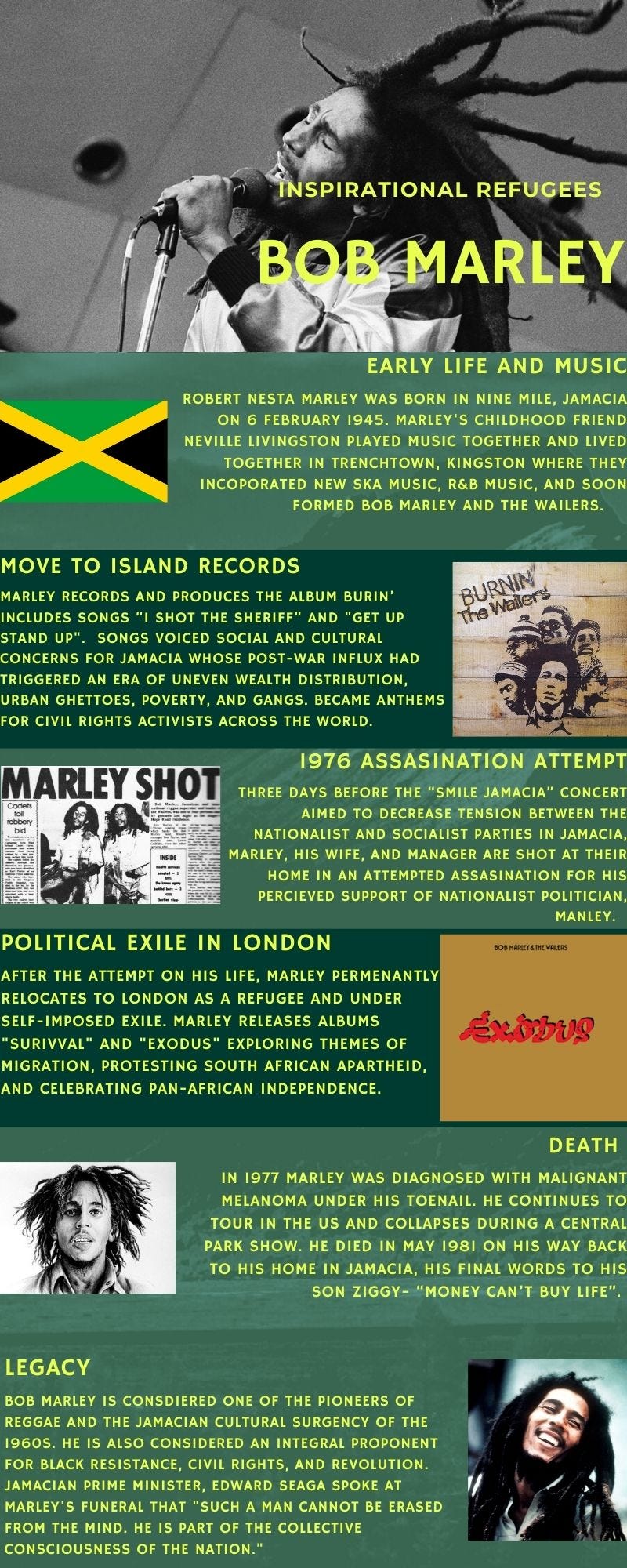
To many, the name Bob Marley is notorious for his contribution to reggae and the Jamaican cultural surge in the 1960s, his Rastafarian beliefs, and his call for love, peace, and equality. However, not many know that Bob Marley was a refugee.
A few months after his debut solo album Natty Dread, on December 3, 1976, Marley, his wife, and manager Don Taylor were wounded for their perceived support for Jamaican Prime Minister Michael Manley. Bob Marley was exiled from Jamaica and permanently relocated to London.
Marley’s exile in London inspired his album Exodus, which blended blues, soul, British rock, and funk. The album tackled religion, politics, sex, and change. The title track, “Exodus,” mirrors the Biblical story of Moses and the Rastafarian struggle for freedom, paralleling Marley’s political exodus from Jamaica. Despite an assassination attempt for supporting Jamaican politician Michael Manley, in “Exodus,” the lyric “we know where we’re going” is a direct nod to the slogan of Manley, who had recently won the Jamaican election. Marley showed defiance against political persecution through his music. Understanding Marley as a musician first highlights his musical and political agency, not victimhood.
Decades after his death, Bob Marley is infamous for his One Love, peace, and Rastafarian message, but reducing him to an advocate for world citizenship denies the complexity of Marley’s experience and message. His music channels the brutality of life and poverty, and the use of violence to reach emancipation and revolution away from an imperial and capitalist society. Exploring political themes like social transformation and revolution, along with ideas of devotion and self-emancipation, Marley became an icon for dissent and spiritualism. As Dave Thompson in Reggae and Caribbean Music states, “Bob Marley ranks among both the most popular and the most misunderstood figures in modern culture.”

In this article Sofia Aujla-Jones highlight the arty refugee experience of Bob Marley. She is a student journalist with us on a placement organised with Oxford University Career Services. This article was edited using Lex.page. The article was converted into a micro game using Rosebud.ai by Constantin. He is a front end developer placed by Virtual Internships to build his Ai & Gaming Dev experience.

Thank you for reading an A4R 🎨 Post. Don’t forget to visit our gift shop here. Every purchase scales our impact and pays our bills.
