


Click here to play & learn.
Back Story
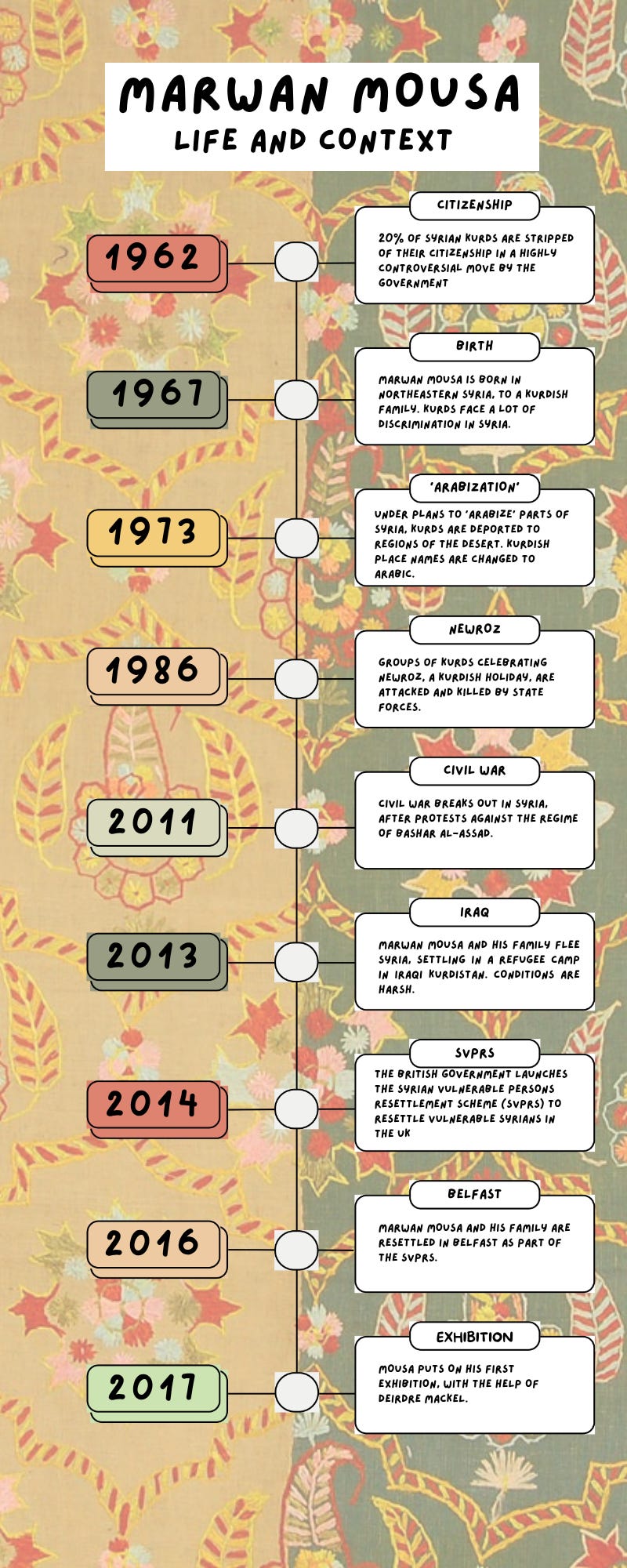
Brushstrokes of Resilience: Marwan Mousa’s Journey from Refugee to Artist
It is the 15th of March, 2011. The air in Damascus is dry- Syria is undergoing its worst drought in modern history. The dry heat is perfect kindling for the firestorm of dissent that is about to explode in Syria. In protest of Bashar Al-Assad’s government, and despite the regime’s anti-demonstration laws, hundreds of protesters are gathering in Damascus, Aleppo, and other major cities. They are protesting the arrest and torture of a group of teenagers who painted revolutionary slogans on a school wall. Before long, the protests are violently dispersed- state security forces attack and detain men, women and children. A 10-year-old boy is detained alongside his father. The police have opened fire on protesters, and by the end of the day, 3000 people have been detained. Some are known to have been killed, although official figures are hard to come by. The next day, protests erupt again. The protests grow, and the extreme police force only strengthens resolve. By July, the protests are hundreds of thousands strong. These protests are the foundation for what will become the Syrian civil war.
Marwan Mousa was born in 1967 in northeastern Syria. His family is Kurdish, the largest ethnic minority in Syria. In spite of their prevalence, they are routinely subject to discrimination. In 1962, in a highly controversial move, the government stripped 20% of Syria’s Kurdish population of citizenship after claims that Kurds from Turkey were illegally migrating to Syria, although evidence for this is unclear. A process of registration was enforced on the Kurdish population, leading to up to 200,000 ‘stateless’ Kurds denied citizenship. Roughly 500,000 stateless Kurds live in Syria today, with no access to education, limited employment opportunities, and an inability to emigrate due to lack of documentation. By 1973, areas with majority Kurdish populations were being resettled under government plans to ‘Arabise’ Syria, involving the replacement of Kurdish place names with Arabic ones, and the deporting of 140,000 Kurds to a southern desert region.
The erasure of Kurdish culture continued, often through violence. In March 1986, a few thousand Kurds gathered in Damascus, wearing traditional dress, celebrating Newroz, a Kurdish new-year festival. Police fired on the crowd, killing one, and at a similar celebration in Afrin, three Kurds were killed. The government would later ban Newroz festivities. In 2011, against a backdrop of anti-government protest, Kurdish politician and advocate Mashaal Tammo was killed. It is not entirely clear who is responsible for his death, but at his funeral procession, when 50,000 people gathered in Qamishli to mourn, police opened fire on the crowd, killing five.
The Syrian civil war was a vast and complex conflict, with numerous factions and interest groups fighting for their own interests. The historically disenfranchised Kurdish population of Syria participated in this.
The conflict disrupted the life and livelihood of Marwan Mousa, a husband and father of four. He owned a cellphone repair shop in Syria, but the war soon forced him and his family into exile. In 2013, Mousa and his family fled to Iraqi Kurdistan, a majority-Kurd region, where they spent two years in a refugee camp. While they were safe from the Syrian civil war, times were still incredibly challenging. Iraqi Kurdistan faced extreme repression, and the Kurds suffered genocide under Saddam Hussein during the 1988 Anfal and Halabja military campaigns. In late 2012, tensions rose along the autonomous Kurdish border, resulting in skirmishes between state and Kurdish forces. However, beyond the political tensions, times were particularly tough for Mousa and his family. They lived in a tent in the camp for two years, during which time Mousa began to create art. One of his paintings from the period depicts their tent, reflecting the struggles of living in a refugee camp, “especially in the winter, when the conditions are really bad.”
Beyond the difficulties of the camp, the family faced a pressing medical issue. Mousa’s son, Mohammed, was suffering from Thalassemia, a genetic blood disease that leads to a lack of hemoglobin, an enlarged spleen, and brittle bones, making individuals more susceptible to infections and broken bones. Treatment is costly and demanding, requiring regular blood transfusions, chelation therapy (the removal of excess iron from the blood), and sometimes stem cell treatment. Mousa was unable to access his son’s much-needed treatment in their refugee camp in Iraq.
In 2016, Marwan Mousa and his family were resettled in the UK under the Syrian Vulnerable Persons Resettlement Scheme, which was launched in 2014 to bring high-risk people from Syria to the UK. This involved “people requiring urgent medical treatment, survivors of violence and torture, and women and children at risk.” In 2015, the scheme was expanded to resettle 20,000 Syrians in the UK. Mousa and his family were resettled in Belfast, becoming part of the 632 Syrian refugees in Northern Ireland. The journey was crucial for Mohammed, who was able to access treatment.
Mousa began creating art in Iraq. Once in Belfast, however, his artwork became both richer and more joyful. His son was receiving treatment, his family had a home, and the local council supported their integration into Northern Ireland. While the family was being supported by the children’s charity Barnardo’s, Mousa’s work was introduced to Deirdre Mackel, an arts programme manager at a Belfast trust supporting marginalised groups. Through Mackel, Mousa was able to put on his first exhibition in Belfast in 2017. He put on another at St Mary’s University College, Belfast in August of 2017, displaying paintings that reflected the difficulties of life in Syria and the refugee experience. He has continued to paint since then, putting on another exhibition in September of 2019.
He has also contributed to the Belfast community by volunteering with Action Ability, a group supporting disabled people in the city. He attends their art classes, helping young people with painting.
Marwan Mousa’s story is one of resilience. In spite of the difficulties he has faced, he has made a home for him and his family in Belfast, where he indulges his passion for art and passes it onto others.
In this post Camille highlights the arty refugee experience of Marwan Mousa She is a citizen journalist on a placement with us organised by Oxford University Career Services. She also organised the micro game to make the journalistic experience interactive.
Thank you for reading an A4R 🎨 Post. Don’t forget to visit our gaming art here. Every purchase scales our impact and pays our bills.
