


In this episode Ronan discusses Hannah Ardent. Ronan is a Master’s student in Cultural memory, political narratives, and contested spaces at work in popular culture and media produced during the Troubles. He is a student journalist with us on a placement organised by the Oxford University Career Services. This article was edited using the Hemingway Editor.
🎧 listen to Ronan’s backstory here - he discusses her motivation & research as well.
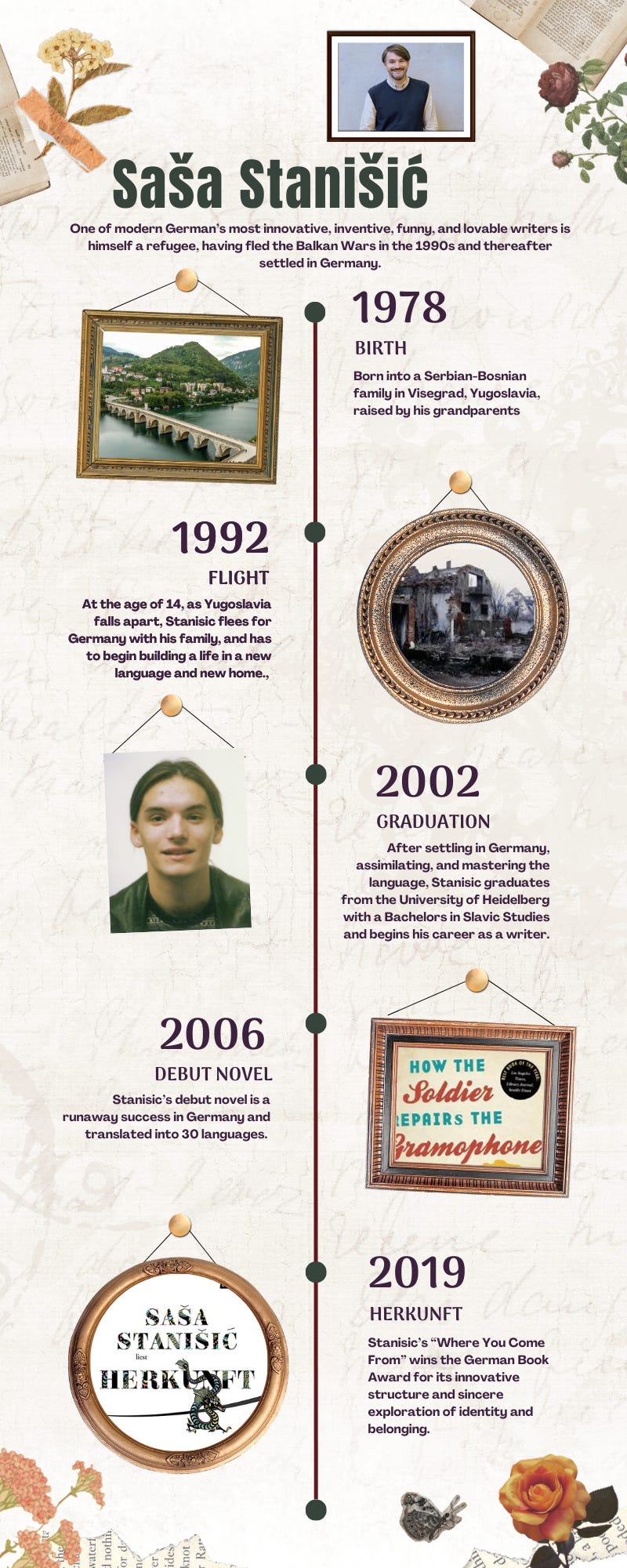
Ronan also wrote a short article about Saša Stanišić with a summary inforgraphic - A quick 2 minute read.
Few people master their native tongue. Let alone go on to innovate in another that they started learning as a teenager. Such is the story of Germany and Bosnia's literary star, Saša Stanišić. In 1978, the year of his birth, Yugoslavia was stable and thriving. The economy was growing, citizens could travel without restriction. Citizens were afforded freedom of speech unseen in the Warsaw Pact countries. And, Tito remained the country's uniting figure.
This relatively tolerant society. Seen especially in multi-ethnic towns in Bosnia fostered relationships between Yugoslavia's different ethnic groups,. Resulting in the marriage between Stanišić's father, a Serb, and his mother, a Bosniak. After Tito's death, however, a tide of competing nationalisms began to grow. Leaving children like Sasa Stanisic unsure where they were supposed to stand in the burgeoning tension. When he was 13. The country's leaders reached an impasse, and the Yugoslav parliament collapsed. A brief war broke out in the Republic of Slovenia in 1991. Shortly followed by war in Croatia and Bosnia, where Stanišić and his family were living. As the conflict gained genocidal intensity and reached his hometown. Višegrad, his family had no choice but to leave the country. They fled to Germany in 1992. 14-year-old Saša Stanišić had to start a life from scratch, in a new language, surrounded by new people, in a new place. He graduated in 1992 from the University of Heidelberg with a degree in Communications and English. He embarked on his career as a writer. His three novels, all written in German, touch on concepts of home, identity, and language. Additionally, they have reached bestseller status,. They have been translated into dozens of languages. And, all won prestigious awards, most recently the German book prize.
Thank you for reading a A4R 🎨 Post. Don’t forget to tell your friends and family.