

Summary:
Traditional security, focused solely on deterring threats, is reactive and ineffective. True security, the author argues, is built during the "morning after" conflict through long-term investment in five pillars: ecological stability, public health, economic equity, democratic infrastructure, and community cohesion. Moving beyond a fortress mentality, we must treat prevention as vital infrastructure. Younger generations are already leading this shift, proving that the most effective way to build a resilient future is by integrating healing into work.
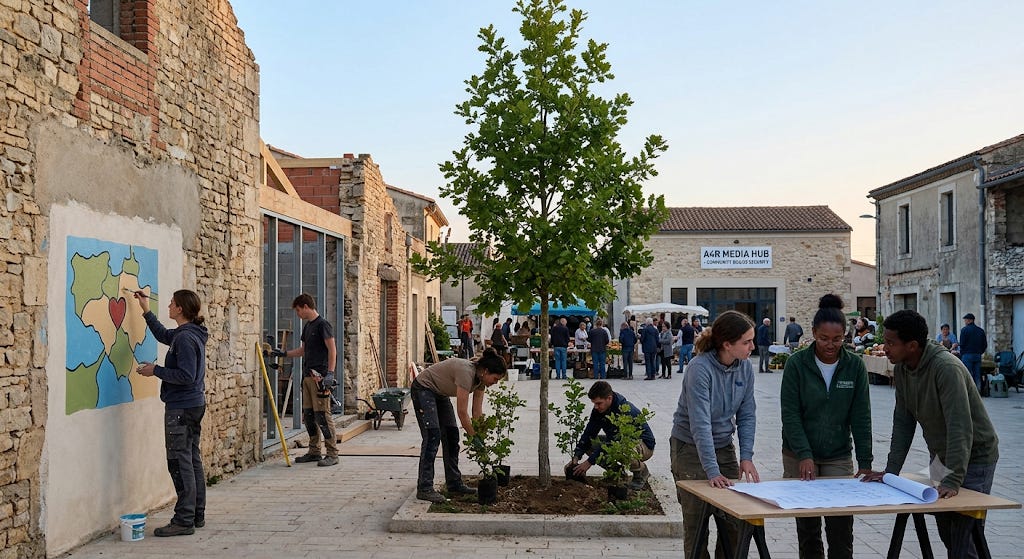
What Comes After the Guns Fall Silent
The hardest, most important security work begins the day the fighting stops — and a generation of young correspondents is already documenting it.
There is a moment, in almost every conflict, that gets very little attention. It is not the outbreak and it is not the ceasefire. It is the long, unglamorous morning after — the years in which a society decides, often without quite realizing it is deciding, whether it will actually become whole again or merely stop bleeding.
I have spent much of the past year reading dispatches from that morning after, written by the young correspondents of the A4R Media Hub. A piece on Bosnia, three decades on, asking what its rebuilding really taught us about recovery economies. A piece on Syria, arguing that the measure of return is not how fast refugees come home but whether there is anything to come home to. A piece on post-genocide Rwanda and the quiet machinery of risk-sharing and resilience. A piece on Lebanon, where a dollarized survival economy keeps daily life moving while the deeper work of recovery stalls.
Read together, these articles do something I find genuinely important. They relocate the question of security away from the place we usually keep it — the border, the budget line, the weapons system — and put it where it actually lives: in whether ordinary people can rebuild a life worth defending.
That relocation is the heart of the work I do, and the heart of the book I have spent the last several years writing. And it is why I wanted to write for this audience in particular.
The thing we keep getting backwards
We have inherited a definition of security that is almost entirely about threat. Security, in this telling, is the capacity to deter, repel, or destroy a danger. It is fundamentally reactive, and it is enormously expensive, and — this is the part we rarely say out loud — it does very little to produce the conditions under which danger becomes less likely in the first place.
The correspondents writing for A4R keep stumbling onto the alternative, because the alternative is what they can actually see on the ground. When a community in Bosnia or Rwanda begins to knit itself back together, the security that results does not come from a fence. It comes from work people can do, from institutions they can trust, from health they can rely on, from a story about themselves that includes a future. Those are not soft accompaniments to real security. They are the real security. Everything else is the alarm system on a house no one can afford to live in.
I have come to think of genuine security as resting on five interdependent pillars: ecological stability, public health capacity, economic equity, democratic infrastructure, and community cohesion. None of them is optional. A society can have a formidable military and almost none of these, and it will not be secure — it will be brittle, one shock away from the morning after. And a society that invests in these five things steadily, before the crisis, buys itself something we badly undervalue.
We undervalue it because prevention is invisible. The pandemic that doesn’t happen, the conflict that doesn’t reignite, the neighborhood that doesn’t empty out — none of these generate headlines, and none of them photograph well. But the economics are not subtle.
Across the research, money spent preventing conflict before it erupts returns on the order of sixteen dollars for every one spent cleaning up afterward. We persist in paying the sixteen.
Why this is a generational argument
Here is what I want to say directly to the younger readers of this platform, because I think it is the most honest thing I can offer. You did not create the polycrisis you are inheriting — the climate disruption, the conflicts, the fraying institutions, the displacement that A4R exists to document. But you are going to be the ones living in the morning after, and, increasingly, the ones doing the rebuilding. And the most encouraging thing I have observed, across a global network of tens of thousands of people working in the impact economy, is that the generation now entering this work is not waiting for permission to begin.
The A4R model is itself a small, sharp example of this. A correspondent learns to report by reporting on something that matters; the skill and the impact are built in the same motion. That is exactly the logic the regenerative economy runs on — the refusal to separate doing well from doing good, training from contributing, the personal from the structural. The young people I encounter are, as a rule, allergic to that separation in a way that older generations had to be argued into. For them it is simply obvious that an economy which destroys the conditions of life is not a successful economy that happens to have side effects.
It is a failing economy that has not yet finished failing.
I coined the term impact entrepreneur back in 2011 to name a person who builds enterprise in service of that recognition — who treats healing, rather than mere extraction, as the point.
Fifteen years later, what was a fringe idea has become a field. And the people now joining that field in the largest numbers are precisely the ones reading platforms like this one.
What the rebuilding actually asks of us
If you take the morning-after seriously, a few things follow that I think are worth naming for anyone deciding where to put their working life.
The first is that recovery is not charity; it is infrastructure. Maud Sayers’s argument about Syria — that you cannot measure return by speed, only by what people are returning to — is an economic argument, not a sentimental one. The capacity to absorb people back into a functioning life is built with the same five pillars, whether you are recovering from a war, a flood, a pandemic, or the slow violence of a collapsing currency.
The second is that prevention and recovery are the same skill, pointed in two directions. The community resilience that lets Rwanda share risk after catastrophe is the same resilience that, built earlier, would have lowered the odds of catastrophe. This is why I have come to believe security should be approached less as a fortress to be manned and more as a service to be delivered — defense reconceived as the active, ongoing provision of the conditions that make people safe, rather than the threat of force against the conditions that make them afraid.
The third — and this is the one I most want to leave with younger readers — is that the work is available now. You do not need to wait until you are credentialed, senior, or certain. The A4R correspondents I have had the privilege of editing this year were not waiting. They picked the hardest possible subject — what happens after the worst happens — and they reported it with rigor and care. That is the whole move. That is how the morning after gets rebuilt: by people who decide, before anyone gives them leave to, that the rebuilding is theirs to do.
Laurie Lane-Zucker is the founder and CEO of Impact Entrepreneur, a global media and community platform serving the impact economy across more than 200 countries, and the proud content partner of the A4R Media Hub. He coined the term “impact entrepreneur” in 2011. His new book, The Impact Entrepreneur Breakthrough: A Field Manual for the Regenerative Economy (Berrett- Koehler), arrives September 1, 2026 — a practical guide to the redefinition of security and the rebuilding work described here. Learn more at impactentrepreneur.com/breakthrough.
Thank you for reading an A4R 🎨 Post. Don’t forget to visit our gaming art here. Every purchase scales our impact and pays our bills.
