


In this episode Priya discusses Josef Herman. She is a student journalist with us on a placement organised by the Oxford University Career Services. This article was edited using You.com.
🎧 listen to Priya's backstory here - she discusses her motivation & research as well.
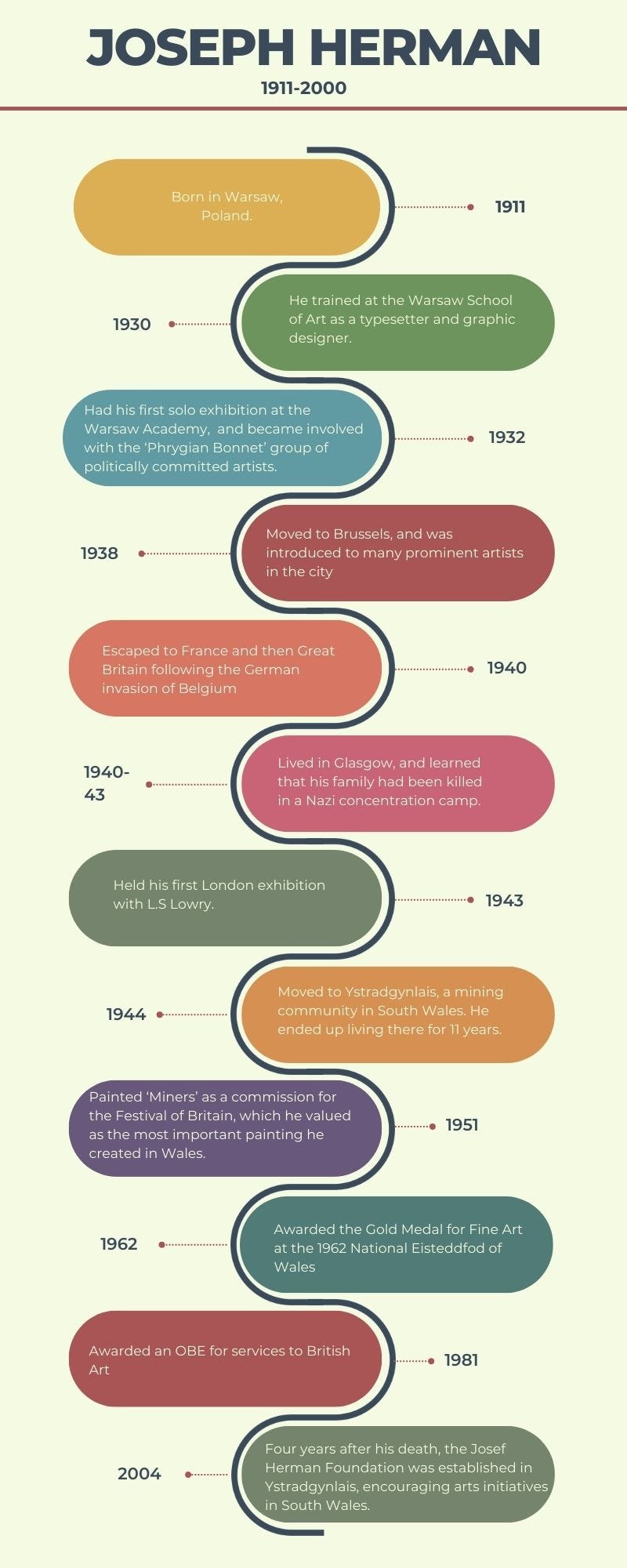
Priya also wrote a short 2 min read article about Josef with a summary inforgraphic.
Josef Herman, born in 1911, grew up in a Polish-Jewish, Yiddish-speaking community in Warsaw. His humble upbringing influenced his fascination with laboring subjects, particularly the Welsh miners of Ystradgynlais, who became the focus of his most renowned works.
Herman received training at the Warsaw School of Art and became a member of the left-wing group of artists called the "Phrygian Bonnet." As a left-wing Jewish artist, he faced threats from the Nazi party and sought refuge in Brussels in 1938. Departing from his family for the final time, he expressed in an article, "I am sure they did not hear my last goodbye... I did not hear theirs."
Following the Nazi invasion of Belgium, Herman left Brussels and settled first in London before eventually making Glasgow his home. It was in Glasgow that he reunited with fellow Polish-Jewish artist Jankel Adler. However, this period was also marked by the devastating news that his family in Poland had perished in a concentration camp, relayed to him by the Red Cross.
Herman's life was characterized by constant movement, as described by his son, David Herman. After spending only three years in Glasgow, he moved to London, where he held an exhibition alongside L.S. Lowry. Just a year later, what was meant to be a two-week trip to Wales transformed into an 11-year-long stay among the mining community of Ystradgynlais.
In Herman's obituary, Agi Katz affirmed that "Herman's central theme was working men: the eternal ritual of labor." Embraced by the Ystradgynlais community, he earned the nickname "Joe Bach" (meaning "Little Joe"). Monica Bohn-Duchen described the community as a surrogate home for Herman, replacing the one he had lost forever in Poland. In 1951, he received a commission to paint a mural for the Festival of Britain, resulting in the creation of "Miners," one of his most notable works. Herman considered it to be one of the most significant pieces of art he had ever produced.
From depicting scenes reminiscent of his childhood in the Yiddish-speaking community of Poland to capturing the plight of working-class men in South Wales, Herman's art is profound, evocative, and symbolic. It offers a poignant glimpse into the experience of a refugee.
Thank you for reading a A4R 🎨 Post. Don’t forget to visit our gifts shop here. Every purchase scales our impact and pays our bills.
