


In this article Tomas discusses the post conflict region of Basque Country. He is a student journalist with us on a placement organised by the Department of War Studies, King's College, London. This article was self-edited.
🎧 listen to Tomas’ backstory here - he discusses his motivation & research as well.
Has reconciliation been achieved in the Basque Country?
It was the writer and thinker Miguel de Unamuno who once wrote: Let us strive to be parents of our future rather than children of our past. This phrase, which resonates in any community who has been hindered by division and conflict, hides a premise; to build a future, reconciliation must be the cornerstone. Therefore, in the delicate tapestry of the Basque Country, reality is not different; certain threads must be carefully woven to mend the fabric of unity and peace.
The historical context.
In the Basque Country, a Spanish region with its own national identity, the battle to guard its richness and heritage exacerbated during the dictatorship, degenerating into the creation of ETA, a terrorist group that committed terrorist attacks in Spain for almost 40 years. This group, who shifted from cultural and political activism to violent militancy, experienced growing opposition within the public to their actions, exacerbated as Spain progressively transitioned into a Democracy. Since the ceasefire announcement in 2011, efforts to effectively reintegrate in the political scene of the territory were in place; although, it must be noted that since 1978 ETA have had a political arm called Herri Batasuna and did not explicitly condemned violence. In 2003 it was reformed under the name Batasuna, nevertheless it was banned by the Spanish government, subjected to allegations of support to terrorism and therefore to ETA. Years later, in 2011, in response to the illegalization of Batasuna and its predecessors, a new party called Sortu was founded.
Sortu marked a significant break with the past because it explicitly rejected violence and was allowed to register as a political party after assurances that it would not have ties to ETA. Moreover, Sortu became part of the coalition EH Bildu, which is combination of left-wing Basque nationalist parties that advocates for Basque independence but strictly through peaceful and democratic means. It has been a significant political force in the Basque Parliament and in broader Spanish politics, distancing itself from ETA’s violent legacy even though it has avoided to explicitly categorized the past actions of the group as terrorism. This remains to be a heated issue within Spanish society and has been severely criticized.
From 2011 onwards.
In the 2011 local elections, Bildu garnered 26% of the vote in the Basque region, making it the second-largest party behind the Basque Nationalist Party (PNV). They achieved representation in most councils within the Southern Basque Country, including significant wins in major cities such as San Sebastián, Bilbao, Vitoria-Gasteiz, and Pamplona. During the 2012 Basque regional election, EH Bildu obtained 25.0% of the votes, earning them 21 parliamentary seats. They were the slate with the most votes in Guipúzcoa and second in Álava and Vizcaya. EH Bildu's performance continued to be significant in subsequent elections, such as int he 2014 European Parliament elections where their coalition led by Josu Juaristi gained the first force in Guipúzcoa and Álava and second force in Vizcaya and Navarra. The 2015 and 2016 local elections saw EH Bildu as the second force in the Basque Country, with the PNV losing institutional power to Bildu in Guipúzcoa. In addition, in the 2020 Basque regional election, EH Bildu topped its best historical result, benefiting from the collapse of the United We Can–United Left alliance. They emerged as a significant force, reflecting an increase in seats and percentage of the vote, indicating the party's growing influence in the region.
From that point onwards, EH Bildu's ascent has been a significant factor in the political discourse of the Basque Country, demonstrating the electorate's shifting attitudes towards issues such as Basque nationalism and independence. The party's performance in elections and the increasing number of seats they hold in the regional parliament underscore the importance of EH Bildu in shaping Basque politics. On the other side, the PNV, which is a moderate nationalist party, experienced a decline in its results, raising questions about its future positioning and necessity for alliances. These outcomes have put the PNV in a challenging situation where it may need the support of other parties, like the PP, for key positions in local governance.
Current situation.
Everything stated so far, the tendency that EH Bildu has undergone these past years, has crystallized in the 2024 Basque regional elections, held on April 21, 2024, which resulted in a highly competitive outcome between the Basque Nationalist Party (PNV) and EH Bildu each securing 27 seats out of the total 75 in the regional parliament. This tie confirmed the progressive political shift that was being signaled in the Basque Country, exemplified in EH Bildu acquisition of six more seats in parliament in comparison to their result in the previous election.
The outcome indicates a pluralistic voter base and the need for agreements in order to govern, with the PNV likely needing the support of the PSE-EE to form a government. Besides, the close election underscores the diverse political landscape in the Basque Country and sets the stage for complex political negotiations and collaborations in the coming term. Moreover, the voter turnout was notably high at 51%, which was an increase from previous years, indicating heightened public interest and engagement in the regional political process. This robust participation might be seen as a reflection of the Basque population's keen interest in shaping their governance amidst evolving political dynamics. In definitive, the overall results and the competitive nature of the elections highlight a vibrant democratic process in the Basque Country, with significant implications for the region's future political and social development.
The implications for reconciliation.
As aforementioned, the current political landscape in the Basque Country has been marked by the 2024 regional election results, where pro-independence sentiments, represented by EH Bildu, have seen a surge. Undoubtedly, the current scenario sparks meaningful questions that need deeper reflection. How can a political party allegedly connected to a former terrorist group be inserted in the public sphere and democratic life of a country? Is it a necessary step to have these parties between the political options civil society can choose from?
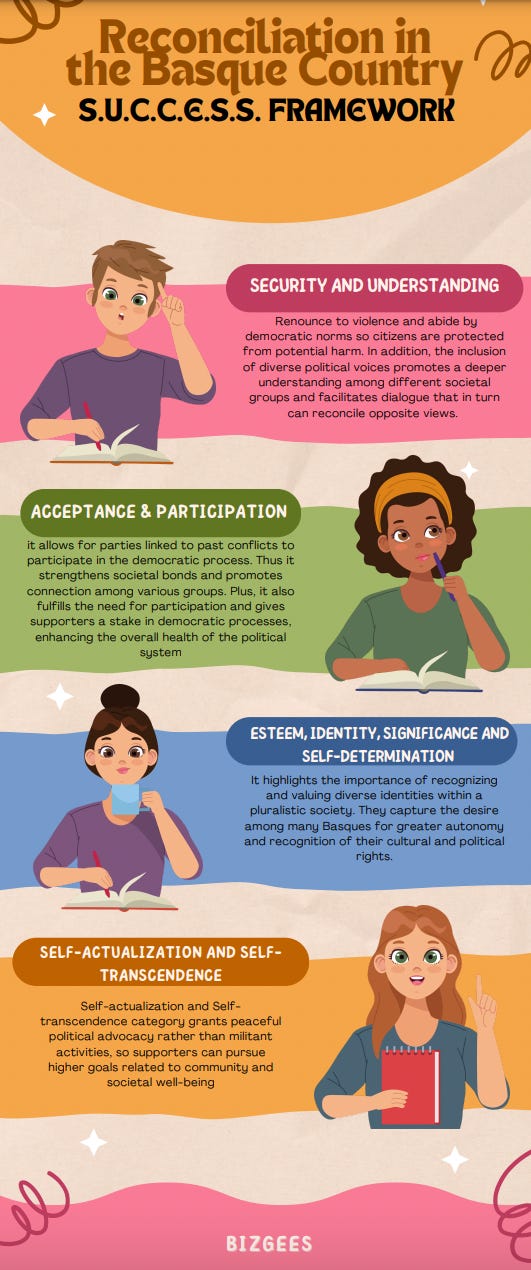
In the end, the questions about how a political party with historical ties to a former terrorist group can be integrated into the democratic fabric of a country is complex and multifaceted, as it involves a delicate balance of legal, ethical, and political considerations. Thus, to properly examine those dimensions, the framework provided in the mnemonic S.U.C.C.E.S.S. strategy developed by Dr. Kenneth Acha becomes handy, which is a set of guidelines intertwined with the well-known pyramid of Maslow.
In essence, it deals with what are catalogued as 7 fundamental categories of needs, all of them mandatory to achieve a live enriched with meaning. Besides, it is noted that the framework is a fantastic tool to influence people and therefore their future. Using it to develop an analysis of the Basque Country yields a fruitful result with key takeaways for both policy makers and the civil society.
First, it addresses the Security and the Understanding categories; by requiring the renounce to violence and enforcing the necessity to abide by democratic norms, citizens are protected from potential harm. In addition, the inclusion of diverse political voices promotes a deeper understanding among different societal groups and facilitates dialogue that in turn can reconcile differing views.
Next, through the Connection (Love) and Acceptance category, it allows for parties linked to past conflicts to participate in the democratic process. This inclusivity strengthens societal bonds and promotes connection among various groups, moving toward societal reconciliation. Plus, this also fulfills the need for participation and gives supporters a stake in democratic processes, enhancing the overall health of the political system. Moreover, the categories of Esteem, Identity, Significance and Self-determination are useful to highlight the importance of recognizing and valuing diverse identities within a pluralistic society. They capture the desire among many Basques for greater autonomy and recognition of their cultural and political rights.
At last, the Self-actualization and Self-transcendence category grants peaceful political advocacy rather than militant activities, so supporters can pursue higher goals related to community and societal well-being.
In summary, the integration of parties like EH Bildu into democratic processes, under stringent legal and ethical guidelines anchored in the 7 fundamental human needs, is not only a reflection of a mature democracy but also a practical approach to mitigating conflict. It underscores a belief in redemption and transformation, providing a pathway for those who previously supported or engaged in violence to adopt peaceful means to achieve their political goals. The approach leads to a more stable and inclusive political system, where grievances are addressed through dialogue rather than conflict, and people are not asked to forget but to dialogue.
Looking ahead.
In definitive, the success of EH Bildu indicates a potential realignment of political alliances and the need for new policy discussions that prioritize the integration of diverse views within Basque society. As politics in the Basque Country and the broader Spanish state are deeply interwoven, the outcome of these elections is likely to have a profound impact on the process of reconciliation, addressing past conflicts, and forging a shared vision for the future.
As has been seen, through the framework of Acha, steps in the right direction for reconciliation are being done with the inclusion of EH Bildu. Notwithstanding, the potential impact of these efforts will largely depend on the policies and strategies adopted by the new leadership and their willingness to engage in dialogue and negotiate with all segments of the Basque population. There is a shared responsibility from all the sectors in the population to construct the future.
Thank you for reading an A4R 🎨 Post. Don’t forget to visit our gift shop here. Every purchase scales our impact and pays our bills.
