


Click here to play & learn.
Back Story
Art providing hope: meet the Artist whose cartoons help transform the lives of Syrian children
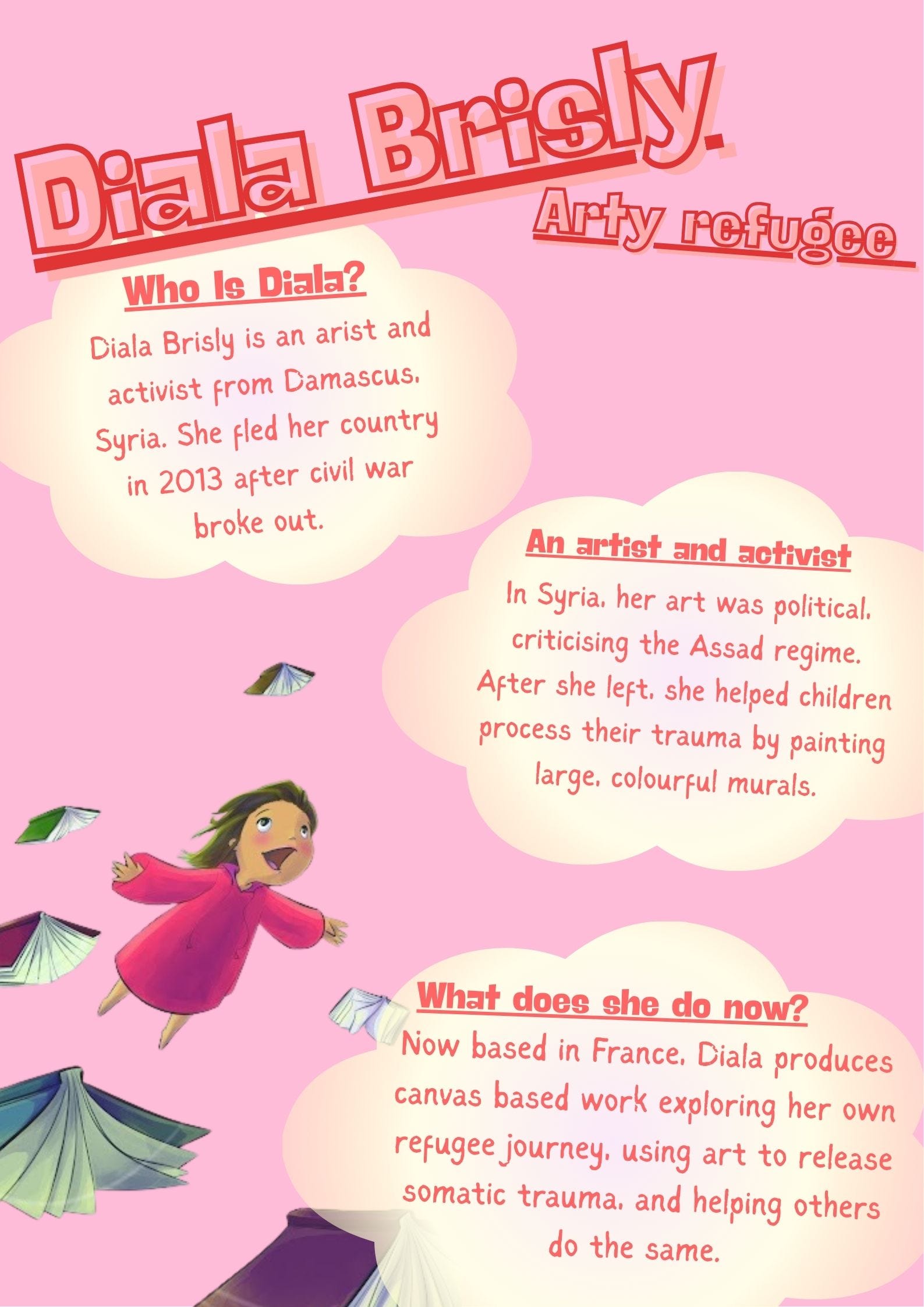
When civil war broke out, Diala Brisly fled Syria, travelling to Turkey and Lebanon where she found a new mission: helping children heal. Campaigning against the Assad regime showed Diala the power of her drawings and in Beirut she found that painting bright murals collaboratively with children gave them space to process their trauma. She is a driving force behind the children’s magazine Zayton and Zaytonah (Olive and Olivia) which reminds Syrian children how to be normal despite their experiences. Her work often serves as a visual education for children in refugee camps with little access to school. Diala now resides in southern France where she has shifted her focus to her story and personal experience as a refugee. Her work grapples with themes like ‘survivor’s guilt’ and what it means to carry your culture around with you.
The conflict in Syria:
The situation in Syria started to become dangerous for Diala following the outbreak of the civil war. Pro-democracy demonstrations, linked to the Arab Spring in 2011 were met by brutality from the government. The Free Syrian Army was formed by defectors from the Syrian Army with the aim of overthrowing the Assad regime, an authoritarian dictatorship headed by President Bashar al-Assad. His rule was characterised by violence and oppression and during the war itself he is thought to have uses chemical weapons, and dropped barrel bombs on civilian neighbourhoods, including schools and hospitals. Through 55,000 images, the Caesar files document the industrial scale torture and execution in state prisons sanctioned by the regime. Assad’s forces made use of ‘starve or surrender’ tactics, placing entire cities under siege. According to UN agencies, 13-14 million Syrians were either forced to flee the country or were internally displaced within Syria. To counteract the violence rescuers like the White Helmets and civilians like Diala worked to preserve lives and alleviate suffering. Assad’s regime was overthrown in 2024 by the rebel group Hay’at Tahrir al-Sham (HTS) which took Damascus and while many Syrians have returned to their homeland, the situation there remains fragile.
Diala’s story:
Beginning her career working for the children’s animated TV channel “Spacetoon”, Diala soon realised the power of art and began publishing work with a political message. Openly criticising the Assad regime would have been incredibly dangerous and have immediately flagged Diala to the Mukhabarat [the secret police] who monitored the ‘electronic army’ of activists; using the pseudonym Elvis Presley, Diala was able to safely circulate her work online. She describes being the only activist amongst her artistic circle; in an interview with The New Arab, she revealed “Out of the ten artists I shared a studio with in Damascus, I was the only activist. It was really sad but they were terrified.”
In 2012, after a massacre in Daraa orchestrated by the government in which over 400 civilians were murdered, Diala began signing her work with her name. She explained that she was no longer content to hide behind a pseudonym, feeling that this was “shameful” when others were being arrested and dying in prison. Her series “Leave Us” was inspired by the events in Daraa; her first, signed illustration of a boy who had lost his arm and leg is accompanied by the words “leave my last hand and leave us.” With this work, Diala challenged Assad’s ‘protection’ narrative, showing that the government was not keeping people safe but actively destroying their future. Fear of being arrested because of her political work was partly what motivated her to leave Syria.
It was not the fear of arrest for her activism alone which motivated her flight. She describes an event which brought the reality of the danger all too close. While smuggling medical supplies under the seat of her car, Diala was stopped at a checkpoint. If they had found the medical supplies she was hiding, she would have been killed. The Assad regime declared bringing medical aid to rebel areas was a “terrorist act” and those found with supplies were executed; the Mukhabarat would use temporary checkpoints to catch people. Fortunately for Diala, the soldier was drunk and let her go because she was a “beautiful woman.” The fact that her life had hung on the whim of a drunk soldier made her realise she had to get out. She left Syria, first fleeing to Istanbul, Turkey, and then to Beirut, Lebanon.
In Istanbul, she began production of the children’s magazine Zayton and Zaytonah [Olive and Olivia], an apolitical magazine smuggled into Syria to restore a sense of normalcy. In Lebanon, she found more ways to use her artwork as a force for good; she offered to paint a mural for a woman opening a library for displaced Syrian children. Diala had the idea to do more of this, voluntarily, in refugee camps. She painted murals with children and offered art therapy workshops. She admits that often this was challenging; the children she was working with were scarred from their experiences and often drew pictures of the horrific things they had seen and been through. Diala’s aim was to help them shift their focus towards hope for the future though images featuring constellations and fun cartoon characters that fly through the sky. She wished to provide a break from the dullness of the refugee camps with bright, joyful colours; tents, mud and skies formed a world of grey, mirroring the dire situation the refugees found themselves in. Diala’s murals created a sensory escape.
Before her passport expired, Diala was keen to leave Lebanon. “I didn’t have a good childhood. So, I want to have a good rest of my life” she says in an interview. She found a host family in Pelissanne, France, where she moved after securing a visa. There she was granted the NORA scholarship, a prestigious residency programme designed to support people with refugee status in France, providing a stable environment and links to French artistic networks. In France, Diala found that she could continue her work with refugees without being physically present. Working on canvas, she creates work that can be shipped to Lebanon, continuing to provide hope and escapism for displaced children. Her artistic journey became more personal, moving away from digital tools and street art towards slower canvas work. Her participation in major European exhibitions, such as the Institut du Monde Arabe in Paris solidified her status as a global artist.
Since moving to Europe, Diala has been able to create varied work, much of which explores her experiences and her relationship to her past. In 2023, Diala spent two-month in Rotterdam as part of the INSPIRE Rotterdam Residency which focussed on collective healing from war related trauma. Her project “You Are Not Alone” invites people to connect with their “bodies, memories, emotions, and each other.” It emphasises the way trauma is stored in the body, her art provides a guide to releasing it. One poignant image features a woman, crouched down with a large snail sitting on her head. The snail is a metaphor for the burden which refugees carry, of all that has been left behind, as well as the culture and language; refugees are homeless in the traditional sense but bring with them their entire world. Diala’s artwork is no longer just for children; it touches an audience of all ages.
Diala’s story is one that many refugees resonate with. Her desire to bring aid to those who have been failed by the leaders who should protect them ultimately had to come second to protecting her personal safety. Grappling with survivor’s guilt, she remained committed to helping others, if not in the form of medical supplies, then through emotional healing. Her artwork tells the story of her activism, her humanitarian work, and finally her journey to personal healing, working through somatic trauma alongside others from the refugee community. A survivor of unimaginable hardships, Diala’s dedication and resourcefulness, her continued commitment to hope is testament to the transformative power of art to bridge the gap between trauma and healing.

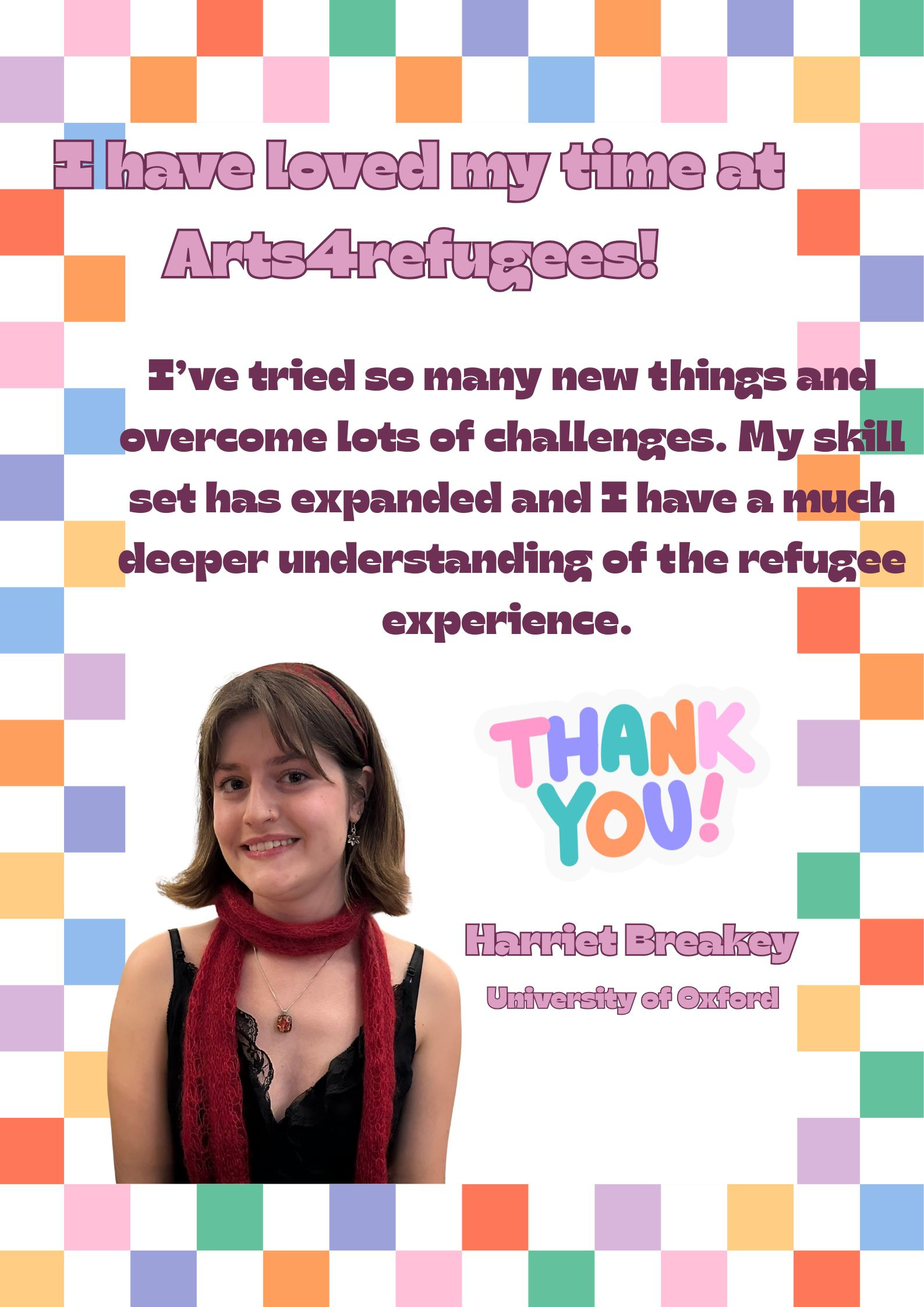
In this post Harriet highlights the arty refugee experience of Diala Brisly. She is a citizen journalist on a placement with us organised by Oxford University Career Services. She also organised the micro game to make the journalistic experience interactive.
Thank you for reading an A4R 🎨 Post. Don’t forget to visit our gaming art here. Every purchase scales our impact and pays our bills.
