


Click here to play & learn.
Back Story
Bearing Witness: Art, Memory, and Survival in the Work of Vann Nath
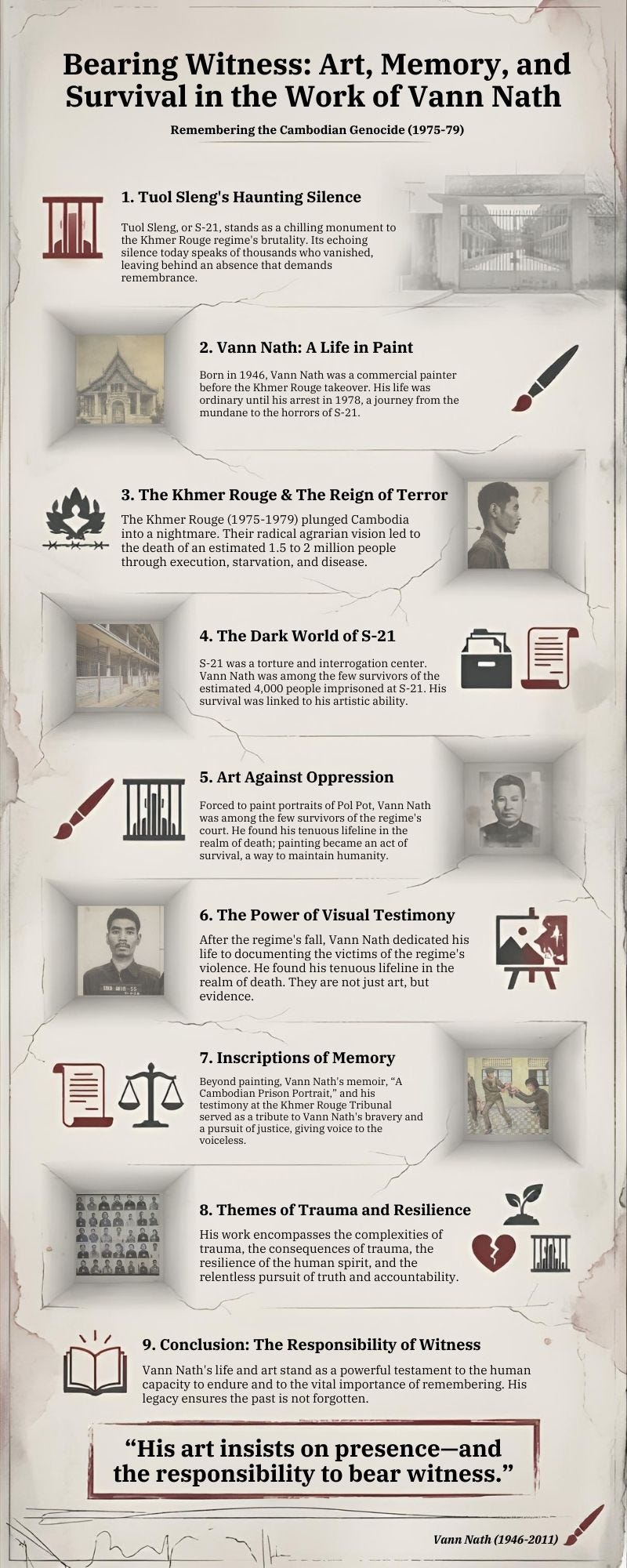
The first thing that struck me at Tuol Sleng was the quiet. Not the reverent hush of a memorial, but the stillness of an abandoned schoolyard at midday. A basketball hoop leaned over cracked concrete; climbing frames remained where children had once played. Without context a visitor might assume the place had simply been deserted. On closer inspection, a photograph fixed to the wall revealed the truth: the same hoop had been used to suspend prisoners during interrogation. Tuol Sleng, or Security Prison 21, was a secondary school in central Phnom Penh until 1975, when the Khmer Rouge converted its five buildings into one of the regime’s most notorious prisons. It is within this space that the work of Vann Nath acquires its full force.
Born in 1946 in Battambang province, Vann Nath grew up in a poor rural family with little access to formal education. He came to art outside institutional pathways, first encountering it through temple murals and later developing his skills through informal study. Before 1975, his life followed a modest course: he painted landscapes and cinema posters, earning a living within a small, local art economy.
This trajectory was violently interrupted by the rise of the Khmer Rouge. On 17 April 1975, the Communist Party of Kampuchea seized Phnom Penh, inaugurating a radical political project under Pol Pot. Influenced by Maoist agrarianism, Stalinist centralisation, and anti-colonial nationalism, the regime sought to dismantle urban society and construct a rural, classless utopia. Cities were evacuated, intellectuals targeted, and perceived enemies systematically eliminated. In 1978, Vann Nath was arrested and accused of being an “enemy of the state.” He was transferred to S-21, the regime’s central interrogation and torture facility, where an estimated 15,000-20,000 prisoners were processed. Only a handful survived.
Vann Nath’s survival was precarious, and in many ways accidental, but it was also bound to his ability to paint. His name appeared on an execution list before being altered by the prison commandant, Kang Kek Iew, with the brief instruction: “Spare the painter”. He was then made to produce portraits and sculptures of Pol Pot—images designed to project authority and reinforce the regime’s ideology. In this context, art became something else entirely: not an act of expression, but a form of labour imposed under threat. It was both a tool of the system that imprisoned him and the reason he remained alive.
Following the Vietnamese overthrow of the Khmer Rouge in 1979, Vann Nath emerged as one of the twelve recorded survivors of S-21. He was found at Choeung Ek shortly after the prison was abandoned, severely weakened from starvation and illness, and later began to recover in Phnom Penh. But rather than distancing himself from what he had lived through, Nath returned to it repeatedly within his work. In the early 1980s, when the new authorities began commissioning visual documentation of Khmer Rouge crimes for the newly opened Tuol Sleng Genocide Museum, he was asked to reconstruct scenes from memory. These works draw directly on what he witnessed inside the prison: interrogation rooms, shackled prisoners, forced confessions, and executions carried out in and around S-21.
He often worked from specific, repeated memories revisiting the same spaces and events in multiple paintings. The result is less interpretation than reconstruction—images that sit closer to testimony than representation. Nath recollected “I told myself I did not care any longer because I could die any time and I’d rather die than live in such conditions.” Many of these works remain displayed in the former classrooms of the Tuol Sleng Genocide Museum, installed within the very rooms they depict. During my visit to S-21, that proximity becomes difficult to hold at a distance. The boundary between image and site collapses: what is shown is also what surrounds you. The paintings give form to experiences that resist articulation, while also insisting on the physical reality of what occurred within those walls.
Elsewhere in the prison, inscriptions remain carved into the walls, carefully indexed, ‘Building C, First Floor, Room Four, Cell Nine, South Wall, Square 264’. One engraving reads: ឥឡូវនេះខ្ញុំចង់និយាយលាហើយ…ខ្ញុំសូមជូនពរឱ្យអ្នករស់នៅដោយសុភមង្គល “Now I would like to say goodbye…I wish that you live in happiness”. Another, carved into the same wall, one brick across, reads: អូយសម្លាញ់អើយ លាហើយ “Oh my darling, goodbye”. These lives are not merely statistics; they are people reaching forward through time, leaving proof that they have lived, loved, and hoped someone would one day bear witness.
Vann Nath’s work operates within the same impulse. His paintings return to these same spaces of detention and disappearance, refusing abstraction in favour of precise, located memory. Like the inscriptions on the walls, they function as acts of witness—ensuring that what happened is neither reduced to numbers nor allowed to fade into distance.
Nath’s 1998 memoir, A Cambodian Prison Portrait, was among the first detailed written accounts by an S-21 survivor. At a time when documentation was limited and many perpetrators remained unchallenged, the text provided an essential narrative record, bridging personal memory and historical archive. This commitment to testimony extended beyond both memoir and artistic production into direct engagement with justice processes. In collaboration with filmmaker Rithy Panh, Nath appeared in the documentary S-21: The Khmer Rouge Killing Machine (2003), which brought together former prisoners and guards. In the film, Nath confronts those who once oversaw his imprisonment. His questioning is measured, controlled, yet persistent: less an expression of anger than a demand for acknowledgment.
Later, Nath became the first survivor of S-21 to give testimony during proceedings at the Extraordinary Chambers in the Courts of Cambodia in 2009. On Day 35 of the trial (29 June 2009), he appeared as a prosecution witness against the former prison chief Kaing Guek Eav, known as Comrade Duch, and his paintings were entered into evidence. While photography captured the Khmer Rouge takeover of Phnom Penh in April 1975, the years that followed were defined by the systematic restriction of imagery as a means of control. Within this evidentiary gap, his paintings moved beyond personal recollection to become part of the tribunal record, submitted as visual evidence in the prosecution of Duch.
S-21 resists the distancing effect of history. What occurred there was neither inevitable nor confined to a singular moment in the past. Standing within its rooms, and seeing Nath’s works in situ, makes clear that memory alone is insufficient; it must be actively maintained, interrogated, and sustained. Through his painting and writing, Nath turned survival into testimony that continues to shape how the Cambodian genocide is understood. His work prevents the past from settling into abstraction, insisting instead on presence—the visibility of what occurred, and the responsibility of those who encounter it to bear witness.

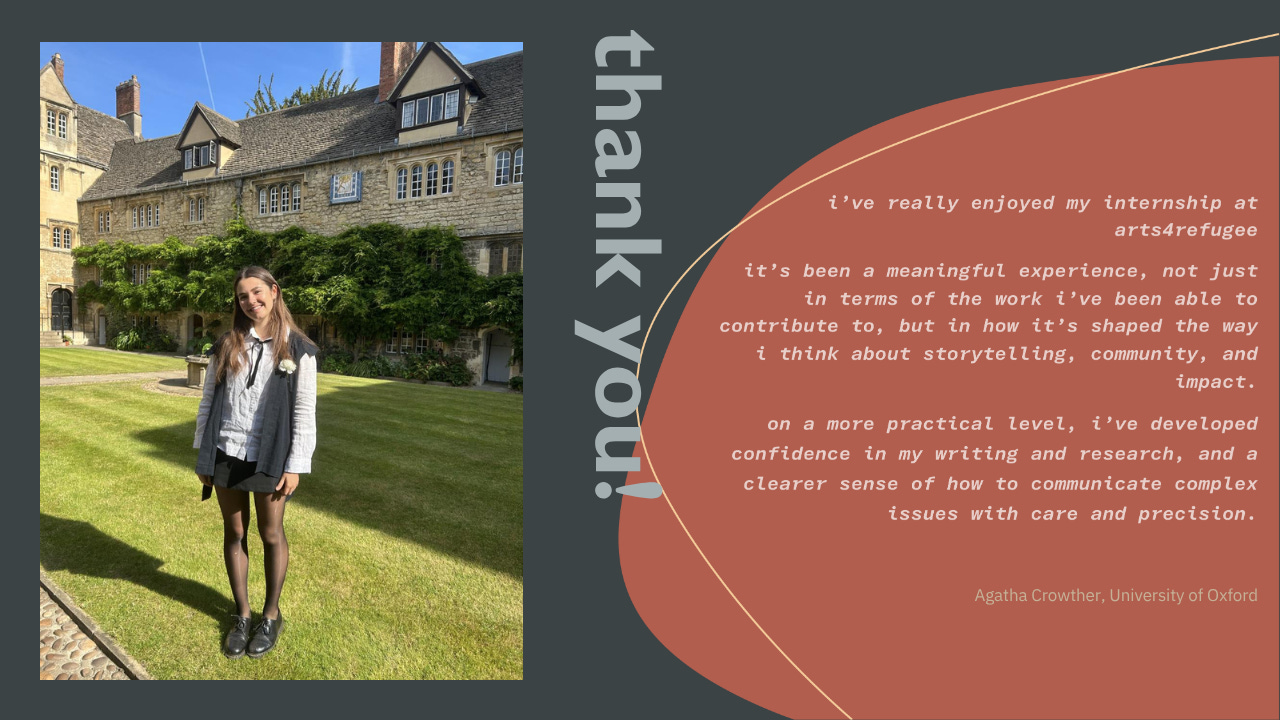
In this post Agatha highlights the arty refugee experience of Vann Nath. She is a citizen journalist on a placement with us organised by Oxford University Career Services. She also organised the micro game to make the journalistic experience interactive.
Thank you for reading an A4R 🎨 Post. Don’t forget to visit our gaming art here. Every purchase scales our impact and pays our bills.
