

Aleppo, an 8,000-year-old trade hub, faces a $31 billion recovery after years of war. While historic souks slowly reopen under new leadership, stability remains fragile. Private groups now lead the rebuilding of shattered landmarks. True recovery requires more than bricks; it means restoring the social trust of a fragmented population.
Aleppo rebuilds: recovery after ruin
Reconstruction is slowly renewing life in the ancient city of Aleppo - yet any sense of renewal is cautious, shaped by years of devastation, and now punctuated by fresh outbreaks of violence. The city’s recovery is not a story of swift transformation, rather of uneven progress, where visible signs of rebuilding coexist with deep uncertainty about the future.
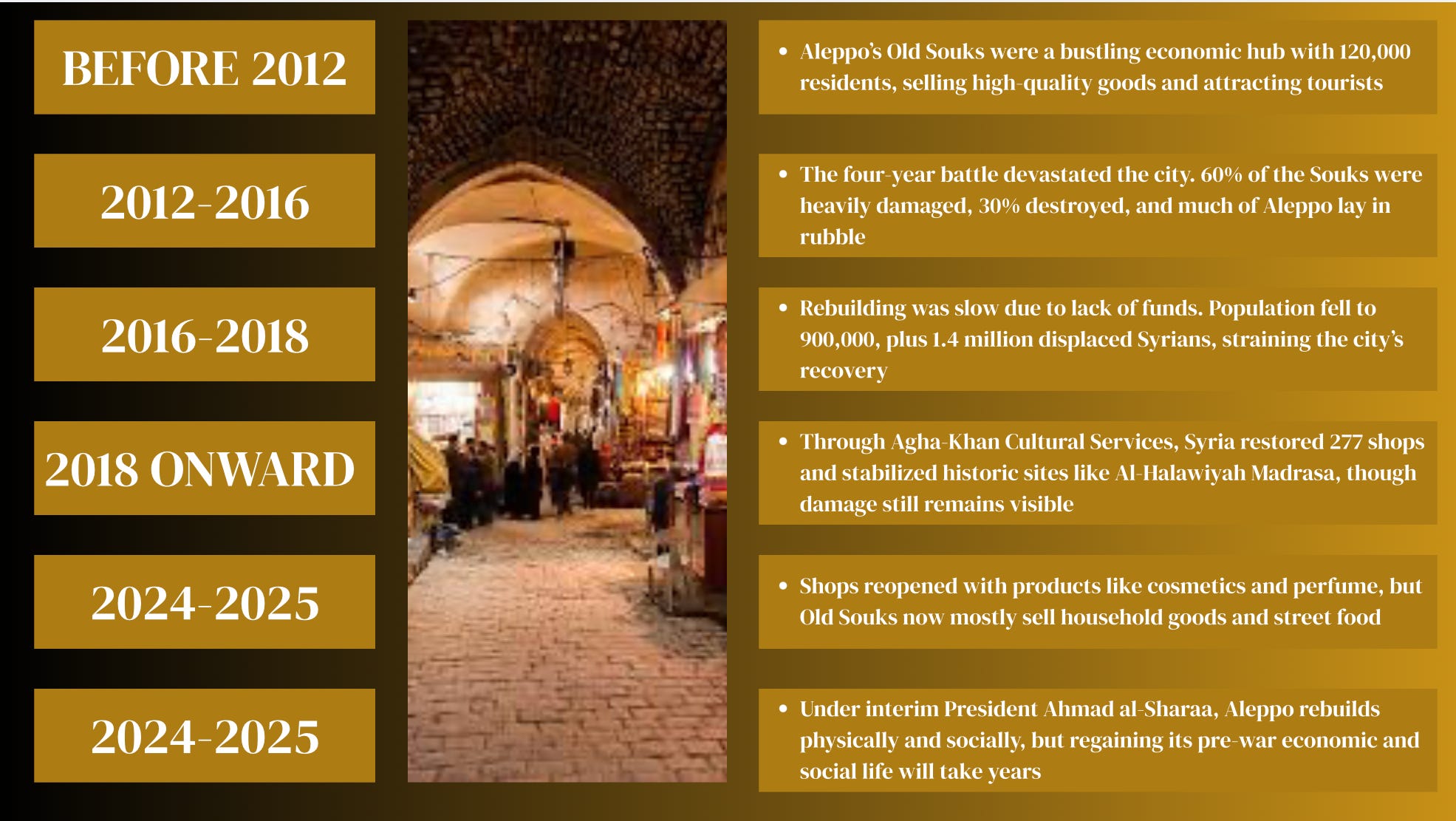
Just a few years ago, Aleppo’s historic souks lay in ruins. Today, parts of them are stirring with life again. Newly rebuilt shops have begun to reopen, including cosmetic stores displaying items that would once have been unthinkable. Under the rule of former president Bashar al-Assad, many imports were heavily restricted; now, goods like perfume and CDs line the shelves. Even the way people pay has changed: customers increasingly use US dollars, something which, not long ago, could have led to imprisonment. These shifts reflect the broader changes that followed the fall of the previous regime on December 8th 2024, after 14 years of a destructive and devastating civil war.
Aleppo, Syria’s second-largest city - and long considered economic heart - has endured immense destruction. One of the world’s oldest continually inhabited cities, with a history stretching back roughly 8,000 years, it has faced countless crises, Yet few compare to the scale of devastation wrought by the Syrian Civil War. Even recent clashes - like the deadly fighting in mid-January between government forces and the Kurdish-led Syrian Democratic Forces - serve as reminders that instability has not fully receded.
The most catastrophic period came after the four-year Battle of Aleppo, from 2012-2016. Often referred to as ‘Syria’s Stalingrad,’ the conflict was marked by relentless bombardment and brutal urban warfare, with entire neighbourhoods being reduced to rubble. Today, the physical scars of that period remain starkly visible. Hollowed-out buildings, shattered facades, and vast stretches of concrete debris continue to define much of the city’s landscape. Reconstruction has been slow, hindered by a severe lack of funding and the sheer scale of damage. A World Bank report published in October estimated the cost of destruction across the Aleppo governorate at $31 billion - higher than in any other region of Syria.
At the centre of Aleppo’s historical and cultural identity lies its Ancient City, a UNESCO World Heritage Site since 1986. This area, parts of which date back to the 11th century, contain some of Syria’s most treasured landmarks, including the Citadel and Umayyad Mosque. Before the war, it drew hundreds of thousands of tourists each year, and was home to around 120,000 residents. Its beating heart was the Old Souk - a labyrinthine, covered marketplace, stretching over 13 kilometres. Divided into specialised sections known as khans, the souk once offered everything from fine Persian silk to the city’s framed, handmade soaps.
Today, that world has profoundly changed. The population of the Ancient City has fallen to an estimated 40,000. According to UNESCO, around 60% of the souk suffered significant damage during the war, with another 30% being completely destroyed. What was once a thriving commercial hub is now only partially restored, its revival piecemeal and fragile.
In the absence of substantial state funding, much of the reconstruction has fallen to private organisations and non-governmental groups. Among the most prominent is the ‘Aga Khan Cultural Services - Syria’, which is part of the wider Aga Khan Development Network. Since beginning its work in the Old Souk in 2018, the organisation has restored 277 shops, many of which have been returned to their original owners. These efforts have played a crucial role in reviving economic activity, even if only on a limited scale.
Restoration work has also extended to some of the city’s historic buildings. The Al-Halawiyah Madrasa, for example, stands as a powerful symbol of both endurance and vulnerability. A site with more than 1,000 years of history, it has survived centuries of upheaval; yet today, it is in a precarious state. Wooden supports brace its weakened structure, preventing collapse, while bullet marks scar its walls. The building embodies the broader condition of Aleppo itself: still standing, but deeply injured.
Despite these efforts, the city is still far from reclaiming its former status as Syria’s economic centre. The nature of commerce in the souks has changed significantly. Where traders once specialised in high-quality goods and artisanal products, many shops now sell basic household items or inexpensive street food. The shift reflects both reduced purchasing power, and the altered priorities of a population focused on day-to-day survival.
Underlying this fragile recovery is a pervasive sense of uncertainty. Many residents remain wary, waiting to see how the country will evolve under its new leadership. The political transition has brought change, but not yet stability. For those who have returned or chosen to remain, the future remains unresolved.
The demographic transformation of Aleppo also adds another layer of complexity. Before the war, the city’s population stood at around three million. Today, estimates suggest that only about 900,000 people remain. At the same time, approximately 1.4 million internally displaced Syrians have arrived from other parts of the country. This dramatic shift has reshaped the city’s social fabric, with communities that developed over generations now being fragmented, replaced, or reconfigured by waves of displacement.
Rebuilding Aleppo is not simply a matter of bricks and mortar. It also involves restoring a sense of social cohesion that has been deeply eroded. Trust, shared identity, and community networks take far longer to rebuild than physical structures. In many ways, this invisible reconstruction is the most challenging of all. However, there are undeniable signs of progress. Shops reopening in the souk, heritage sites undergoing restoration, and the gradual return of economic activity all point towards a city attempting to recover.
Aleppo’s story is one of cautious hope. Neither defined by destruction nor emerged from its shadow, the city’s recovery remains incomplete. For now, Aleppo stands in a state of transition - caught between a past marked by profound loss, and a future still uncertain.
Backstory -
In this post Kiana highlights the post conflict expereine of Aleppo. She is a citizen journalist on a placement with us organised by Oxford University Career Services.
A4R 🎨 Media is a user supported publication. Don’t forget to subscribe.