

Summary
Gen Z often face unique pressures navigating intergenerational trauma and identity. This post explores why “off-the-shelf” mental health support often fails and explains how a personalized, concierge-style triage process can help young adults find the right professional fit for their specific story.
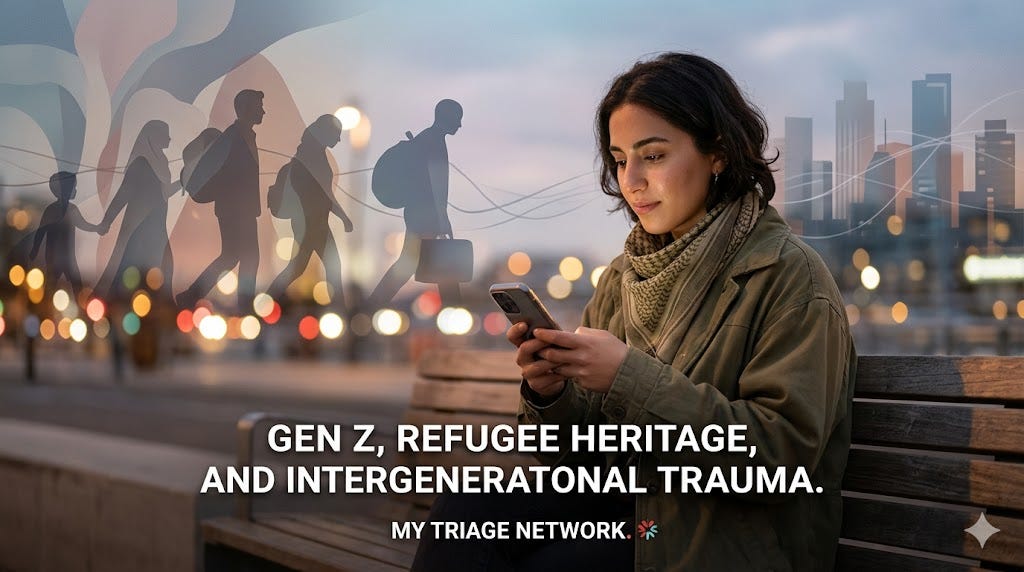
Gen Z, Refugee Heritage, and Intergenerational Trauma: Finding the Right Mental Health Support
Gen Z and Mental Health
Gen Z has grown up in a world of constant information, online communities, creator culture, global crises, and fast-changing identities. Many young people do not just want to be “spoken to”; they want information that feels conversational, relevant, participatory, and real. The A4R Media piece on Gen Z describes this well: this is a generation shaped by digital participation, peer-to-peer storytelling, gaming culture, social platforms, and co-created narratives rather than one-way information from institutions.
For 18- to 28-year-olds, mental health support often needs to recognise that life is not happening in neat boxes. Stress can come from identity, family expectations, money, work, study, relationships, racism, displacement, climate anxiety, social media, loneliness, trauma, or feeling caught between cultures. UNICEF’s 2025 youth mental health report found that many young people feel overwhelmed by world events, and only around half know where to find mental health resources.
For young people from refugee, migrant, or displaced families, the picture can be even more layered. You may be second or third generation and still feel the emotional impact of histories you did not personally live through: war, persecution, forced migration, racism, poverty, loss, silence, survival, or family separation. This does not mean you are “damaged” or destined to struggle. It means your nervous system, family story, and identity may have developed around pressures that need understanding.
What intergenerational trauma can mean
Research on refugee families shows that trauma can affect more than one generation. Trauma in refugee families can be linked with psychological distress in the next generation, although the pathways are complex and shaped by family, social, cultural, and environmental factors. Furthermore, children of trauma-affected refugee parents can be at increased risk of mental health difficulties, particularly when parental PTSD affects family functioning and emotional communication.
This is sometimes called intergenerational trauma. It does not mean trauma is automatically “passed down” like a fixed inheritance. It means that what happened to previous generations can shape the emotional climate of a family. It may show up through silence, fear, pressure to succeed, difficulty talking about feelings, overprotection, mistrust of services, shame, guilt, or a sense that you must be “strong” because your parents or grandparents survived worse.
How trauma can show up
Trauma symptoms can look different for different people. NICE describes PTSD symptoms as including re-experiencing, avoidance, hyperarousal, emotional numbing, dissociation, and changes in mood and thinking. In everyday language, this might mean nightmares, flashbacks, panic, feeling constantly on edge, avoiding reminders, zoning out, feeling detached, struggling to sleep, becoming irritable, feeling numb, or finding it hard to trust people.
But trauma is not the only common issue for Gen Z. Many young adults also struggle with anxiety, low mood, loneliness, burnout, identity stress, relationship difficulties, body image concerns, self-doubt, neurodivergence-related stress, and uncertainty about the future. Social media can help people find support and language for their experiences, but it can also create comparison, information overload, and confusion about what kind of help is actually right. Digital engagement can feel negative for some young people, while also helping others find connection and mental health support.
What Kind of Mental Health Support Is Available?
This is where getting the right support matters. Not every problem needs the same professional. Some people may benefit from therapy for anxiety or depression. Others may need trauma-focused therapy, such as trauma-focused CBT or EMDR, both of which are included in evidence-based PTSD guidance. Some may need a psychologist, psychotherapist, psychiatrist, family therapist, neurodiversity-informed clinician, or culturally sensitive practitioner. Some may not know what they need yet - only that they are not coping, or that something feels stuck.
That uncertainty is exactly why My Triage Network can help. A good triage process is not about pushing you into the first available appointment. It is about listening carefully, understanding what is going on, and helping you find the right kind of professional for your needs. This can reduce the stress of searching through endless directories, guessing at titles, or messaging people who may not be the right fit.

For young people whose stories involve trauma, culture, migration, family pressure, neurodivergence, or identity, the “right fit” matters even more. You may need someone who understands trauma without pathologising your culture. You may need someone who can work with family patterns without blaming your family. You may need someone who understands that being high-functioning on the outside does not mean you are fine on the inside. Getting the right support is not about proving that your pain is “bad enough.” It is about having someone help you make sense of what you are carrying and what kind of help would actually support you.
You do not have to work it out alone
Gen Z is often described as anxious, overwhelmed, or too online. That is too simplistic. Many young people are trying to process personal, family, and global stress while also building a life in uncertain times. The question is not whether you should “just cope.” The question is: what happened, what are you carrying, and who is the right person to help you carry it differently?
If you feel lost about where to start, the first step is to Get Triaged. You do not need to know the exact diagnosis or therapy model. You only need to know that you would like support that fits your story, your background, and your needs. From there, the right signposting can help you move from confusion to clarity and from coping alone to being properly supported.
———
Key Takeaways
The Gen Z Context: Traditional mental health resources often lack the conversational, participatory, and culturally sensitive approach required by Gen Z.
Intergenerational Trauma: Trauma isn’t just “passed down” as a fixed inheritance; it shapes the emotional family climate, requiring practitioners who understand complex cultural and historical contexts.
The “Right Fit” Matters: For those carrying the weight of migration or identity-based stress, successful therapy depends on finding a practitioner who understands trauma without pathologizing the individual’s background.
Triage as a Solution: A concierge-style triage process bridges the gap between feeling overwhelmed and accessing evidence-based support by carefully matching individual needs to specific clinical expertise.
Actionable First Step: You do not have to navigate the search for support alone; a professional triage consultation provides the clarity needed to move from confusion to the right therapeutic care.

Dr. Patapia Tzotzoli AFBPsS, HCPC registered, EuroPsy, BSc (Hons) (UEL), MSc (Oxford), MPhil (Cambridge), DClinPsy (KCL)is a UK-trained, Clinical Psychologist with 20 + years of experience. She is the Director of My Psychology Clinic, where she offers one-to-one online therapy tailored to a select clientele.
She is also the Founder of My Triage Network, where she provides free consultations and personalised introductions to trusted UK-based mental health professionals for anyone seeking assessments or therapy. Looking for support? Start with a free consultation - Get Triaged today.
My Triage Network works closely with A4R Media Hub to inform and educate GenZ about their mental health needs and how best to access the right support for their unique story.
Thank you for reading an A4R 🎨 Post. Don’t forget to visit our gaming art here. Every purchase scales our impact and pays our bills.
