


Click here to play & learn.
Lucian Freud's Portrait Memory Game is an interactive memory game centered around the renowned artist's portraits. Players match images to reveal Freud's art style and attention to detail, immersing them in his work. After completing the memory game, players can have a conversation with Freud’s AI character, offering insights into his touching story. This feature makes the game both educational and engaging.
- Amira Ismael
Back Story
The 1930s and 1940s was a period clouded by fear and anxiety for refugees. Jews, amongst many other groups, were prosecuted by the rapid rise of Nazism and Fascism across Europe. Between 1933-1945, more than 340,000 Jews fled persecution in Germany and Austria across Europe.
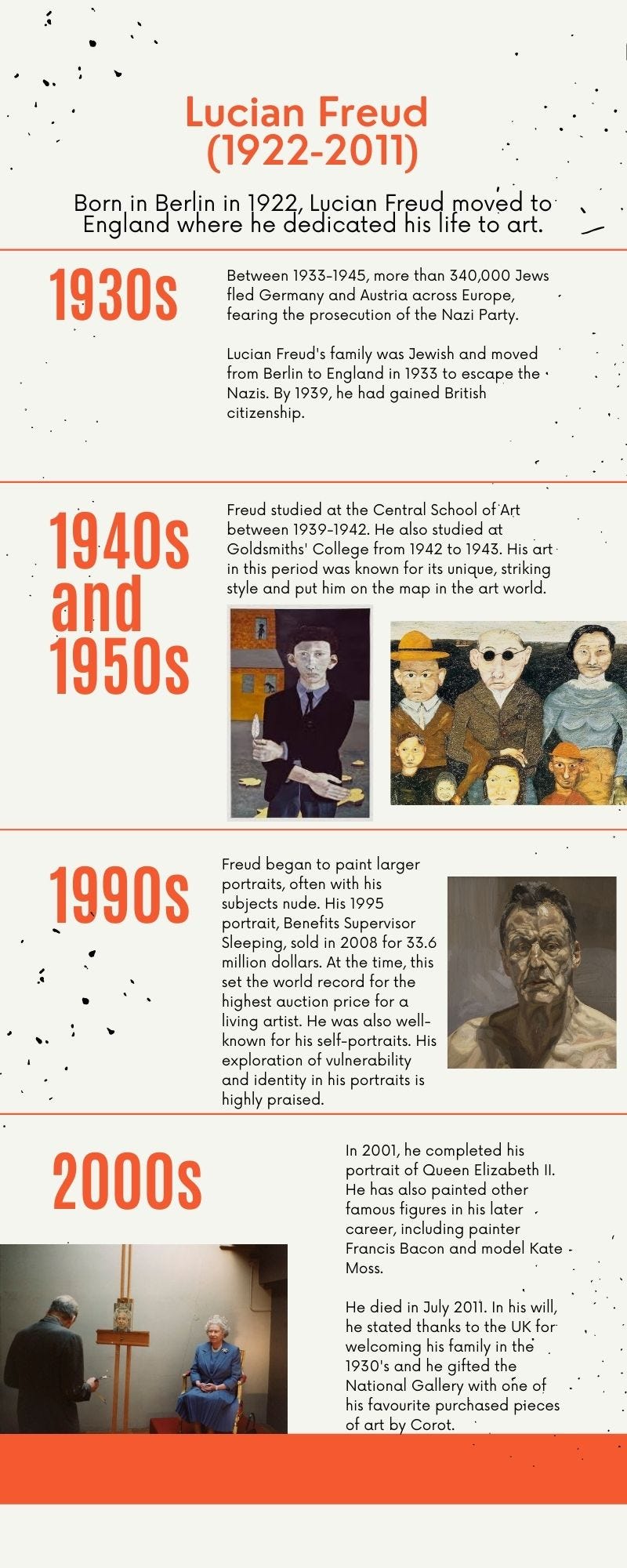
In 1922, Lucian Freud was born in Berlin and came from a Jewish family. In 1933, Nazi Germany began a more aggressive policy against Jews as Adolf Hitler rose to power. The same year, Freud’s uncle was one of the first to die under suspicious circumstances and his family then decided to flee to England, fearing prosecution from the Nazis themselves.
Freud arrived in England as an outsider and unable to speak the language as he began his education at Dartington Hall School. By 1939, Freud became a British citizen and started his studies at the Central School of Art in London until 1942 before attending Goldsmiths’ College in 1942-3. He served briefly in the British Merchant Navy during the Second World War before being discharged.
Freud contributed to society through his lifelong dedication to art. His paintings were mostly portraits and often nudes, revealing a sense of vulnerability in his subjects. Freud completed many self-portraits as well, exploring wider narratives of identity and psychological self-examination. By the 1950s, his style developed into using larger and rougher brush strokes and is known to be some of his best work. In October 2011, his 1952 Boy’s Head sold for almost $5 million. His art career continued to rise in the 1950s and by 1989 Freud was shortlisted for the Turner Prize. He reached his height in the 1990s and even completed a portrait of Queen Elizabeth II in 2001. Tate director Sir Nicholas Serota praises his paintings that “redefined British art”.

In this article Henry highlights the arty refugee experience of Lucien Freud. She is a student journalist with us on a placement organised with Oxford University Career Services. The article was converted into a micro using Rosebud.ai by Eric. He is a front end developer placed by Virtual Internships to build his Ai & Gaming Dev experience.

Thank you for reading an A4R 🎨 Post. Don’t forget to visit our gift shop here. Every purchase scales our impact and pays our bills.
