


In this episode Thomas discusses Oskar Kokoschka. He is a student journalist with us on a placement organised by the Oxford University Career Services. This article was edited using Lex.page
🎧 listen to Thomas's backstory here - he discusses her motivation & research as well.
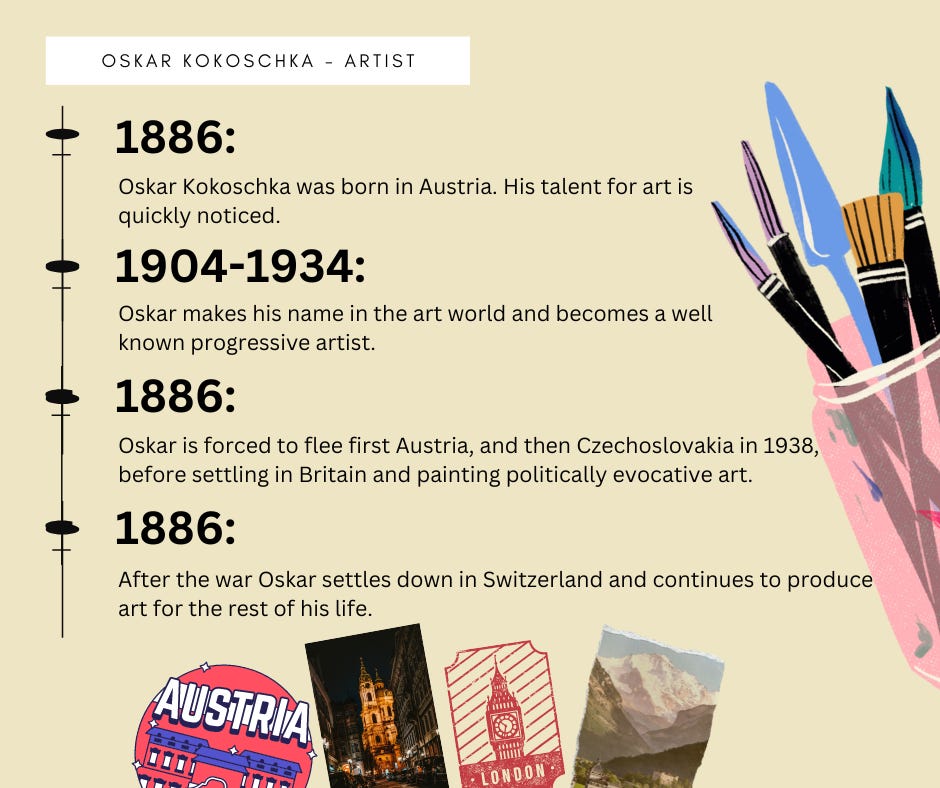
Thomas also wrote a short 2 min read article about Oskar Kokoschka with a summary inforgraphic.
The Second World War engulfed Europe in the 1930s and 40s. In 1939, Britain marked the beginning of the struggle against the Nazi regime. For Oskar Kokoschka, 1939 was another tragedy.
He was born in Austria in 1886 and showed artistic talent. Against his parents' wishes, he applied to an art school in Vienna and received a scholarship. Introduced to progressive circles, he made a name for himself as an artist blending traditional elements in new ways. For example, his portraits followed traditional rules but used harsh, vivid colors. Art critics see this as a representation of the anxiety felt by Kokoschka and his group of artists.
The anxiety was well-founded. Kokoschka fled Austria in 1934 for Prague, and then Czechoslovakia in 1938 for Britain after being branded a degenerate by the Nazis. He formed a strong connection in Prague and was anguished to see the allied powers abandoning Czechoslovakia in the Munich agreement, which inspired one of his most famous paintings: the crab. This work depicts Neville Chamberlain as a crab, refusing to stop a man from drowning – the man representing Czechoslovakia. Kokoschka continued painting politically evocative works through the war, as well as landscapes.
When the war ended, he moved to Switzerland, where he lived and produced art for the rest of his life. His art and story evoke the powerful declaration after the Second World War: “Never Again!”
Thank you for reading a A4R 🎨 Post. Don’t forget to visit our gifts shop here. Every purchase scales our impact and pays our bills.
