


In this episode Eve discusses Thomas Mann. She is a student journalist with us on a placement organised by the Oxford University Career Services. This article was edited using Gemini Ai.
🎧 listen to Eve’s backstory here - she discusses her motivation & research as well.
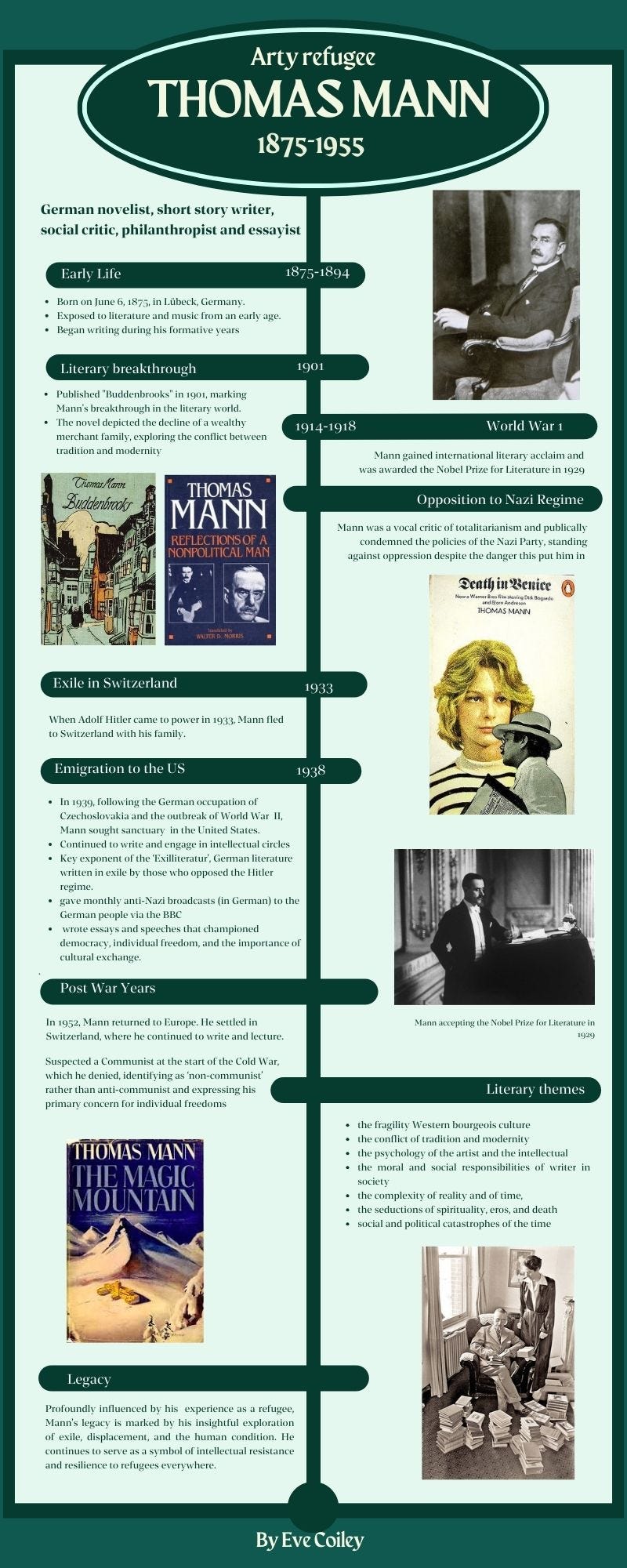
Eve also wrote a short 2 min read article about Thomas Mann with a summary inforgraphic.
A famous writer named Thomas Mann was forced to flee his home country because of his beliefs. This experience as a refugee greatly impacted his writing and made him a symbol of fighting for what's right, even in tough times.
Early Life and Success:
Born in 1875, Mann became a celebrated author with his novel Buddenbrooks in 1901. He believed in freedom of thought and basic human values. This put him at odds with the Nazi party, who rose to power in Germany in the 1930s.
Exile and Continued Writing:
In 1933, the Nazis took away Mann's German citizenship, forcing him and his family to flee. He settled in Switzerland, where he continued writing and speaking out against fascism (a system of government that controls everything). With the threat of the Nazis growing, he moved again to the United States in 1938.
A Leader in Exile:
In California, Mann became a leader among other Germans who had fled the Nazis. He spoke up for democracy and the importance of sharing cultures. Even though he was displaced, he kept using his writing to fight against tyranny (cruel and unfair rule).
Exploring the Human Condition:
Being a refugee changed Mann's writing. He started focusing on how people deal with difficult times. His stories combined rich narratives with deep questions about life. His later works often dealt with themes of exile, feeling like an outsider, and cultural identity. He was also interested in how history repeats itself. In his book Joseph and His Brothers, he uses stories from the Bible to show how humans struggle with the same issues over and over again.
The Impact of War:
World War II, a massive war that caused great suffering, led Mann to explore the moral consequences of political unrest. His book Doctor Faustus uses a fictional story to symbolize the deal the Nazis made with evil and to question whether artists have a responsibility to use their talents for good.
A Lasting Legacy:
Thomas Mann's story as a refugee writer shows how powerful literature can be, even in the face of great difficulty. His dedication to human values and his belief in the power of art to make a difference remind us of the importance of freedom of thought, even in the darkest of times.
Thank you for reading a A4R 🎨 Post. Don’t forget to visit our gifts shop here. Every purchase scales our impact and pays our bills.
