In this episode Airin discusses Tenzing Rigdol Airin is studying for a Master’s in Japanese Studies. She is a student journalist with us on a placement organised by the Oxford University Career Services. This article was edited using the Hemingway Editor.
🎧 listen to Airins backstory here - she discusses her motivation & research as well.
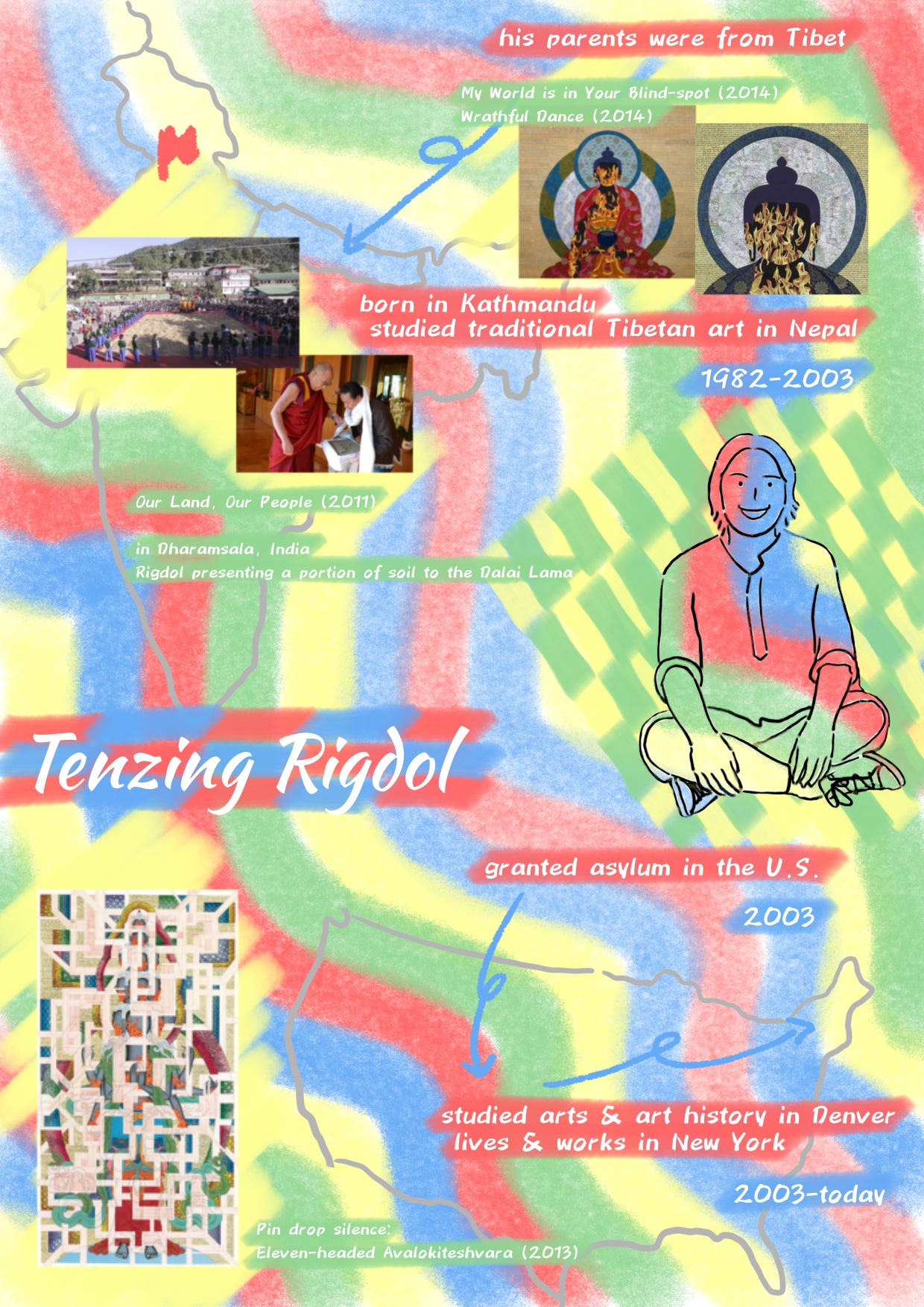
Airin also wrote a short article about Tenzing Rigdol with a summary inforgraphic - A quick 2 minute read.
Tenzing Rigdol was born in Kathmandu, Nepal in 1982, to Tibetan parents who fled from Tibet. Starting from 17, he studied traditional Tibetan art. This included thangka (a type of Buddhist painting on cotton or silk). Sand mandala (sandpainting characterised by the creation and destruction of mandala symbols). And, torma (dough and butter sculptures used as offerings).
In 2002, Rigdol and his family were granted asylum in the United States. After receiving his diploma in thangka painting in Kathmandu in 2003, he moved to Denver. Here he studied painting and drawing as well as art history at the University of Colorado Denver. His works were first exhibited in Denver, and later in other cities across the country. In 2008, he displayed his works for the first time outside the U.S. – in Hong Kong and Shanghai, China. A year after that, he had his first exhibition Experiment with Forms at Rossi and Rossi in London. His painting Pin drop silence: Eleven-headed Avalokiteshvara was acquired by the Metropolitan Museum of Art in New York in 2014.
Going beyond painting and sculpture. Rigdol has also made a foray into video-making, writing, and poetry. He introduces Tibetan Buddhist symbolism into contemporary art. He also reflect on issues in Tibetan philosophy as well as contemporary Tibet. In his works My World is in Your Blind-spot and Wrathful Dance, he discusses the topic of Tibetan self-immolations. He does this by portraying the Buddha in flames. In 2011, he created an art installation named Our Land, Our People. This is an attempt to connect the Tibetan exiles to their homeland. He transported 20,000 kilograms of soil from Tibet to Dharamsala, India. He invited the emigres to step on the soil, and also presented a portion of the soil to the Dalai Lama.
He currently lives in New York.