

In this episode Elysia discusses Behjat Omer Abdulla He is a student journalist with us on a placement organised by the Oxford University Career Services. This article was edited using Hemingway editor.
🎧 listen to Elysia's backstory here - she discusses her motivation & research as well.
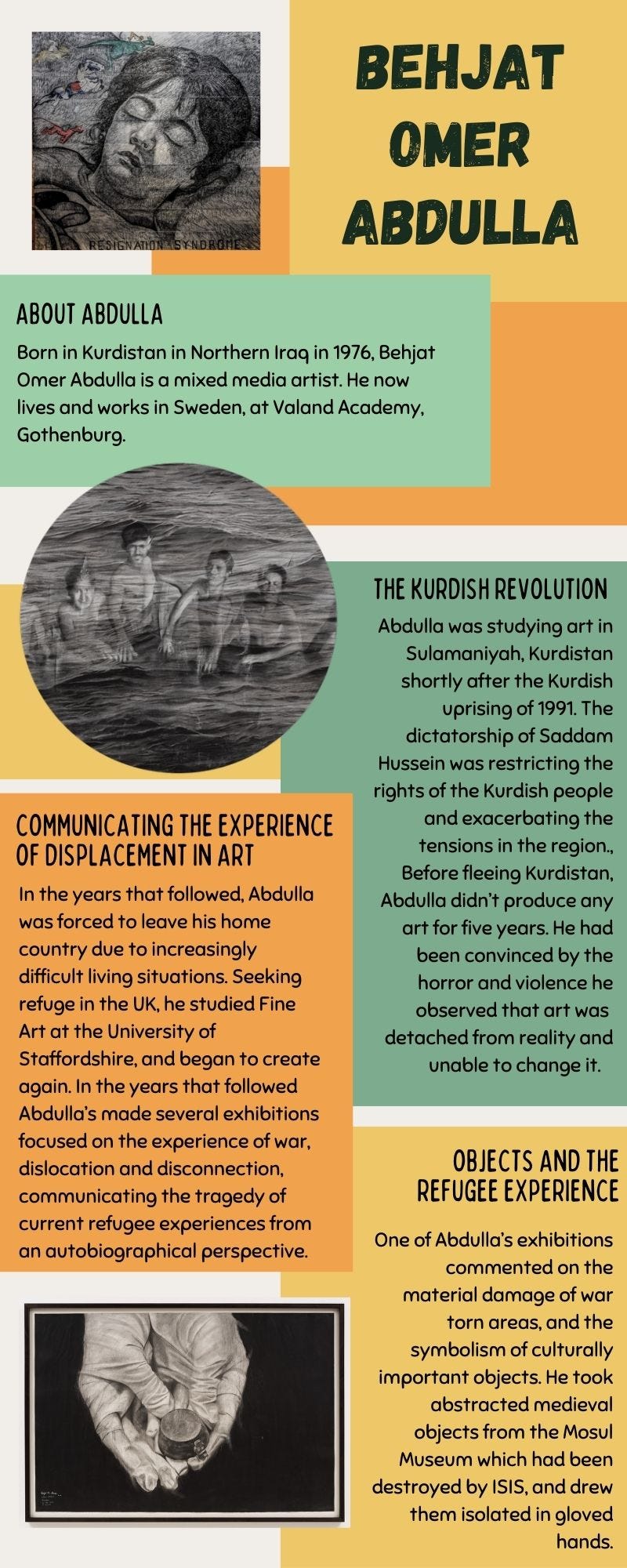
Elysia also wrote a short 2 min read article about Behjat Omer Abdulla with a summary inforgraphic.
Behjat Omer Abdulla is a mixed media artist from Kurdistan, Iraq. He uses his art to convey his experience of displacement and shed light on current refugee struggles. Forced to flee due to escalating political tensions culminating in the Kurdish Uprising of 1991. Abdulla sought refuge in the UK, continuing his art education at Staffordshire University. He later moved to Sweden, where his artistic career flourished.
In the five years preceding his departure from Kurdistan. Abdulla faced a creative block and doubted art’s ability to effect change amidst conflict. After moving to the UK, he drew on his Kurdish heritage and new experience of displacement. He created exhibitions about remembrance, identity, and exile.
Speaking on a recent exhibition—What if Life is Black and White? (2022)—Behjat describes a creative process driven by autobiography and discomfort:
‘They are always starting from my own experience… or topics that I am feeling uncomfortable with, or about feeling powerless in front of a story that I cannot change…’
One of Abdulla’s notable exhibitions is Unidentified Objects (2015). In this exhibition, Abdulla created graphite drawings of unidentified archaeological objects left behind after ISIS looted the Mosul Museum. His exhibition serves as a poignant reminder of stories that can only be told from the damage left behind. His work turns symbols of violence into art by reconnecting the objects with their history.
Behjat continues his work as a powerful testament to the importance of compassion and the enduring spirit of refugees. His exhibitions communicate the experience of refugees and displaced communities. Along with the need for compassion, solidarity, and humanity in our connections with displaced people.
Consulted Sources:
Bhejat Omer Abdulla and Meriwan Abdullah, ‘A River of Light: An Interview with Behjat Omer Abdulla’, The Journal of Intersectionality, 6.1 (2022), 41-50 (p.43)
Laetitia Commanay, ‘Visual Art as a Gateway to Storytelling: Behjat Omer Abdulla’s Art Questions the Meaning of Displacement and Identity’, Justice For Kurds (October 2021), <https://justiceforkurds.org/2021/10/08/visual-art-as-a-gateway-to-storytelling-behjat-omar-abdullas-art-questions-the-meaning-of-displacement-and-identity-in-original-ways-that-surprises-viewers/>
Behjat Omer Abdulla, <https://www.behjatomer.com/cv.html>
‘Behjat Omer Abdulla’, Who Are We, <https://www.whoareweproject.com/2017-programme/artists/behjat-omer-abdulla>
‘Behjat Omer Abdulla, Unidentified Objects (2015)’, Gulan: Promoting Kurdish Culture, <https://www.gulan.org.uk/portfolio-item/behjat-omer-abdulla/>
Thank you for reading a A4R 🎨 Post. Don’t forget to visit our gifts shop here. Every purchase scales our impact and pays our bills.
