

Summary:
A Viber in our community got inspired by Tiffany Chung's work and started digging. What she found is bigger than a statistic — it's a signal that the world we're inheriting wasn't built for what's coming.
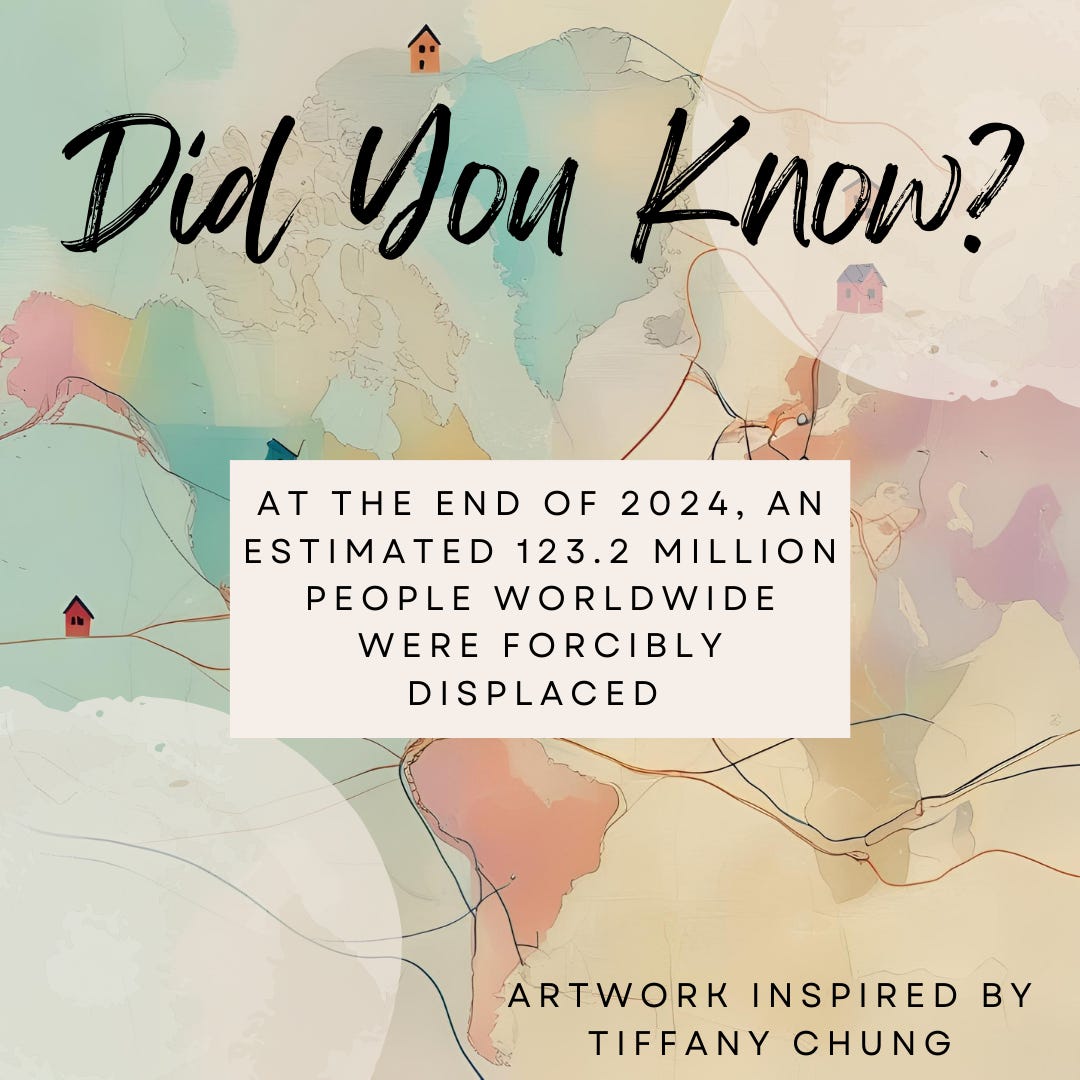
Have you come across Tiffany Chung? She’s a Vietnamese-American artist who maps displacement — not with data visualisations or policy graphics, but with hand-drawn cartographies that feel like memory. Soft shapes. Fractured borders. Small houses scattered across abstracted landscapes like people mid-journey with nowhere clear to land.
One of our Vibers found her work and couldn’t move on. So she didn’t. Instead she started asking a question that sounds simple until you actually try to answer it: how many people in the world right now don’t have a place that claims them?
The number she came back with was 123.2 million. Forcibly displaced, at the end of 2024. And that was before this year’s numbers came in.
Here’s what struck her — and what she brought back to the rest of us. That number isn’t just a humanitarian crisis. It’s a structural one. The nation state, as a system, was not designed to absorb displacement at this scale. Not the largest countries by land mass. Not the wealthiest by GDP. Not the most politically stable. None of them. The architecture we built to manage human movement across borders was designed for a different world — a world where 123 million people needing somewhere to go was simply not a scenario anyone planned for.
And the forces driving that number aren’t slowing down. Climate change is displacing people before conflict even arrives — failed harvests, disappearing coastlines, water scarcity that turns neighbours into competitors. Conflict then does the rest. These aren’t parallel crises. They’re the same crisis at different stages.
We’re not going to solve that here. That’s not the point. The point is that a Gen Z student, still at university, building her CV through real work at the A4R Media Hub, was the one who stopped, looked properly, and then turned to her peers and said — you need to understand this.
That’s what we do at A4R. We’re a co-creation community where Gen Z journalists, researchers, and storytellers apply what they’re learning at university to questions that actually matter. We work with displaced communities directly. We build real skills — editorial, research, digital, production — while we’re still studying, so that by the time we graduate, we already have a body of work that reflects who we are and what we care about.
If you're at university and you've ever looked at a number like 123.2 million and felt the gap between knowing something and actually understanding it — that gap is exactly where we work.
Join the Conversation
Displacement isn’t a distant issue — it’s the defining challenge of our generation. Explore the stories, research, and co-created content changing how young people engage with it.
This piece was produced in collaboration with the BizGees community, amplifying the work of Arts4Refugees Media Hub and the Gen Z Vibers co-creating it.
Thank you for reading an A4R 🎨 Post. Don’t forget to visit our gaming art here. Every purchase scales our impact and pays our bills.
