

AT A GLANCE:
Diversity gets justified three ways — morally, because it’s right; relationally, because it builds belonging; and functionally, because it makes organisations smarter and harder to blindside. A4R Media Hub leans hardest on the third. This is the story of a signal 480+ Gen Z Vibers sent years before COVID made it obvious to everyone else — and the two distinct solutions that came out of listening to it.
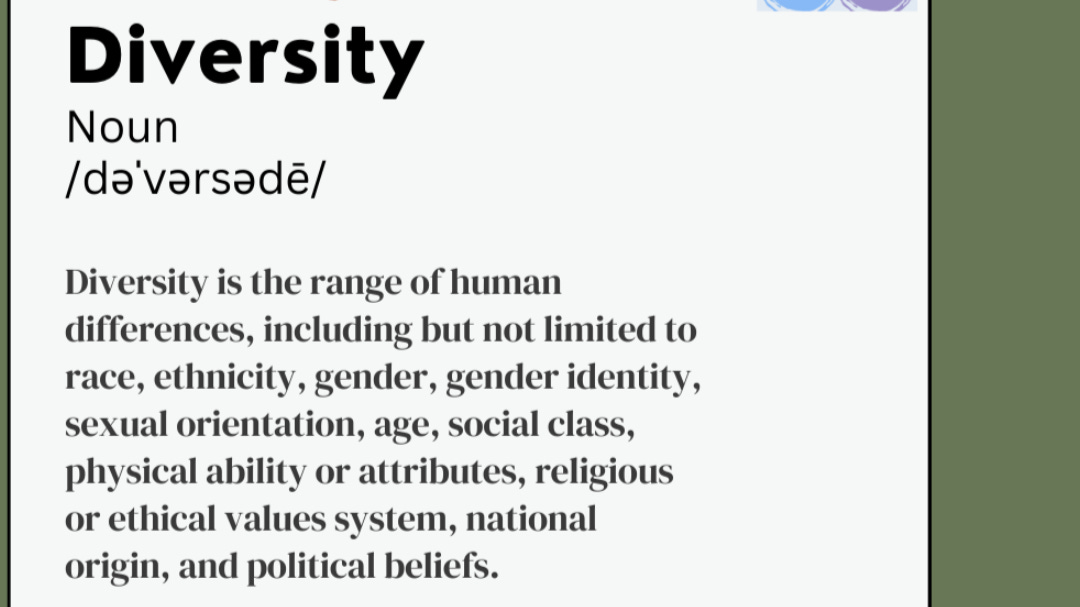
Five hands. Different skin tones, locked together at a single point of contact. That’s the image. Underneath it, a dictionary-style definition: diversity — the range of human differences, including but not limited to race, ethnicity, gender, gender identity, sexual orientation, age, social class, physical ability, religious or ethical values, national origin, and political beliefs.
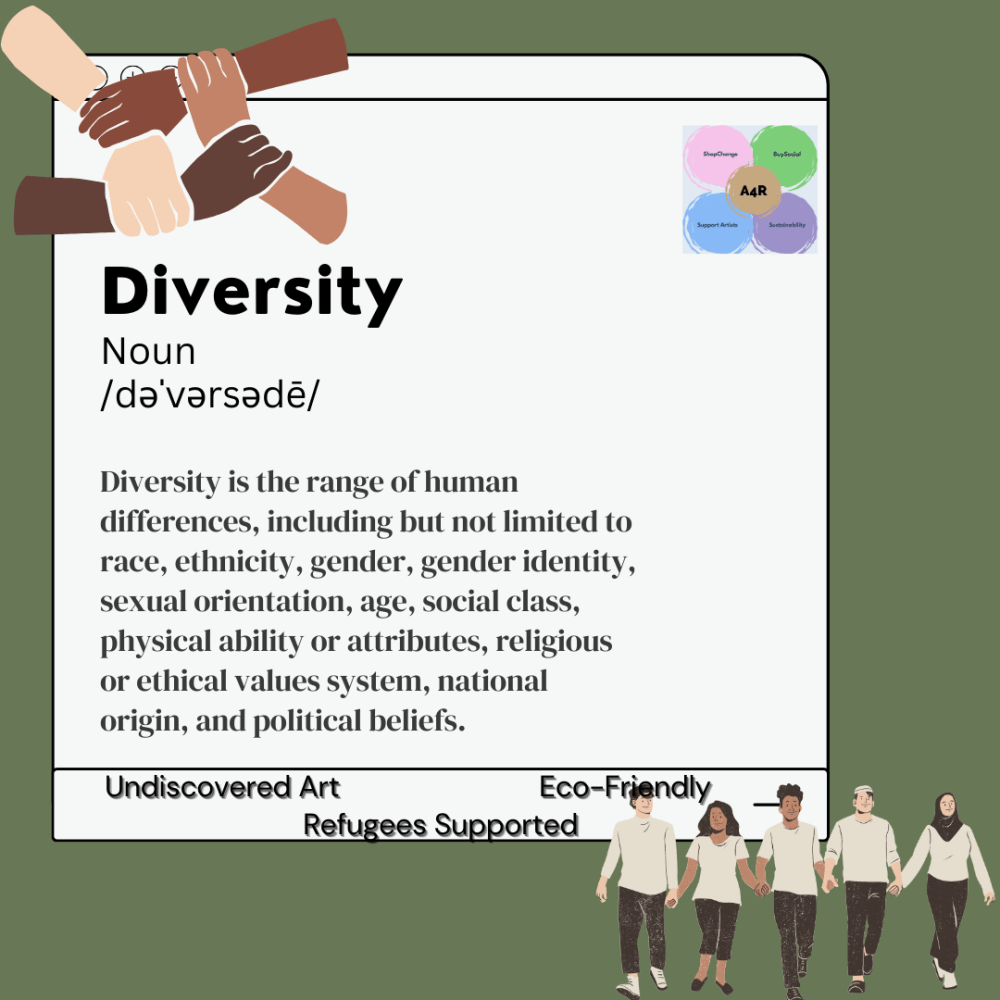
It’s a comprehensive definition. It’s also, on its own, a little flat. The real question isn’t what diversity means. It’s what it’s actually for.
There are three honest answers.
Three reasons. One that we lean on hardest.
The first is moral. Inclusion and equality are good in themselves — every person’s voice and dignity matter regardless of what including them produces. This is true, and it doesn’t require justification beyond itself.
The second is relational. People do better work, stay longer, and contribute more fully when they feel they belong rather than merely tolerated. This matters too, and it shows up throughout the rest of this series — in the work on identity, in the mirror image inspired by Tidawhitney Lek, in the question of who gets to bring their whole self into a room.
The third is functional. Diverse groups make better decisions because they don’t converge on the same blind spots. A room full of people who think alike, come from the same background, and have lived through the same experiences will agree quickly — and miss the same things, together, with total confidence. This is the mechanism behind black swan failures: not a lack of intelligence, but a lack of perspective diverse enough to see the thing coming before it arrived.
A4R holds all three. But the functional case is the one we actually operationalise, day to day, because it’s the one with a measurable track record.
The signal nobody else was positioned to hear.
Here’s the proof.
Before COVID, A4R’s mission — supporting communities recovering from conflict — was already resonating strongly with Gen Z Vibers. They cared about it, believed in it, and wanted to be part of it. But across a community of hundreds of young people from radically different backgrounds — different countries, different economic situations, different proximities to conflict and to comfort — a second signal kept surfacing alongside the first one. They loved the mission. And they also wanted to support their own friends and family, in their own local communities, who were struggling in ways that had nothing to do with conflict abroad.
A more homogeneous team — recruited from a narrower set of backgrounds, listening to a narrower set of voices — would very plausibly have missed this. Not because anyone would have dismissed it on purpose, but because monothought doesn’t notice what it isn’t built to hear. When everyone in the room shares roughly the same starting assumptions about what “impact” looks like, a second, quieter signal pointing somewhere else gets filtered out before it’s even registered as data.
A4R’s Vibers came from enough different places, carrying enough different lived realities, that this second signal didn’t get filtered out. It got heard. Repeatedly. Clearly enough that it became impossible to ignore.
Then COVID happened. Local economic precarity, youth unemployment, and the NEET crisis — young people not in employment, education, or training — became visible to everyone, almost overnight, as lockdowns exposed exactly how fragile local economies and local support networks already were. The organisations and businesses that responded well were, almost without exception, the ones that had already been paying attention to that signal before it became impossible to miss.
A4R was already there.
Two solutions, not one stretched thin.
This is the part worth being precise about, because it’s not just a comms story.
A4R didn’t take its existing post-conflict programme and quietly widen its eligibility criteria to include local Gen Z as well. That would have been the strip-down approach — take something built for one context and stretch it to cover another, hoping the fit is close enough. It usually isn’t.
Instead, A4R built two distinct, purpose-designed offerings. One remains focused on supporting communities recovering from conflict — the Swat Valley, Lebanon, Lira, and others — built around the specific human needs of displacement, statelessness, and post-conflict economic recovery covered throughout this series. The other is a separate solution addressing NEET and local economic precarity for Gen Z in the UK, US, and Australia — built around a different set of constraints entirely: different infrastructure, different cultural context, different starting points, but the same underlying conviction that creativity, vocational training, and genuine opportunity are the right response.
Two solutions, co-designed from the ground up for two different communities, because a sufficiently diverse group of young people told A4R, years in advance, that both needs were real and both deserved a real answer — not a single template applied twice.
Resilience that shows up before the crisis does.
This is what functional diversity actually buys an organisation. Not a single good decision. A pattern of catching things early, because the room contains enough different vantage points that very little gets to hide.
Human-centred design only works if you can actually hear the full range of humans you’re designing for. A4R’s 480+ Vibers, drawn from radically different countries, generations, and conflict histories, are not a diversity statistic to be reported in an annual review. They are the organisation’s early warning system, its market research, and its conscience, all operating at once, mostly without anyone needing to ask them to.
The moral case for diversity says this is the right thing to do. The belonging case says it makes people want to stay. The functional case says, more bluntly: a narrower team would have built one good programme, for one community, and been a full pandemic late catching the second.
This is what A4R looks like.
Every Viber who comes through the Media Hub brings something into the room that nobody else there carries in quite the same way — a country, a history, a worry about a friend back home, a question nobody else thought to ask. Some of that becomes published work. Some of it becomes a signal that reshapes what A4R builds next, years before the rest of the market catches up.
Five hands, one grip. None of them holding on for exactly the same reason. That’s not a weakness in the model. It’s the whole point of it.
Join the conversation
The A4R Media Hub is co-created by Gen Z, for Gen Z — on the issues that matter most, made by young people who refuse to look away.
🔗 Explore our latest work at arts4refugees.com
This piece was produced as part of the Ink & Ashes series at the Arts4Refugees Media Hub, in collaboration with the BizGees community and the Gen Z Vibers co-creating it.
Thank you for reading an A4R 🎨 Post. Don’t forget to visit our gaming art here. Every purchase scales our impact and pays our bills.
