

In 2007, the Taliban banned girls' education in Pakistan’s Swat Valley. Young Malala Yousafzai refused to be silent. She blogged for the BBC and survived an assassination attempt. Today, the Nobel laureate fights for 122 million girls still out of school, proving that one book and one pen can change the world.

Click here to play & learn.
Back Story
The Girl Who Risked Her Life to Fight for the Right to Education
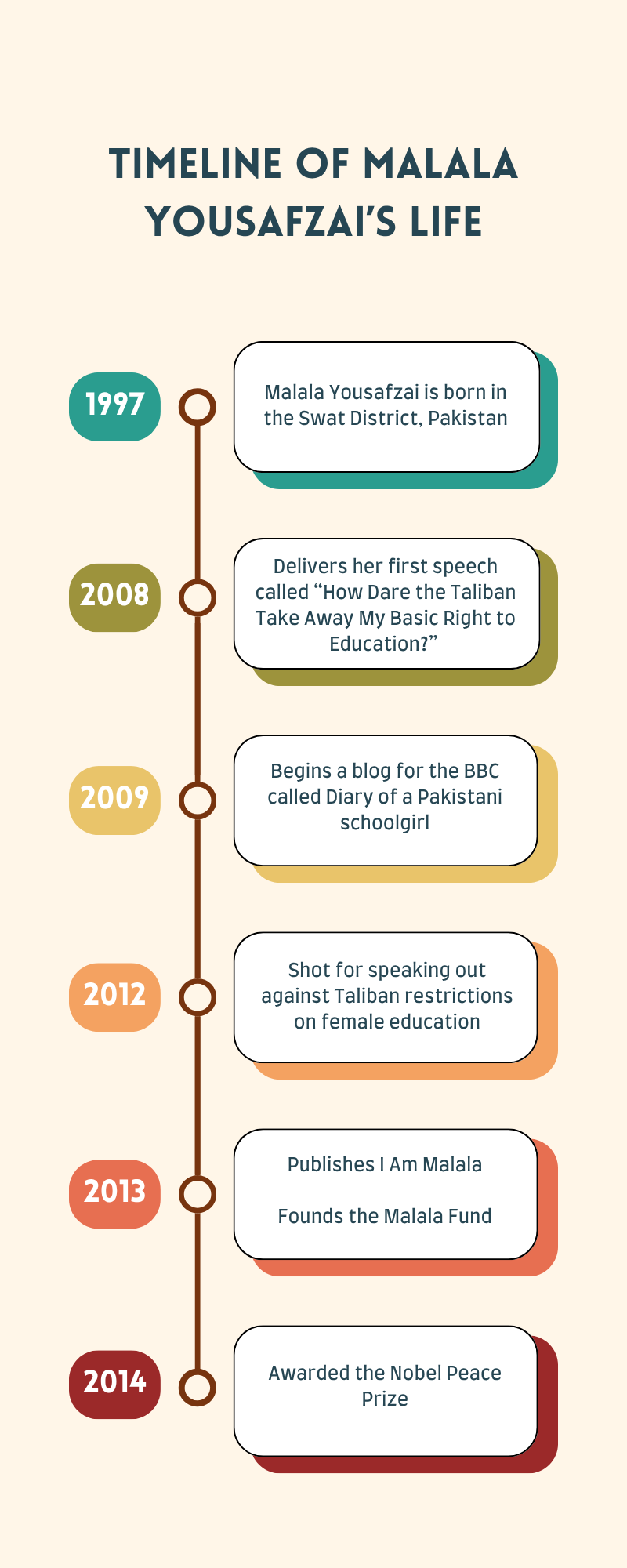
The Swat valley in northwestern Pakistan is known for its scenic views. The Swat river flows through lush green forests against a backdrop of snow-capped mountains. Malala Yousafzai was born in 1997 in the Swat District. In 2007, the Pakistani Taliban took control over the valley, transforming it into a war zone. This jihadist militant organization is designated as a terrorist organization by the United Nations and the Government of Pakistan. The organisation has a highly conservative interpretation of Islam. The Pakistani Taliban banned residents from owning televisions, playing music, and dancing. They targeted schools. The Taliban blew up more than 100 schools for girls in an attempt to limit girls’ access to education.
Malala Yousafzai spoke out against the ban on the education of girls. She began her activism journey in 2008, at the age of 11. Malala delivered her first speech called “How Dare the Taliban Take Away My Basic Right to Education?” which was covered by newspapers and television channels all over Pakistan.
Malala’s activism began at a young age with the encouragement of her father Ziauddin Yousafzai. He founded Khushal Girls High School and College. Malala’s father advocates for education for all, in particular for girls who are often denied an education in Pakistan.
Malala began writing about her experience at a young age. She began a blog for the BBC called Diary of a Pakistani schoolgirl under a pseudonym at age 11. Malala shared her daily life under the Taliban. Writing became a form of resistance. She expresses her fear of being killed by the Pakistani Taliban. But Malala refused to be silent and continued to fight for the right to an education. Malala famously said “if people were silent, nothing would change.” In her first diary entry, Malala writes “I was afraid going to school because the Taliban had issued an edict banning all girls from attending schools.” But she continued going to school even when the Swat valley became a war zone.
In 2011, she was awarded Pakistan’s National Youth Peace Prize. On the 9th of October 2012, on the way home from school, Malala was talking with her friends about schoolwork. Two members of the Pakistani Taliban stopped her school bus. One of them boarded the bus and asked “Who is Malala?” He shot her in the head for speaking out against Taliban restrictions on female education. Her murder attempt received worldwide media coverage. Malala became an international symbol of the fight for girls’ education.
Malala was moved to the United Kingdom where she recovered from her assassination attempt. She was lucky to survive. But Malala was unable to return to her home country for six years. She wrote her first memoir with journalist Christina Lamb. In I Am Malala: The Girl Who Stood Up for Education and Was Shot by the Taliban (2013), she tells the story of her childhood in the Swat valley as it gradually came under Taliban control. Malala wrote about surviving a Taliban attack and her fight for girls’ education. The book became a best-seller. Pakistani private schools banned Malala’s book.
Malala’s activism did not stop after her assassination attempt. In 2013, she spoke at the United Nations Youth Assembly, calling for all children to have access to education. Malala argued that “one child, one teacher, one book, one pen can change the world.” Girls’ education allows them to choose their own futures, reaching their full potential. Education for all promotes gender equality.
She founded the Malala Fund with her father. The organisation campaigns globally so that girls can access at least 12 years of free, safe, and quality education. Over 122 million girls are still out of school today, primarily in low-income countries. Girls are stopped from getting an education by gender biases, conflicts, and poverty. Women still represent around two-thirds of all illiterate adults according to UNESCO. The Malala Fund helps to provide schooling for girls in countries including Pakistan, Afghanistan, and Nigeria. In 2015, she opened a girls’ school in Lebanon for refugees from the Syrian Civil War. Investment in education should be increasing. But in some countries like Pakistan, it is decreasing. This motivated Malala to launch the social media campaign #booksnotbullets in 2015. She called on world leaders to increase funding for education, rather than wars. Malala emphasises the importance of education in building peace.
Malala became the youngest Nobel laureate at the age of 17. She was awarded the Nobel Peace Prize in 2014 for her fight for the right of every child to receive an education. During her acceptance speech, Malala said “this award is not just for me. It is for those forgotten children who want education. It is for those frightened children who want peace. It is for those voiceless children who want change.” She dedicated the prize money to the Malala Fund.
She wrote the picture book Malala’s Magic Pencil (2017) which was based on her childhood, inspiring young readers. As a child, she made a wish for a magic pencil to solve her problems. In We Are Displaced: My Journey and Stories from Refugee Girls Around the World (2019), Malala writes about her experience as an internally displaced person in Pakistan and her visits to refugee camps. As a child, her family lived as displaced people in Pakistan when they were forced to flee Taliban rule. Malala also shares the stories of nine other displaced people from countries including Syria, the Democratic Republic of Congo, and Columbia. She gave a voice to those who are often silenced. Malala famously said “I tell my story not because it is unique, but because it is the story of many girls.” More than 68 million people are currently living as refugees or internally displaced people.
In 2020, she graduated from the University of Oxford where she read Philosophy, Politics and Economics. Her most recent memoir Finding My Way (2025) tells the story of her life in high school and university. She tells the story of smoking a bong at Oxford which brought back the trauma of being shot by the Taliban. Malala remembered “my school bus. A man with a gun. Blood everywhere. My body carried through a crowded street. Strangers hunched over me, yelling things I didn’t understand. My father rushing toward the stretcher to take my hand.”
This year a new portrait was unveiled at her Oxford college Lady Margaret Hall to celebrate her. Malala spoke at the 2026 United Nations’ International Women’s Day commemoration. In her speech, she expressed concern about the situation in Afghanistan. Girls have been unable to go to secondary school or university since the Taliban took over the country in 2021. Women cannot go to work, leave their homes without a male chaperone, or even speak in public. Women and girls in Afghanistan are being erased from public life under Taliban rule.
Malala gives voices to those who are often silenced. Her story reflects the experiences of many girls who are denied an education and internally displaced people. Malala inspires a generation through her speeches and books. Through her storytelling, she highlights the importance of education in a world where a quarter of a billion children remain out of school. Malala continues to fight for girls’ education around the world today.
Why Girls’ Education | Malala Fund
Out now: Malala’s new book, “We Are Displaced”
Malala Yousafzai at the UN: Justice Cannot Be Selective
Malala Yousafzai | Biography, Nobel Prize, & Facts | Britannica
I Am Malala | Story, Summary, Author, Themes, & Facts | Britannica
The Inspiring Story of Malala Yousafzai’s Fight for Education | Britannica
Malala Yousafzai: Portrait of the girl blogger - BBC News
Malala portrait unveiled at her Oxford college
New Portrait Celebrates LMH Alumna Malala Yousafzai | Lady Margaret Hall
Malala Yousafzai’s book banned in Pakistani private schools
Finding My Way by Malala Yousafzai review – growing up in public | Books | The Guardian
Malala Yousafzai | United Nations
Education emergency: now or never | UNICEF Pakistan
Malala Yousafzai – Biographical - NobelPrize.org
Malala Yousafzai wants leaders to invest in #booksnotbullets - Los Angeles Times
In this post Laura highlights the arty refugee experience of Malala Yousafzai. She is a citizen journalist on a placement with us organised by Oxford University Career Services. She also organised the micro game to make the journalistic experience interactive.
Thank you for reading an A4R 🎨 Post. Don’t forget to visit our gaming art here. Every purchase scales our impact and pays our bills.
