


In this article Lucy discusses the post conflict regions of South Sudan and Ethiopia. She is a student journalist with us on a placement organised by the Department of War Studies, King's College, London. This article was edited using Lex.page.
🎧 listen to Lucy’s backstory here - she discusses her motivation & research as well.
‘Unheard Voices’: Women’s Needs in Post-Conflict Ethiopia and South Sudan
War and violence negatively impact women, but ‘peace time’ has implications for women as well (Maina, 2012). Post-conflict environments present unique challenges for women. Women are neglected and excluded from peace building and post-conflict reconstruction.
In 2000, the UN Security Council Resolution 1325 addresses the impact of conflict on women and girls and the important role women play in peacebuilding and conflict prevention (USIP, n.d.). The resolution recognised the unique impact of conflict on women and girls and was adopted after the International Criminal Tribunal for Yugoslavia in 1993 and Rwanda in 1994. However, its implementation has seen failures.
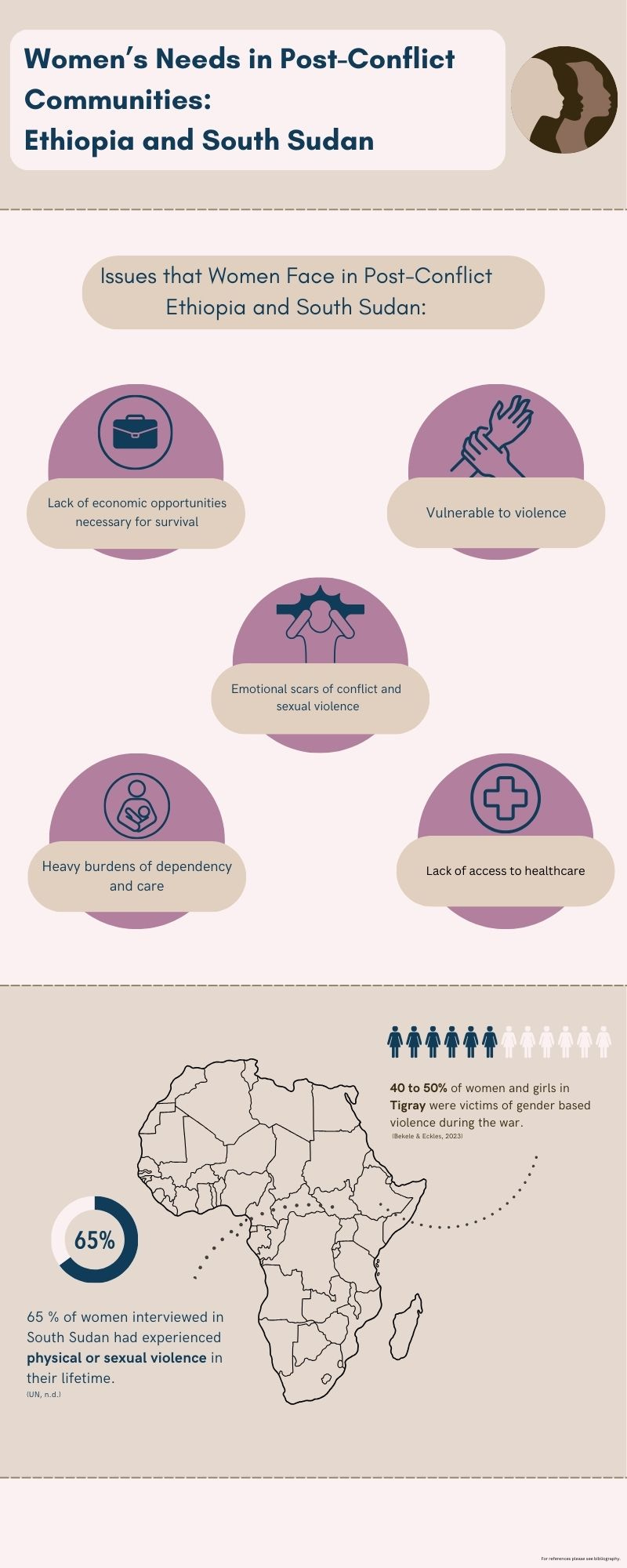
In post-conflict countries, women lack economic opportunities, face daily violence, struggle with care burden, and suffer emotional and physical scars without support or recognition (WPS, 2015).
Despite women’s hardships during and after conflict, they have little influence over peace negotiations and rebuilding. Women’s participation in peace processes is low. In 2022, only 16% of negotiators in active peace processes were women (CFR, 2023). This is concerning because sexual violence is used as a weapon against women in conflicts, with severe mental, physical, and socioeconomic impacts.
Tigray: Women and Girls bare significant costs of Ethiopian conflict.
In 2020, a war started in northern Ethiopia’s Tigray region, marked as the ‘worst war of the 21st century’ due to an estimated 600,000 deaths (Burton, 2024). During the Tigray conflict, women faced severe gender-based violence (GBV), with experts estimating GBV affecting 40-50% of women and girls in Tigray and neighbouring regions of Ethiopia (Bekele & Eckles, 2023).
After hunger, the second most critical concerns among internally displaced people in Ethiopia were sexual violence and the need for mental health services. Sexual violence has been extensive against women and girls during the conflict and is ongoing, perpetrated by Eritrean and Ethiopian forces as a weapon of war.
Horrific acts have lasting physical and mental effects on women, making it hard for them to function. However, there is a lack of resources to help the victims. To illustrate how scarce mental health resources are, consider this comparison: Massachusetts and Tigray in Ethiopia have similar populations of around seven million. Massachusetts has nearly 6,000 licensed psychologists but Tigray has only eight. Women who are victims of sexual violence may face discrimination, ostracism, and abandonment by their husbands (Miller, 2024). They don’t report the incident for fear of being an outcast (Fisseha, et al., 2023), living in silence and fear, and remaining vulnerable to further abuse and exploitation.
Women suffer physical health consequences due to GBV, such as contracting HIV. They may undergo ‘back-street’ abortions to terminate pregnancies resulting from rape (Fisseha, et al., 2023).
A peace deal was reached in 2022, but women were not involved in the process (Wallström, 2023). The peace agreement did not address gender considerations besides condemning violence against women and girls. This reflects the political landscape in Ethiopia. Structural and legal barriers to women’s political participation, cultural gender norms, and inequalities exist (Tornius, et al., 2023).
When women are excluded from the peace process, there is a risk that sexual violence as a war crime won’t be addressed in the post-conflict community, leading to continued impunity and lack of justice for the victims (Wallström, 2023). Excluding women from Ethiopia’s transitional justice plans hinders access to resources for those affected, such as medical care, protection, and economic assistance (Gusky & MacLean, 2024). Groups like Mums for Mums provide physical and psychological help to women and girls. However, these facilities lack resources to address the issues, leading to overcrowding and separation (Women for Women, n.d.).
Female victims of the Tigray conflict struggle to recover emotionally, physically, and economically. Despite the formal end of the conflict, some women still face GBV. Internally displaced women are three times more likely to face GBV than those who haven’t been displaced (Desalegn, et al., 2022). Due to lack of social structure in IDP camps, women often become the head of households with little social support and a heavy burden of care and dependency. Many women are worried about their safety and survival, and they lack basic needs like adequate food and water.
South Sudan: Women and Girls Face Violence and Marginalisation
Women and girls in South Sudan have disproportionately affected by the civil war, suffering similar effects as those in Ethiopia. The conflict, which lasted from 2013 to 2018, created insecurity for women and widespread sexual violence. These crimes are underreported and have diverse effects, usually occurring alongside other human rights violations, like witnessing family members being killed or being displaced. The humanitarian crisis in South Sudan has led to the largest refugee crisis in Africa (Human Rights Council, 2022). Women often suffer conflict-related sexual violence, food insecurity, and displacement.
GBV survivors in South Sudan have little access to medical care. The Family Protection Centre in Juba Teaching Hospital offers clinical treatment, counseling, and legal support (UNFPA, 2018). Most women and girls do not get help because of limited resources. GBV has extensive physical and psychological health impacts, including short- and long-term injuries, acute stress, depression, anxiety, and PTSD. The psychological impact extends to families and communities (Human Rights Council, 2022).
Gloria Soma, the director of the Titi Foundation, a South Sudanese NGO, argues that women in South Sudan have been marginalised and seen as second-class citizens who cannot deliver (Davies, 2021). When women are excluded from the peace process and politics, it dismisses their perspectives and experiences. In post-conflict South Sudan, around 58% of households are led by women but their voices are ignored. Women’s ‘voices need to be heard, their perspectives seen, and their solutions legitimised’ (Ali, 2023). Without this, justice for victims of conflict-related sexual violence will be hard to reach. Crimes of sexual violence are forgotten, and victims are invisible during justice processes. When women are excluded from peace building, women-led and women’s rights organizations receive the least resources (Human Rights Council, 2022). Without adequate inclusion, the effects of conflict on women will continue to be under-addressed.
Women’s participation in peace processes decreases the likelihood of failure by 64% and increases the likelihood of reaching a peace agreement (Ahmed & Tank, 2020). Including women in post-conflict peace processes benefits all parties.
Change is necessary for justice and healing for women and girls in Ethiopia, South Sudan, and other post-conflict communities. The world looks bleak to many women in post-conflict communities and this needs to change. As former UN Secretary-General Ban Ki-moon told the security council, ‘in failing to include women and girls in peace processes, we are failing the world’ (UN, 2016).
Bibliography
Ahmed, N. & Tank, P., 2020. Women's Participation in Peace Processes, Oslo: PRIO.
Ali, J., 2023. Challenging Norms: Marginalising Women and Informal Peacebuilding in South Sudan, Uppsala: Life & Peace Institute, Horn of Africa Bulletin.
Bekele, M. & Eckles, T., 2023. Gender-Based Violence and the Tigray Conflict in Ethiopia: A Path to Accountability and Resolution. [Online]
Available at: https://www.wilsoncenter.org/blog-post/gender-based-violence-and-tigray-conflict-ethiopia-path-accountability-and-resolution
[Accessed 24 April 2024].
Burton, K., 2024. Tigray: the war the world forgot. [Online]
Available at: https://geographical.co.uk/culture/tigray-the-war-the-world-forgot#:~:text=The%20outbreak%20of%20full%2Dscale,the%20other%20side%20called%20unconstitutional.
[Accessed 30 April 2024].
CFR, 2023. Women’s Participation in Peace Processes. [Online]
Available at: https://www.cfr.org/womens-participation-in-peace-processes/
[Accessed 24 April 2024].
Davies, L., 2021. ‘Any time, anything could go wrong’: the women hoping to heal South Sudan. [Online]
Available at: https://www.theguardian.com/global-development/2021/jul/09/after-10-years-of-conflict-south-sudan-women-seek-peace
[Accessed 1 May 2024].
Desalegn, S., Kasseye, E., Gebeyaw, G. & Meshelemiah, J., 2022. The Challenges of Women Housed in Internally Displaced Persons (IDP) Camps During an Armed Conflict in Ethiopia. Feminist Inquiry in Social Work, 38(1).
Fisseha, G., Gebrehiwot, T. & Gebremichael, M., 2023. War-related sexual and gender-based violence in Tigray, Northern Ethiopia: a community-based study. BMJ Glob Health, 8(7).
Gusky, M. & MacLean, M., 2024. Applying a Gender Lens to Transitional Justice After Ethiopia’s Tigray War. [Online]
Available at: https://www.iar-gwu.org/blog/iar-web/applying-a-gender#:~:text=In%20contrast%2C%20Ethiopia's%20exclusion%20of,to%20the%20disproportionate%20suffering%20of
[Accessed 1 May 2024].
Human Rights Council, 2022. Conflict-related sexual violence against women and girls in South Sudan, OHCHR.
Maina, G., 2012. An Overview of the Situation of Women in Conflict and Post-Conflict Africa, The African Centre for the Constructive Resolution of Disputes.
Miller, S., 2024. Scars of War and Deprivation: An Urgent Call to Reverse Tigray's Humanitarian Crisis, Washington: Refugees International.
Tornius, K., Kolling, M. & Engberg-Pedersen, L., 2023. Implementing the Global Women, Peace and Security Agenda in Ethiopia, Kenya and Mali, Copenhagen: DIIS.
UN, 2016. Women Too Often Omitted from Peace Processes, Despite Key Role in Preventing Conflict, Forging Peace, Secretary-General Tells Security Council. [Online]
Available at: https://press.un.org/en/2016/sc12561.doc.htm
[Accessed 30 April 2024].
UN, (n.d.) One-stop care centre helps women amid South Sudan’s epidemic of violence. [Online] Available at: https://www.un.org/africarenewal/news/one-stop-care-centre-helps-women-amid-south-sudan%E2%80%99s-epidemic-violence#:~:text=Though%20comprehensive%20data%20are%20difficult,sexual%20violence%20in%20their%20lifetime.
[Accessed 24 April 2024].
UNFPA, 2018. One-stop care centre provides survivor-centered comprehensive care for clients. [Online]
Available at: https://southsudan.unfpa.org/en/news/one-stop-care-centre-provides-survivor-centered-comprehensive-care-clients#:~:text=The%20Family%20Protection%20Centre%20in,care%20available%2C%20including%20clinical%20treatment
[Accessed 24 April 2024].
USIP, n.d.. What is UNSCR 1325? An Explanation of the Landmark Resolution on Women, Peace and Security. [Online]
Available at: https://www.usip.org/gender_peacebuilding/about_UNSCR_1325
[Accessed 30 April 2024].
Wallström, M., 2023. Without women’s voices, democracy and peace are weaker. [Online]
Available at: https://www.chathamhouse.org/publications/the-world-today/2023-02/without-womens-voices-democracy-and-peace-are-weaker
[Accessed 23 April 2024].
WomenforWomen, n.d.. Supporting women in ethiopia. [Online]
Available at: https://womenforwomen.org.uk/work-we-do/where-we-work/conflict-response-fund-ethiopia
[Accessed 30 April 2024].
WPS, 2015. Building inclusive and peaceful societies in the aftermath of conflict. [Online]
Available at: https://wps.unwomen.org/building/
[Accessed 30 April 2024].
Thank you for reading an A4R 🎨 Post. Don’t forget to visit our gift shop here. Every purchase scales our impact and pays our bills.
