

Summary: Gen Z is entering adulthood inside a shrinking entry-level job market, a fragmented gig economy, and a rapidly AI-automated workplace. This article explores how A4R Media — co-created with Gen Z — is building a participatory media ecosystem that functions simultaneously as a journalism platform, a vocational learning environment, and an AI-native skills pipeline designed for global scale.
Reading time: Approximately 7 minutes
This Is the What and the How
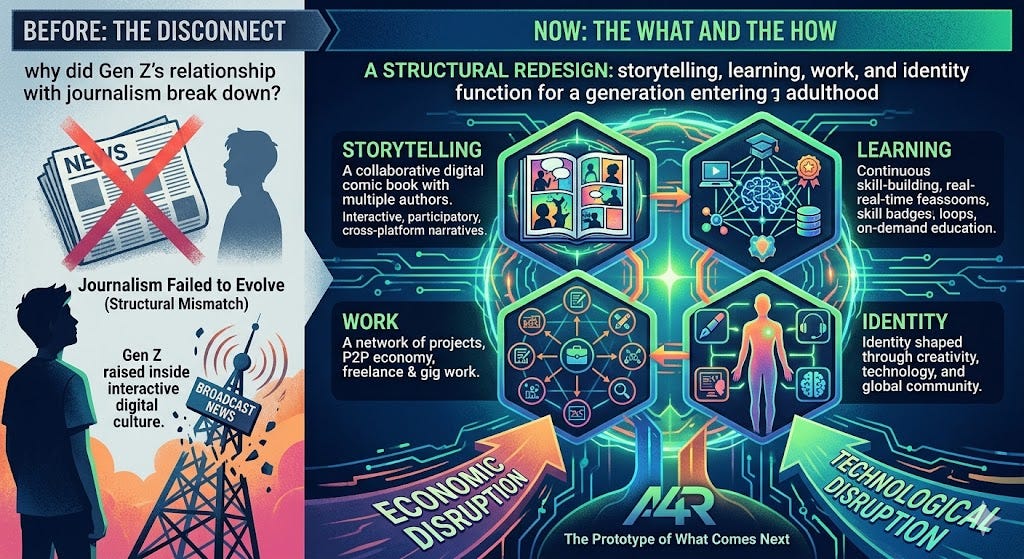
A previous article in this series asked a simple question: why did Gen Z’s relationship with journalism break down?
The answer was structural. Gen Z did not abandon journalism. Journalism failed to evolve fast enough for a generation raised inside interactive digital culture.
That was the why.
This is the what — and more importantly, the how. Because what is happening now is not simply a shift in media consumption. It is a structural redesign of how storytelling, learning, work, and identity function for a generation entering adulthood inside economic and technological disruption at the same time.
A Generation Entering a Compressed Opportunity Economy
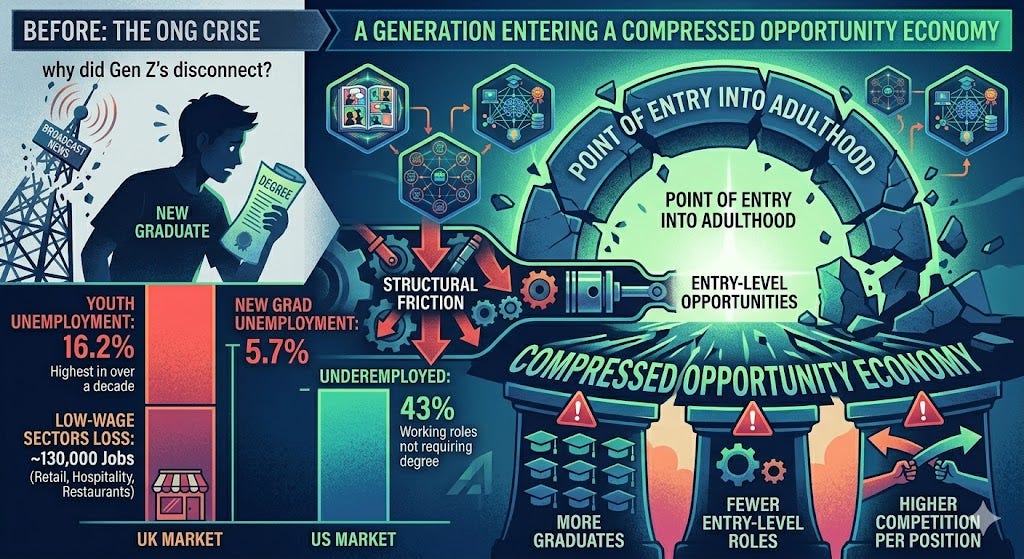
Gen Z is entering the labour market at a moment of significant structural pressure across both the UK and the US — the two core markets where this shift is most acute, alongside other global economies where similar patterns are emerging.
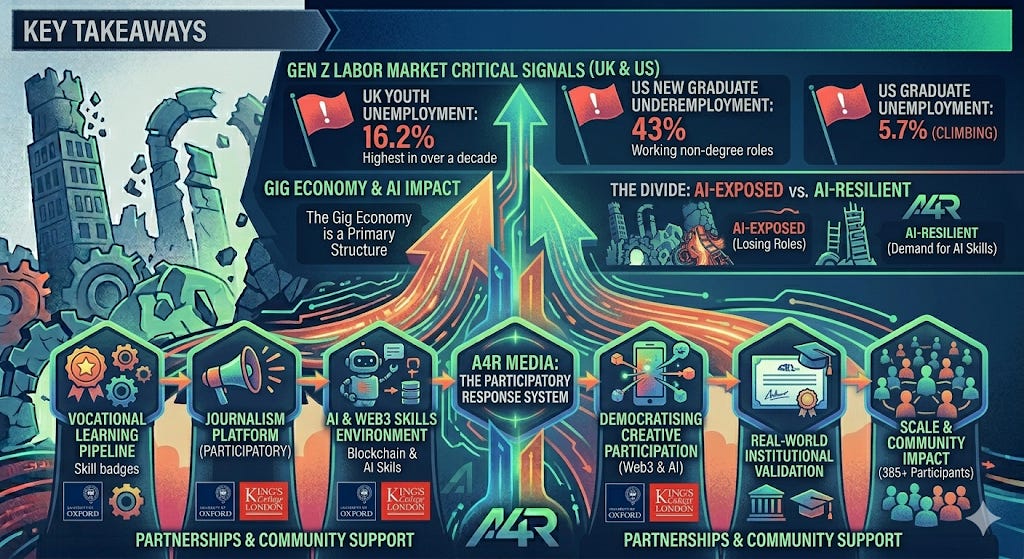
In the UK, youth unemployment has risen to 16.2% — the highest in over a decade, with workers at the beginning of their careers feeling these pressures first and hardest (Indeed Hiring Lab UK, May 2026). Low-wage sectors that traditionally absorb young workers — retail, wholesale, hospitality and restaurants — have collectively lost nearly 130,000 jobs over the past year, with early indications that AI is also replacing entry-level positions in white-collar industries (ONS via Investing.com, 2026).
In the United States, the picture for new graduates is similarly stark. New graduate unemployment has hit 5.7% and is climbing, with 43% of new graduates underemployed — working in roles that do not require the degree they just completed (Metaintro, April 2026).
The result is not just unemployment. It is structural friction at the point of entry into adulthood: more graduates, fewer entry-level roles, higher competition per position, and slower career starts.
The Gig Economy Is No Longer Alternative — It Is Mainstream
At the same time, the nature of work itself is shifting.
Across the UK and US, the gig and freelance economy is no longer a side path. It is becoming a default survival strategy for many young people entering the workforce. With entry-level jobs vanishing, Gen Z graduates are increasingly piecing together careers through entrepreneurship, gig work, and freelancing — choosing less linear paths whose outcomes are, in many cases, actually improving (Fortune, April 2026).
What used to be side income — freelancing, content creation, contract work, short-term projects — is increasingly becoming the primary structure of early-career work.
This matters because it fundamentally reshapes how Gen Z thinks about stability, identity, learning, and career progression. Work is no longer a ladder. It is a network of projects.
AI Is Reshaping the Bottom of the Career Ladder
Layered on top of this is the impact of artificial intelligence — and it is not abstract.
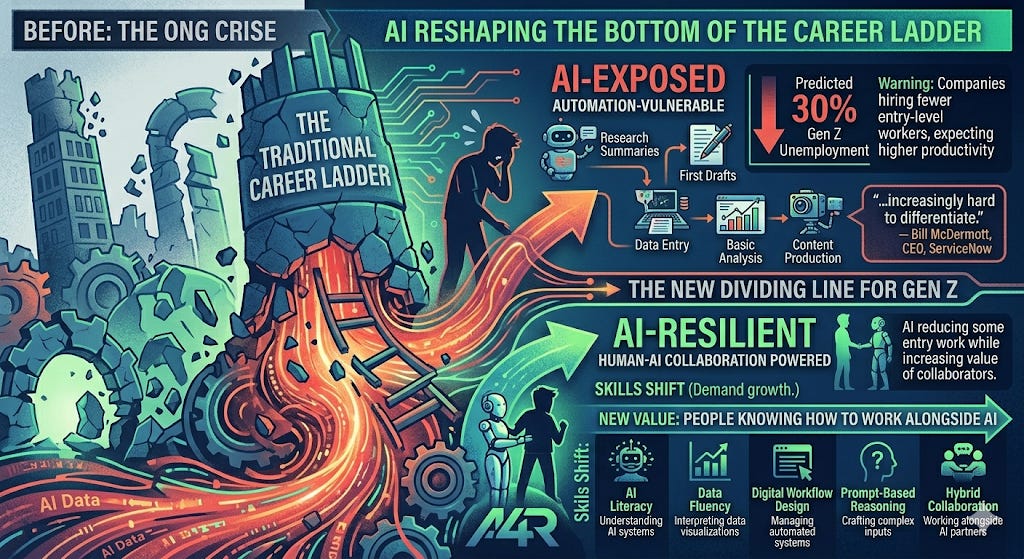
AI is not just changing jobs. It is changing the structure of entry-level work itself. Tasks traditionally assigned to junior workers — research summaries, first drafts, data entry, basic analysis, content production — are increasingly automated or AI-assisted. As a result, companies are hiring fewer entry-level workers while expecting higher productivity from those they do hire.
Bill McDermott, CEO of enterprise software giant ServiceNow, has predicted that Gen Z college graduates could face at least 30% unemployment within the next couple of years as AI takes over, warning that it will be increasingly hard for young workers to differentiate themselves in a corporate environment (Fortune, March 2026).
But there is another side to this shift.
AI is also increasing demand for AI-native skills. Employers are reporting growing shortages in AI literacy, data fluency, digital workflow design, prompt-based reasoning, and hybrid human–AI collaboration. In other words, AI is reducing some entry-level work while increasing the value of people who know how to work alongside it.
This creates a new dividing line for Gen Z: AI-exposed versus AI-resilient.
This Is Not Just a Media Shift — It Is a Survival Shift
This is the context in which Gen Z is forming its relationship with media, learning, and storytelling.
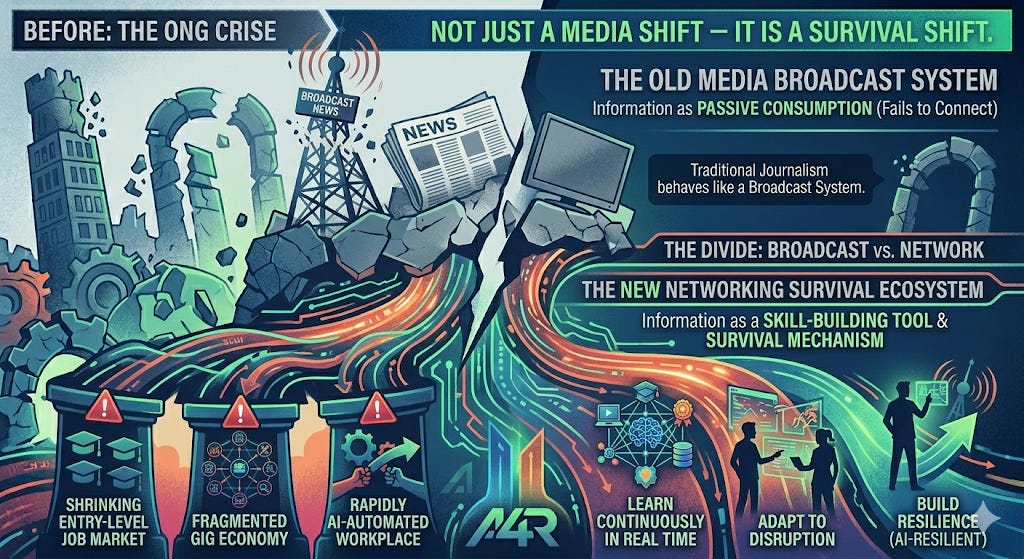
They are not just choosing different platforms. They are adapting to a shrinking entry-level job market, a fragmented gig economy, and a rapidly AI-automated workplace. Which means information is no longer passive consumption. It becomes a skill-building tool, a career survival mechanism, and a way to learn continuously in real time.
And this is where traditional journalism increasingly fails to connect. It still behaves like a broadcast system in a world that now functions like a network.
A4R Media as a Gen Z-Native Response System
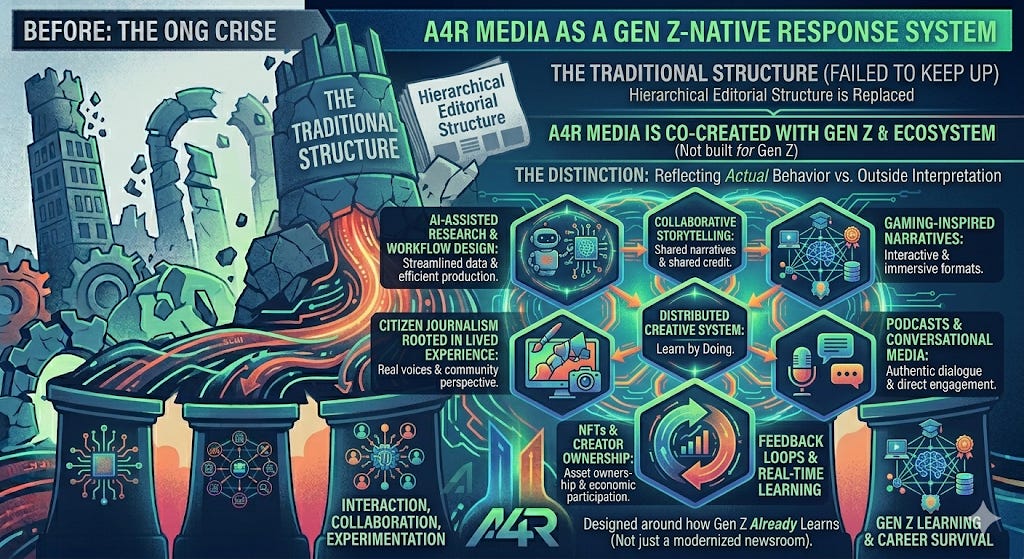
A4R Media was not built for Gen Z. It was co-created with Gen Z.
That distinction is critical — because it means the platform is not interpreting Gen Z from the outside. It is reflecting how they already behave inside digital ecosystems.
Instead of a traditional newsroom, A4R Media operates as a creative community lab, where contributors actively participate in storytelling, research, and production. The model blends AI-assisted research and workflow design, collaborative storytelling across contributors, gaming-inspired narrative structures, podcasts and conversational media formats, digital art and visual storytelling, NFTs and creator ownership models, citizen journalism rooted in lived experience, and peer-to-peer vocational learning.
Rather than hierarchical editorial structures, A4R Media functions like a distributed creative system where contributors learn by doing. This is not a media company trying to modernise journalism. It is a participatory system designed around how Gen Z already learns — through interaction, collaboration, experimentation, and feedback loops.
Why Gaming Culture Is the Hidden Architecture
Gaming is not a side influence here. It is structural.
Games are collaborative systems, identity spaces, learning environments, narrative worlds, and real-time social networks. Gen Z did not just play games. They were socialised through them. Which means they already understand interactive systems, shared world-building, progression through participation, and community-driven outcomes.
A4R Media applies that logic directly to journalism. Stories are no longer just consumed. They are explored, shaped, and participated in.
The AI Layer: From Information to Interaction
AI accelerates this shift further.
Search taught people to find information. AI teaches people to interact with it. This changes expectations fundamentally — from static articles to conversational systems, from fixed narratives to adaptive understanding, from reading to participation.
A4R Media integrates AI not as a replacement for human storytelling, but as a research assistant, workflow layer, creative co-pilot, and learning accelerator. This connects directly to a bigger Gen Z need: becoming AI-resilient in a shrinking entry-level job market. The platform is not just producing journalism. It is producing the skills that make young people viable in the economy that is emerging around them.
Web3, Creativity, and Why the Arts Are No Longer for the Few
This is where the A4R Media model becomes genuinely distinctive — and where the convergence of Web3, AI, and participatory storytelling opens something much larger than a media platform.
Financial institutions are migrating onto blockchain infrastructure. Bitcoin is recognised as a mainstream financial asset by governments and central banks across the US, UK, and Europe. Smart contracts are moving from pilot projects into real-world enterprise applications. Digital ownership and creator economies are becoming structurally embedded in how online culture operates.
But here is the question that matters for Gen Z: so what?
The answer is not just about financial systems. It is about who gets to participate in the economy being built on top of them. Web3 is not simply a technology upgrade for banks. It is the infrastructure of a new creator economy — one where ownership, attribution, and value can be distributed to contributors rather than concentrated in institutions.
Through the gaming-inspired digital art that participants create using AI tools on the platform, contributors are producing work that is native to Web3 formats — NFTs, digital collectibles, tokenised storytelling assets. This is not theoretical. It is vocational. Participants are learning by making, and what they are making has real-world relevance in a sector that is growing rapidly.
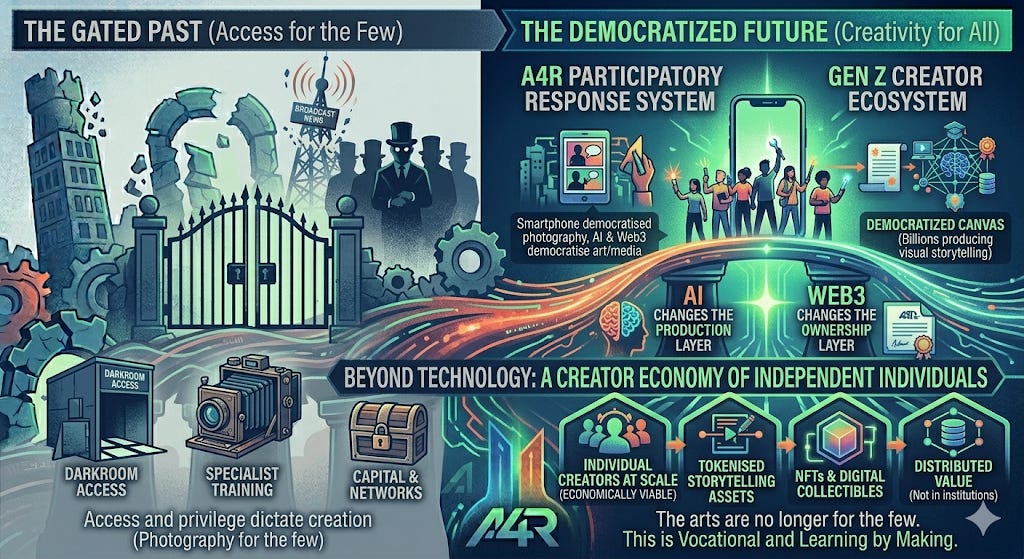
Think about what the smartphone did to photography. For most of human history, photography required specialist equipment, technical training, and access to darkrooms or professional labs. It was a skill for the few. The smartphone did not just make cameras cheaper — it democratised the creative act itself. Today, billions of people produce visual storytelling as a natural part of daily life.
AI and Web3 are doing the same thing for creativity, innovation, and economic participation. For most of history, creating publishable art, producing professional-quality media, building financial assets, or contributing to a global creative economy required access — to institutions, to capital, to training, to networks. That access was not equally distributed. It followed existing lines of privilege and geography.
AI changes the production layer. Web3 changes the ownership and distribution layer. Together, they do not just make creativity more accessible — they make it economically viable at the individual level, at scale, for people who would previously have had no route in.
The arts are no longer for the few.
Built for Scale — and Already Validated
A4R Media sits at the centre of this shift not accidentally, but by design.
The vocational training co-created with Gen Z is embedded in partnership with the career services of leading universities — including Oxford University Careers Service and King’s College London — and has already engaged over 385 student participants through structured programmes. It is not a niche experiment for a handful of students. It is a scalable model, built to grow globally, that uses AI-assisted storytelling, gaming-inspired digital art, Web3 publishing tools, and citizen journalism frameworks to give young people — including those from refugee backgrounds and post-conflict communities — genuine skills, genuine creative output, and genuine economic participation.
The broader ecosystem has received innovation and excellence recognition in education and media, with nominations tied to gaming journalism and experimental storytelling formats. These signals matter not as badges, but as evidence that the model works — that A4R Media is already functioning as a vocational pipeline, a media innovation lab, and a Gen Z participation ecosystem with the institutional backing to grow.
Journalism Is Becoming Infrastructure
The shift underway is not simply about new media formats. It is about infrastructure.
A4R Media represents one version of that infrastructure — participation-first, AI-native, gaming-informed, vocationally embedded, and co-created with the generation it serves.
Gen Z is not waiting for journalism to evolve. They are already building systems where learning, work, storytelling, and identity are no longer separate domains. They are part of the same ecosystem.
And A4R Media is one of the clearest early prototypes of what that ecosystem looks like in practice.
Key Takeaways -
UK youth unemployment has reached 16.2% — the highest in over a decade, with entry-level sectors hardest hit (Indeed Hiring Lab UK, May 2026)
43% of US new graduates are underemployed; new graduate unemployment is at 5.7% and climbing (Metaintro, April 2026)
The gig economy is no longer alternative — it is a primary structure of Gen Z early-career work (Fortune, April 2026)
AI is eliminating some entry-level roles while creating demand for AI-native skills — splitting Gen Z into AI-exposed and AI-resilient (Fortune / ServiceNow, March 2026)
Web3 and AI together are democratising creative and economic participation the way the smartphone democratised photography
A4R Media is a participatory response system — journalism platform, vocational pipeline, and AI and Web3 skills environment in one
With 385+ participants and partnerships at Oxford and King’s College London, it has real-world institutional validation at scale
Thank you for reading an A4R 🎨 Post.
Don’t forget to visit our gaming art here. Every purchase scales our impact and pays our bills.


