


AT A GlANCE - After five decades in exile, Sahrawi refugees in Algeria’s Tindouf camps continue to face profound challenges to health, safety, autonomy and self-actualization. Despite developing education and healthcare systems, humanitarian aid remains insufficient and economic opportunities scarce. As international support increasingly favours Morocco’s autonomy plan, Sahrawi hopes for dignity, independence and a lasting solution continue to fade.
Life in Limbo: The Struggle for Human Needs of Sahrawi Refugees after 50 years in Exile.
‘It is not a tent:
it is a provisional motherland
where time learns
not to advance.’
Haima, Bahia Mahmud Awah (translation)
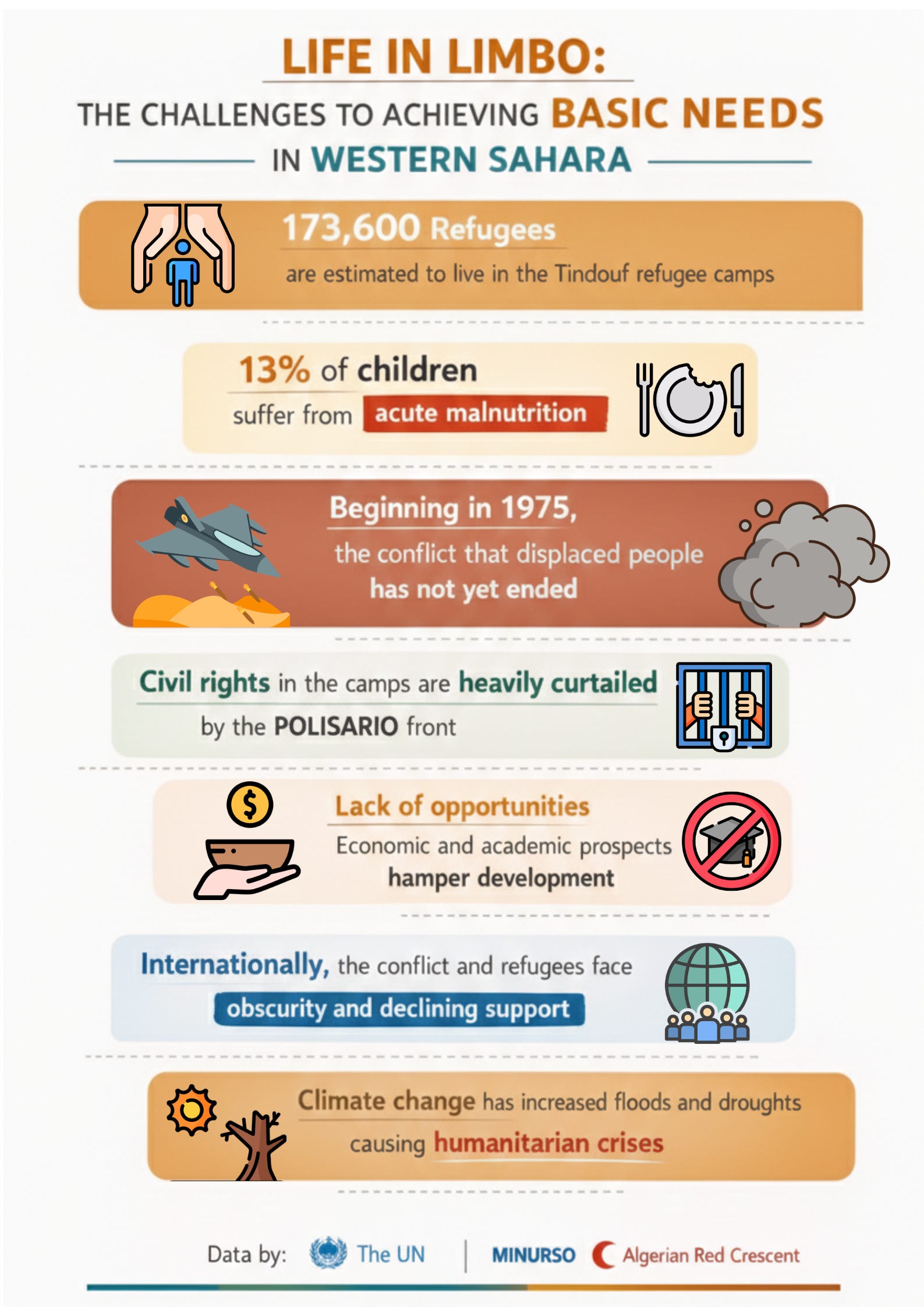
Nestled among sandy dunes, where the scorching Sahara regularly reaches over 50ºC in the summer, stands the Algerian city of Tindouf. But this city is not the real subject of this article. Instead, that title goes to the five refugee camps around Tindouf –El Aaiun, Awserd, Smara, Dakhla and Cape Bojador– and the 173,600 Sahrawi refugees that the UN estimates live in them.
It was back in 2024, while volunteering for the Red Cross, that I first heard of the Sahrawis and Tindouf. Back then, I had the chance to work with Brahim, a 22-year-old Sahrawi refugee who had managed to settle in Spain. He would tell me stories of a forgotten people in dire circumstances, frozen in time and stuck in a conflict with no clear end in sight, all at the very gates of Europe. Though Brahim later moved to Madrid, it has been his stories, pictures and experience that have inspired me to write this article and highlight the struggles of over 100,000 people for dignity, safety and ultimately, a home.
Brahim, like most other Sahrawi refugees, traces his ancestry to Western Sahara, a region in dispute between Morocco and the Sahrawi Arab Democratic Republic (SADR) since 1975, when both Morocco and Mauritania invaded as Spanish colonial rule ended. Mauritania would retreat and sign a peace agreement in 1979, but the region remained in a state of conflict until 1991, when a UN-brokered ceasefire entered into force, leaving around 80% of the territory to Morocco and the other 20% to the SADR. The UN would form MINURSO, its mission to both monitor the ceasefire and organise an independence referendum in Western Sahara in under 6 months.
Yet, this did not occur. The referendum never took place, and after 30 years of stagnation and failed promises for a diplomatic solution, the ceasefire broke down in 2020. Yet, for most Sahrawi refugees in Tindouf, the situation is the same as it was 5, 10 and over 50 years ago: An inability to return to their homes, a humanitarian crisis that has only worsened throughout years of international neglect and a reliance on foreign aid to survive.
And this survival is not the same thing as living. For the first generation who fled in 1975, the refugee camps were a price to pay for an eventual return. Yet, for most of their descendants, the camps represent limitations, and the closest they have ever been to the cities they are named after. Autonomy and opportunities are restricted due to the harsh climate, while the very identity of the Sahrawi people as a distinct group continues to be put under pressure by Morocco. To be Sahrawi is to exist politically and diplomatically, but not territorially, bearing an identity whose existence and significance is under constant attack.
However, not all is bad. The Tindouf camps, which are the second oldest in the world only behind those of Palestine, have seen several positive developments in the past half a century. Most notably, the SADR runs its own public education and healthcare systems, with remarkable results. Literacy rates have increased from under 10% in 1975 to over 90%, while nursing and midwifery schools have been created to train and employ local Sahrawis.
Yet, these developments are not enough, and the camps around Tindouf still face significant challenges. There is a severe lack of economic opportunities around the camps, leaving the need for contribution and to shape one’s own future unmet. Additionally, there is no local education beyond secondary school, making self-actualization and academic growth an odyssey for young Sahrawis. At the same time, civil liberties and democratic rights in the camps are restricted by the POLISARIO, as opposition parties are banned and election processes are limited to operate within the front itself.
Climate change has also made the extreme weather of the region even more unstable. Droughts and floods have increased in strength and number, causing chaos and widespread destruction in the camps. Paired with plagues of mosquitoes and a UN aid relief program inadequate to meet the basic nutritional needs of the Sahrawi population –with over 13% of children suffering from acute malnutrition–, the physical safety and wellbeing of the Sahrawis is increasingly unsteady.
Meanwhile, more members of the international community, particularly Western countries, are beginning to support Morocco’s autonomy plan for the region –which advocates for Western Sahara to become a mostly autonomous but not sovereign region of Morocco–, further straining the refugees’ bid for the outright independence of their homeland. In many ways, hope itself is beginning to run low among the camps. Many are tired of the continuation of a situation they see no end to, and others, particularly among the youth, are becoming radicalised after seeing decades of presence but inaction from the UN and the wider international community. These feelings are further flared due to Morocco’s settler scheme, which brought in hundreds of thousands of Moroccans onto the parts of Western Sahara under its control. In 2015, it was estimated that around two thirds of the region’s 500,000 strong population were settlers or direct descendents from said settlers.
This new population of Western Sahara-born ethnic moroccans that inhabit the area insure Morocco’s present and future justification to continue its presence in the region, and many Saharauis feel betrayed by the UN’s lack of action during the settling. Now though, the conflict is often seen as ever more unsolvable, as the population descendent of the settlers, tens of thousands strong, also has a right to stay on the land they were born in. International law has no answers, and so –following the US’s recognition of Moroccan sovereignty over Western Sahara in exchange for Morocco recognising Israel–, a cascade of mostly Western nations began to support Morocco’s autonomy plan as the ‘only viable solution’ to the conflict, and in some cases cut ties with the SADR. Therefore, it appears that the international community begins to face even further away from the hundreds of thousands of Sahrawis in the Tindouf camps, simply calling the conflict ‘unsolvable’ after decades of inaction. And even then, little has been done in the way of easing the hardships of the refugees and trying to reach a solution, all the while the Sahrawi refugees around Tindouf continue to suffer significant challenges to achieve their basic needs, not just in development or self actualization, but in health and safety too.
Now, the Tindouf camps, having set up their own basic healthcare and education, will probably be able to endure and maintain minimal standards of living even through the current period of hardship and international neglect and even opposition. But again, survival does not equate to a life with dignity, nor does it assure that basic needs like proper healthcare, freedom, justice, esteem, self-actualization or safety are present.
When I spoke with Brahim, he described growing up in a place that was never meant to last, and where making changes to make it last means settling in the current status quo for their inhabitants. And so, fifty years later, the tents remain. Schools teach, clinics operate, aid arrives, insufficient as it may be. But as Bahia Mahmud Awah writes, time has learned not to advance. For the Sahrawi refugees, survival has proven possible. Yet, the international community must look to break the silence around the region and ensure that, beyond survival, dignity, autonomy and hope can flow into the camps, lest they are forced to endure yet another half a century of limbo.
In this episode rafael discusses the post conflict experience of Sahwari Refugees. What the situation on the ground is decades down the road. He is a Citizen journalist with us on a placement organised with Department of War Studies, King’s College, London.
Thank you for reading an A4R 🎨 Post. Don’t forget to try out gaming art NFT’s here. Every purchase scales our impact and pays our bills.


