

In post-Civil War Lebanon, identity is something people are constantly trying to navigate. Shaped by history, education, and access to support, it influences how individuals experience opportunity and belonging. Yet within a system built on sectarian division, people continue to connect across communities, showing that identity can separate people but also bring them together.
Backstory
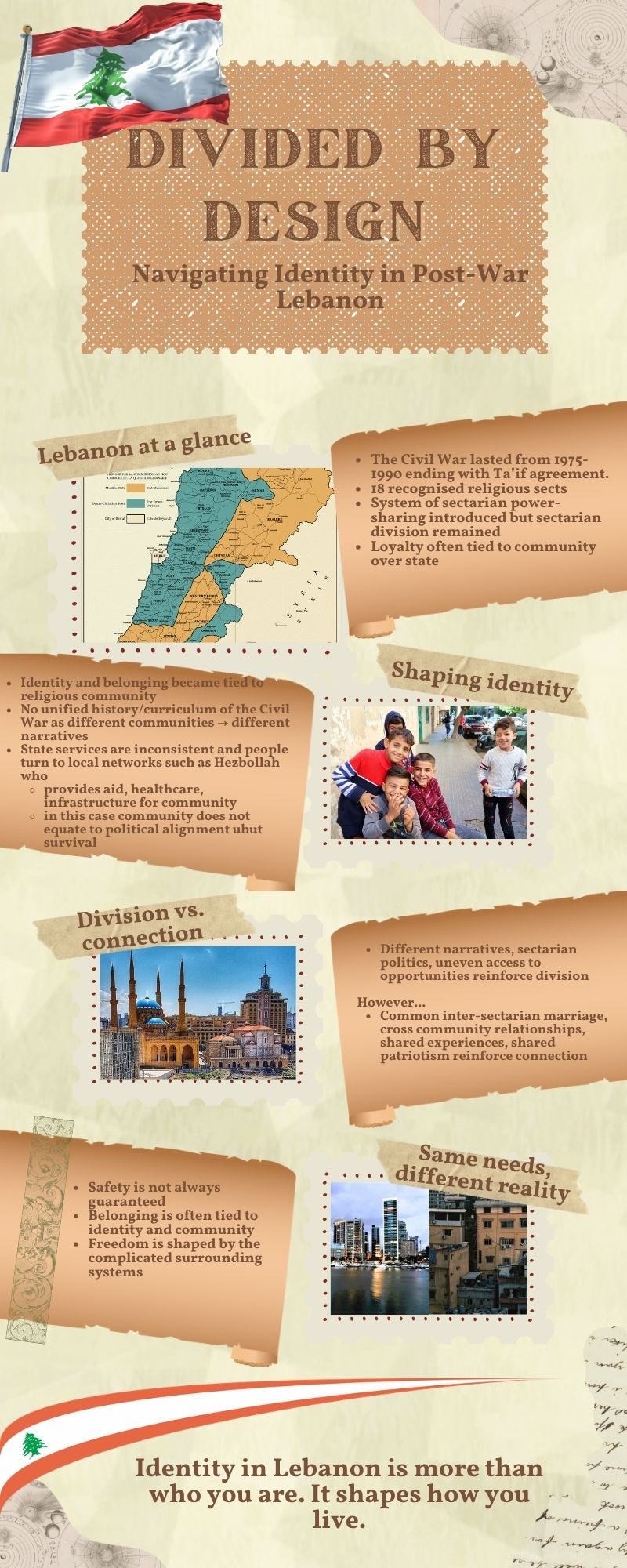
Divided by Design: Navigating Identity in Post-war Lebanon
What does it mean to be Lebanese? If you asked 10 people, you would get 10 different answers, each shaped by a different community, a different experience of the same place, and yet, beneath all of it, an undeniable and profound shared love for the country itself.
Lebanon is one of the Middle East’s most religiously diverse countries, home to a wide range of communities, cultures, experiences, and traditions. Lebanon consists of 18 religious communities or sects, which form the basis of its sectarian power-sharing political system, and while this diversity is part of what gives the country its richness, it also happens to shape everyday life in complicated ways. With so many identities existing side by side, belonging often feels layered or inherited and, at times, confusing. Rather than a simple collection of personal characteristics and experiences, identity in Lebanon sometimes feels more like something people are constantly trying to navigate.
The complicated nature is not new. In fact, Lebanon’s multi-sect power-sharing system is rooted in Lebanon’s history and geographic evolution. Under Ottoman rule, sectarian coexistence was already a governing principle in the region. As the expansion from Mount Lebanon grew into a larger, more diverse state, more religious communities became incorporated, and when France took control under the League of Nations Mandate in 1920, it formalised and expanded this system, favouring the Maronite Christian community with whom it had historical ties.
When Lebanon gained independence in 1943, leaders inherited this framework and cemented it through the National Pact (United Nations, 2008). In practice, this means that Lebanon’s highest offices are allocated by sect. The president a Maronite Christian, the prime minister a Sunni Muslim, and the speaker of parliament a Shiite Muslim (Britannica, n.d.). These systems were later reinforced by the Ta’if agreement of 1989 that ended the Lebanese Civil War, which maintained these categories but shifted the balance of power, reducing presidential authority and increasing that of the cabinet, rather than dismantling the sectarian dynamic (United Nations, 2008).
While this system was originally created to manage coexistence and prevent conflict, it also tied political stance to sectarian identity. This catalysed the idea that loyalty is first owed to the community rather than to the state. Over time, this dynamic made it hard to build a single unified sense of identity, leaving sectarian divisions within the system itself. This system created a fragile and volatile environment that struggled to adapt to internal and external pressures, contributing to the Lebanese civil war, which formally ended in 1990 but whose effects remain present in everyday life. These questions of identity did not merely fade into the background, but they continued to be shaped by the systems that organise society.
My interest in this topic stems from my own experience navigating identity. Having grown up in a family made up of 5 different sectarian backgrounds, I witnessed firsthand how the sense of “belonging” was not always fixed. While at times it raised questions about where I may or may not belong, it also revealed something else: that identity can create connections across the communities, not just division. I believe it is this tension between separation and connection that makes the reality of post-war Lebanon deeply complicated, yet deeply human; a reality that many people in Lebanon continue to navigate. This experience of navigating identity is not unique to Lebanon. For many young people around the world today, identity rarely presents itself as a single, clear answer. It is something negotiated, questioned, and, in some cases, contradicted by the systems around them.
The Lebanese civil war itself left deep and long-lasting scars that are continuously shaping how identity is experienced and navigated today. Over 15 years of civil conflict, state institutions collapsed, and militias began to take control over different regions. For some, violence became part of daily life. Entire communities were displaced and persecuted, and many events of aggression left collective trauma that was never fully addressed (Sune, 2011).
The war was not a single conflict but a collection of shifting alliances and interventions. Consequently, there is no single “correct” narrative or recollection. In practice, decades later, there is still no shared understanding of what really happened, as different communities often hold on to their own interpretations of the past (LCPS, 2025).
These divisions are not only remembered but also reproduced within societies. In education, for example, there is not one fully unified history curriculum that addresses the Civil War in a consistent way. Schools often adopt narratives aligned with their community’s experience of the war, while some schools avoid it altogether, leaving profound gaps in collective memory (Maktabi, 2012).
Students ultimately grow up learning about their country’s history not from a national perspective but through the perspectives of their communities, reinforcing the idea that identity belongs to separate groups rather than a whole nation (Salloukh et al., 2015).
The gap between personal narrative and shared history is also something many young people around the world may resonate with. It is not uncommon to feel that what you are being taught depends heavily on who is teaching and what they need you to believe. In the United Kingdom and the United States, debates regarding how colonialism and racial injustice are taught at schools reflect a similar tension: whose version of history gets told, and whose does not? In Lebanon, however, this is not a political debate happening within a curriculum. It is rooted in the system itself. An entire generation grows up without a common story of their own country to stand on.
The impact of these systems is also prevalent in everyday survival. In parts of Lebanon, particularly in the south, access to basic services such as healthcare and education is not always consistently available from the state. As a result, people often rely on non-state organisations to meet their needs. In certain areas, groups such as Hezbollah have stepped in to fill these gaps, providing welfare services and infrastructure support (Khatib, 2021). For many families, this support is not a matter of political alignment nor a political choice that was made. It is simply a means for survival.
Simultaneously, this dynamic fosters a system where access to essential services becomes closely tied to communal belonging. The idea that where you come from determines what you can access is not specific to Lebanon; however, in this case, it operates at a level that shapes not just opportunity but survival. While these networks do provide support in times of instability, they can also deepen divisions by reinforcing reliance on certain groups. It is in this way that identity becomes linked not only to culture or belief, but to survival itself. The result is a reality where belonging to certain communities or groups determines access to necessary resources.
While these divisions are usually not formally enforced, they are generally understood. They shape where people live and feel safe, what opportunities are available to them, where they build relationships, and more. Yet at the same time, these boundaries are not absolute. Connections across communities continue to exist, figuring out identity in ways that challenge the systems around them. This is often visible in personal relationships where people form connections that may not fit within the sectarian boundaries.
While generally rare in the region, Lebanon in spite of sectarian fragmentation, is frequently cited for its high rate of interfaith/inter-sectarian marriages, reflecting the nation’s deeply interconnected social structure (Deeb, 2020).
This is particularly striking considering Lebanon’s lack of civil marriage structure. Marriages must be conducted through a religious authority meaning couples technically must marry within a shared religious identity or travel abroad to do so. This ultimately gives religious leaders significant influence over personal life, reinforcing ties between legal status, faith, and identity.
However, the persistence of interfaith relationships despite these limitations prove that identity is not always confined to rigid categories that the system imposes.
Additionally, while boundaries are powerful, they were never total, and this is seen in spaces such as central Beirut, home to the American University of Beirut, a private, independent, non-sectarian institution of higher learning founded in 1866. Such institutions historically drew students and communities from across sectarian lines and created common grounds in an otherwise divided landscape (American University of Beirut, 2020).
For people living between communities, identity rarely feels fixed. It shifts depending on contexts, where you are, who you are with, and what’s being asked of you. While for some this can create uncertainty, it also allows for a broader sense of connection that challenges the idea that belonging must belong to a single group.
Addressing challenges of identity in post-war Lebanon is not simply a matter of reforming institutions. It also requires us to rethink how identity is understood within the Lebanese society. For example, efforts to introduce a unified history curriculum, or strengthen public service could create conditions where identity is less tied to division and more so to shared experience. This is evident in institutions such as the Lebanese Army, Red Cross, and other non-sectarian entities. However, one must remember that these changes exist within a system battling economic pressure and unresolved tensions, and any shift towards a more inclusive sense of belonging would eventually need to balance these realities.
Ultimately, Lebanon’s post-war reality cannot be reduced to a single story of division or unity. The systems that structure identity continue to reinforce separation from how people access services to what children learn at school. Yet within these systems, people in Lebanon continue to form relationships and cross boundaries that do not always follow the lines drawn for them. Understanding identity in Lebanon today is not merely about recognising its divisions, but about exploring how people live within and beyond them.
Reference list
American University of Beirut (2020). The University. [online] Available at: https://www.aub.edu.lb/Registrar/Documents/catalogue/graduate20-21/university.pdf [Accessed 22 Apr. 2026].
Deeb, L. (2020). Beyond sectarianism: Intermarriage and social difference in Lebanon. International Journal of Middle East Studies, 52(2), pp.215–228. doi:https://doi.org/10.1017/s0020743819000898.
Encyclopedia Britannica. (n.d.). Lebanon - Lebanon after independence. [online] Available at: https://www.britannica.com/place/Lebanon/Lebanon-after-independence.
Khatib, L. (2021). How Hezbollah holds sway over the Lebanese state. [online] Chatham House – International Affairs Think Tank. Available at: https://www.chathamhouse.org/2021/06/how-hezbollah-holds-sway-over-lebanese-state.
LCPS (2025). Fifty Years After the Lebanese Civil War: Does Knowing Still Matter? [online] LCPS. Available at: https://www.lcps-lebanon.org/en/articles/details/4927/fifty-years-since-the-outbreak-of-the-lebanese-civil-war-does-knowing-still-matter.
Maktabi, R. (2012). Lebanon’s missing history: Why school books ignore the past. [online] CNN. Available at: https://edition.cnn.com/2012/06/08/world/meast/lebanon-civil-war-history.
Salloukh, B.F., Barakat, R., Al-Habbal, J.S., Khattab, L.W. and Mikaelian, S. (2015). The Politics of Sectarianism in Postwar Lebanon. doi:https://doi.org/10.2307/j.ctt183p3d5.
Sune, H. (2011). The Historiography and the Memory of the Lebanese Civil War | Sciences Po Violence De Masse Et Résistance - Réseau De Recherche. [online] SciencesPo. Available at: https://www.sciencespo.fr/mass-violence-war-massacre-resistance/fr/document/historiography-and-memory-lebanese-civil-war.html.
United Nations (2008). The Taif Agreement. [online] Available at: https://www.un.int/lebanon/sites/www.un.int/files/Lebanon/the_taif_agreement_english_version_.pdf.
Van Esveld, B. (2023). Lebanon Rejects Civil Marriages, Puts Children at Risk. [online] Human Rights Watch. Available at: https://www.hrw.org/news/2023/02/07/lebanon-rejects-civil-marriages-puts-children-risk.
In this episode Aiya discusses the Lebanese expereince of rebuolding its identity within a system of secretrain division. She is a Citizen journalist with us on a placement organised with Department of War Studies, King’s College, London.
Thank you for reading an A4R 🎨 Post. Don’t forget to try out gaming art NFT’s here. Every purchase scales our impact and pays our bills.


