

AT A GLANCE - Mosul’s youth are rebuilding more than infrastructure—they are reclaiming identity, dignity, and agency after ISIS. Through education, local initiatives, and creative expression, they are reshaping their city’s narrative. Despite ongoing economic and social challenges, their efforts highlight a shift from recovery as survival to recovery as self-determined and community-led transformation.
Backstory
After ISIS: How Mosul’s Youth are Rebuilding Identity, Not Just Cities
On a quiet afternoon in Mosul, the sound of construction blends with the laughter of university students returning to campus. Less than a decade ago, these same streets were controlled by the Islamic State of Iraq and Syria (ISIS), which seized the city in 2014 and ruled until its defeat in 2017. Today, while buildings and infrastructure are being restored, deeper reconstruction is also taking place—one centred on identity, dignity, and the ability of young people to imagine a future. At first glance, young people in Mosul may seem worlds away, but in reality, they are just like us: young, determined, and ambitious. The only real difference between Gen Z in Mosul and their peers in the West is geographical chance.
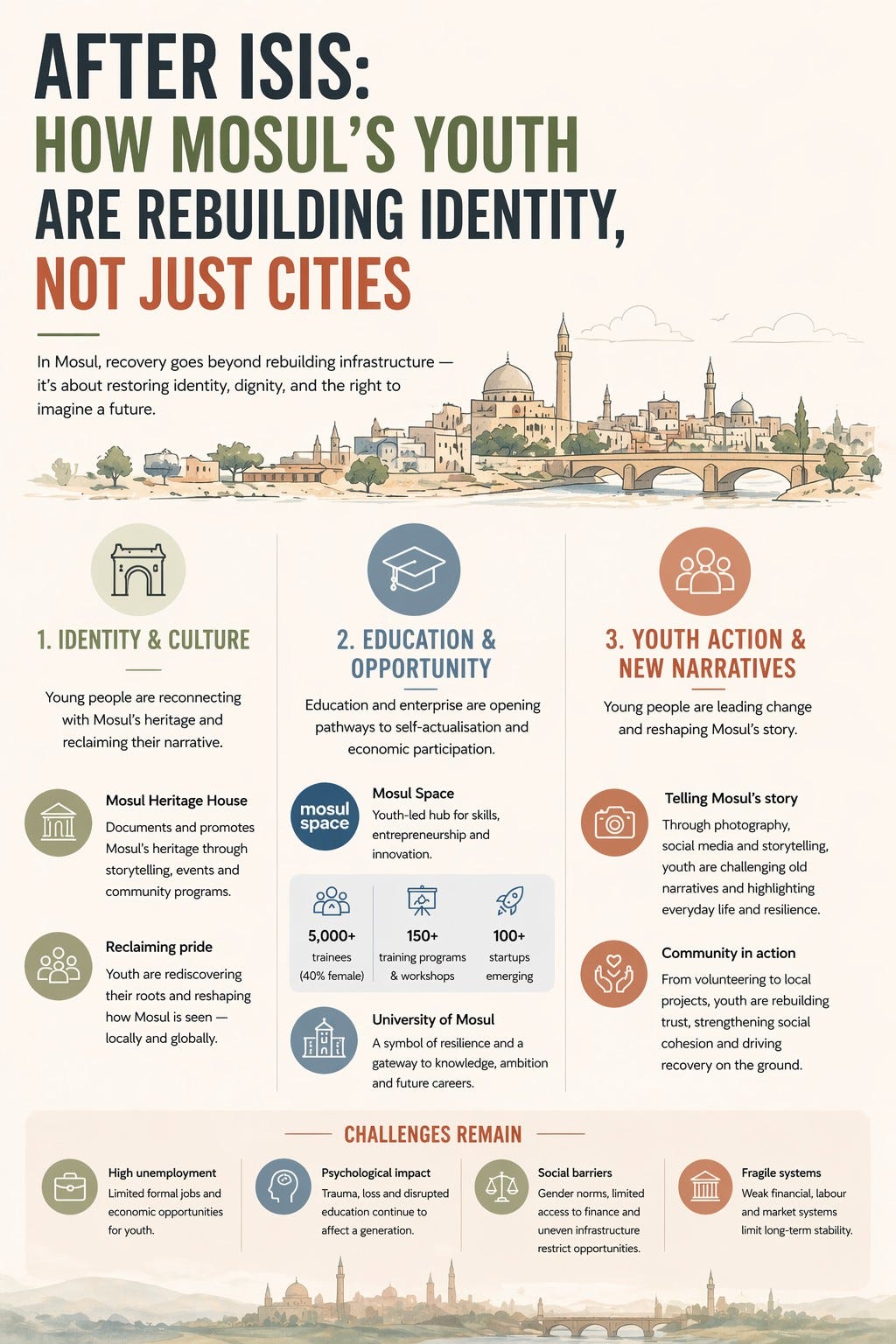
Imagine being known globally for something you didn’t choose. The youth in Mosul are like any other: they had plans and dreams, but had to put these on pause, and instead focus on simply surviving. While they struggled to survive under occupation, they were seen internationally as ‘terrorists’ or a lost generation. Even after the conflict ended in 2017, and reconstruction began, the world seemed to forget about the social costs of war. Gen Z in Mosul were stripped of their identity and dignity, but through local organizations such as Mosul Heritage House and Mosul space, they are beginning to reclaim their narrative and cultural identity.
The idea of Mosul Heritage House (MHH) emerged in 2017, after the second-longest war in modern history. As a result of the conflict, Mosul suffered the loss of various archaeological and heritage sites, a deliberate attempt to strip the city of its identity
and sever its people’s connection to their roots. Inspired by the city’s rich history, MHH documents and promotes Mosul’s heritage, initially through social media, but now more so through developmental programs, events and activities. This has allowed young people to connect with their roots and become proud of their culture. Rather than accepting the narratives imposed on them, Gen Z in Mosul can redefine their narrative, and control how they’re perceived.
Mosul Space is another local organisation whose focus lies in helping young people reclaim their dignity and identity. This youth-led cultural and educational hub offers workshops, community events, and discussions. Their values include ‘making a difference’, ‘community’ and ‘leadership’, which are reflected in their efforts to empower participants to drive social change, rebuild local networks, and take an active role in shaping the city’s recovery. According to Mosul Space, over 5,000 trainees (40% female) have completed over 150 training programmes and workshops in tech and business. Not only this, but over 10,000 youths have been engaged with more than 100 startups beginning their journey through Mosul Space’s activities.
For many, these spaces are more than training centres. They are places where young people meet, collaborate, and begin to rebuild a sense of normal life.
Yet their impact extends far beyond employment. It signals a broader restoration of identity and dignity among Mosul’s youth. By equipping young people with the tools to create, lead, and innovate, Mosul Space enables them to reclaim agency over their futures and challenge narratives that once reduced them to victims or security risks. In doing so, these initiatives contribute to reshaping Mosul’s story—from one defined by conflict and destruction to one rooted in resilience, creativity, and renewal—while reconnecting a new generation to the city’s cultural and social fabric.
For many young people in Mosul, conflict did not erase ambition; it delayed it. They had plans of being students, entrepreneurs, and professionals—plans interrupted not by choice, but by geographical circumstance. During restoration after the conflict, education served as a foundation for self-actualisation. The University of Mosul stands as a powerful symbol of resilience after extensive destruction during ISIS occupation. As one of the largest research and educational centres in the Middle East, and the second largest in Iraq, the university signals the return of intellectual life, ambition and a sense of normality. Education remains one of the clearest pathways to future careers and identity rebuilding and the return of students after such disruption reflects their discipline and ambition.
This process is reinforced by local organizations such as SPARK, which support youth across Iraq through higher education, vocational training and SME development. Through tackling skills mismatch and unemployment, SPARK has enabled the youth to translate education into tangible opportunities. This reflects a broader shift in Mosul’s recovery—from rebuilding infrastructure to rebuilding people, where the focus moves beyond jobs alone to agency, participation, and community rebuilding.
It is through this combination of education and opportunity that self-actualisation becomes possible. In Mosul, this is not simply about careers or economic participation; it is about reclaiming the right to imagine a future. In doing so, this generation is not only rebuilding their own lives but also restoring a sense of dignity and contributing to the redefinition of the city’s collective identity.
Reclaiming the right to imagine a future is only the beginning. Across Mosul, young people are now turning that vision into action. They are not waiting for change—they are creating it.
In the years following the conflict, youth have increasingly taken on active roles within their communities, contributing not only to physical recovery but also to social cohesion. Through volunteer-led initiatives, informal networks, and peer-driven projects, they are addressing local needs and rebuilding trust at the community level. These forms of engagement reflect a shift from participation to ownership, as young people move from being recipients of aid to drivers of change.
Nowhere is this shift more visible than in the digital space, where young Iraqis are using photography, social media, and storytelling to challenge dominant narratives of conflict and destruction. Emerging photographers and content creators from Mosul document everyday life in the city, capturing moments of resilience and cultural continuity that are often absent from international coverage. In doing so, they are not only preserving memory but actively reshaping how Mosul is perceived both locally and globally.
Beyond digital platforms, youth are also contributing to the preservation and revival of cultural identity. Through community engagement and grassroots initiatives, they are reclaiming spaces, histories, and narratives that were once threatened or erased.
In this sense, contribution in Mosul extends beyond rebuilding infrastructure; it is about rebuilding meaning. By actively shaping their communities and redefining their city’s story, young people demonstrate that recovery is not something done for them, but something led by them.
Despite these advances, significant challenges continue to shape the lives of young people in Mosul. Unemployment remains persistently high, particularly among youth, limiting the ability to translate skills and education into stable livelihoods. While initiatives have expanded access to training and entrepreneurship, opportunities in the formal labour market remain constrained, leaving many navigating precarious or informal work.
Beyond economic barriers, the psychological impact of conflict continues to affect a generation that grew up amid violence and instability. Experiences of displacement, loss, and disrupted education have left lasting effects, often shaping both personal and professional trajectories. Social constraints also persist. Gender norms, limited access to finance, and uneven infrastructure development continue to restrict opportunities for many, particularly women and those from marginalised communities.
However, acknowledging these challenges does not undermine progress. Rather, it highlights the complexity of recovery in Mosul—where resilience and ambition coexist with structural constraints, and where the path to long-term stability remains ongoing.
Mosul’s future is no longer defined by the shadows of its past but by the determination of a generation rewriting its story. The aspirations of young people in Mosul mirror those of their peers around the world. The only real difference is geographical chance. By recognising this shared humanity, we move beyond distant empathy and towards genuine connection.
Sources
https://mosulspace.org/
https://www.mosulheritage.org/en/about-3 https://uomosul.edu.iq/en/
https://spark.ngo/middle-east-and-north-africa/iraq/
In this episode Hafsa discusses life after ISIS in Mosul with a focus on how the next generation are education, local initiatives, and creative expression. She is a Citizen journalist with us on a placement organised with Department of War Studies, King’s College, London.
Thank you for reading an A4R 🎨 Post. Don’t forget to try out gaming art NFT’s here. Every purchase scales our impact and pays our bills.


