


AT A GLANCE - Liberian women played a crucial role in ending the civil war and rebuilding communities, yet remain underrepresented politically and economically. Despite legal frameworks and grassroots initiatives, violence, stigma, cultural norms and weak enforcement continue to limit participation. Strengthening women’s leadership, rights, economic opportunities and collective advocacy is essential to sustainable peace and recovery.
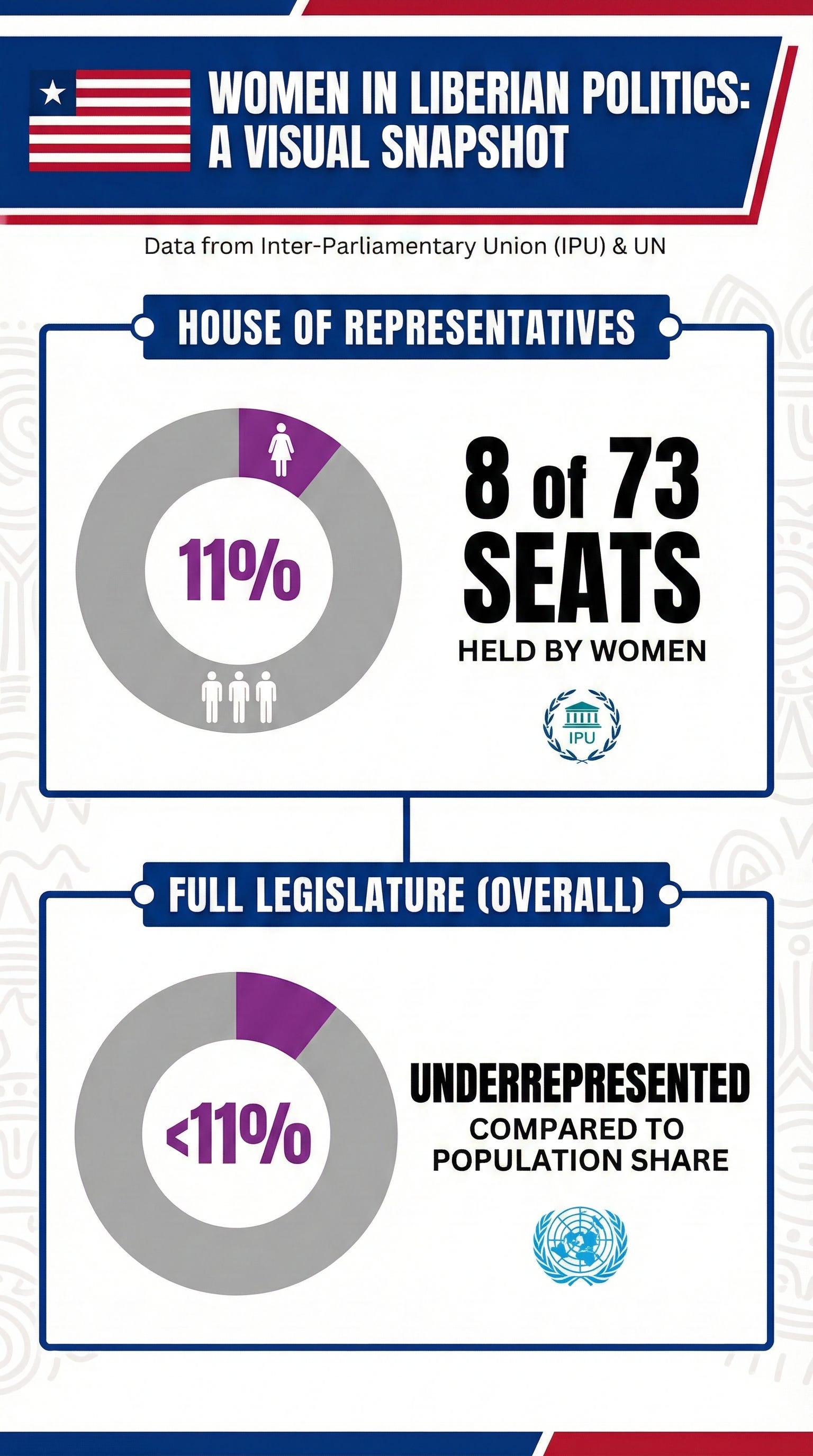
Liberia: Women, Peace building, and the Persistent Struggle for Inclusion
In Liberia, women were central to peacebuilding and post-conflict recovery following the civil war (1989-2003), yet their influence in decision-making remains marginalized. The war subjected women to displacement, sexual violence, and the disintegration of community structures. An estimated 30–40% of all fighting forces were women and girls who joined for survival, protection, or coercion, and many endured brutal trauma. One survivor, forcibly recruited at age ten, recalled: “I stayed with them throughout the course of the war as I was so young and had nowhere else to go.”
Following the ceasefire, women’s groups, including the Women in Peacebuilding Network (WIPNET) and the Mano River Women’s Peace Network (MARWOPNET), mobilized. They participated in peace negotiations, organized public marches, and successfully advocated for the inclusion of women’s needs in the national rebuilding agenda. These efforts were foundational to the election of Liberia’s first female president, Ellen Johnson Sirleaf, and culminated in the international recognition of Leymah Gbowee, Tawakkol Karman, and Ellen Johnson Sirleaf with a Nobel Peace Prize in 2011. Leymah Gbowee described how women saw each other beyond faith differences in their organising for peace across religious lines: “We saw each other not through the lens of our religion, but through the lens of our womanhood.”
After the war the UN standards ordered gender‑responsive Disarmament, Demobilisation, Rehabilitation and Reintegration (DDRR) after 2003, but implementation was limited. The DDRR plan included provisions such as care centres with special assistance in sexual trauma support.
Yet, as Leymah Gbowee observed, when women tried to participate in planning these programmes, they were discouraged: “The women who tried to get involved in the planning of the DDRR process were told to go home and take care of the children.” Many women avoided identifying as ex‑combatants for fear of stigma. Other barriers, from lack of childcare to safety concerns and fear of reprisals, also limited women’s engagement in reintegration and community rebuilding.
Nearly two decades after the conflict’s end, women’s political representation remains low. Women hold only one in nine parliamentary seats and head few government ministries. According to statistics released in March 2019 by the World Economic Forum, Liberia is currently listed low down on the global ranking of women representation in Parliament, at 151 out of 193.
Despite the existence of legal frameworks, such as gender quotas intended to boost representation, enforcement is demonstrably weak, limiting women’s practical influence on national recovery programs. Research into the implementation of the African Union’s Post‑Conflict Reconstruction and Development (PCRD) framework found that only about 15% of post‑conflict programmes in Liberia specifically addressed women and gender issues.
The Enduring Cost of Conflict
The challenges facing Liberian women extend beyond political underrepresentation to issues of fundamental safety. During the civil war, sexual violence was systematically directed against women and girls, many of whom were kidnapped, forced into sexual servitude, or left as sole caretakers for children and families after suffering the loss of male relatives. These experiences have created deep-seated, lasting trauma that complicates long-term recovery.
Post-conflict, sexual and gender-based violence (SGBV) continues to be prevalent, compounded by weak legal protections. Victims reporting abuse frequently face prolonged delays in the justice system, social stigma, or outright dismissal of their claims. The lack of security directly impedes women’s ability to fully participate in community and national reconstruction efforts.
Systemic Barriers to Inclusion
Several factors contribute to the difficulty women face in achieving full participation in post-conflict recovery:
Cultural Norms: Entrenched beliefs regarding gender roles continue to restrict women’s access to education, leadership positions, and property rights.
Political Barriers: Legal mechanisms intended to support women’s representation suffer from poor enforcement. Women remain underrepresented within political parties, government ministries, and legislative bodies.
Economic Inequality: Women generally earn less than men and possess limited access to capital, land, and other resources necessary for meaningful involvement in reconstruction programs.
Fragmented Advocacy: Numerous women’s organizations exist, yet they often operate in isolation, diminishing their collective influence on national policy.
Speaking Out Through Film and Shared Storytelling
To help break stigma and support reintegration, Amnesty International and Liberian partners used film to give voice to women’s experiences. In 2008, they released Women of Liberia: Fighting for Peace and toured the country with it. A former girl soldier featured in the film explained why sharing stories matters: “If I tell my story and listen to other people’s stories, we cry together. [Then] we come together and make a decision about what we want for our country and for women in Liberia. Because we are part of the decision‑making, and we have our rights.”
Grassroots Leadership in Recovery
Despite the barriers, grassroots leadership, community action, and women’s groups have been able to implement positive post conflict development. Across several counties, community‑led initiatives supported by organisations such as UN Women have empowered women through Peace Huts, where women receive literacy training, learn about their land and legal rights, and establish village savings and loans that allow them to start businesses and pay school fees for their children. In some of these Peace Huts, women report newfound confidence in public speaking and awareness that “women can contest in elections as candidates.” The United Nations in Liberia Groups like the Mano River Women’s Peace Network (MARWOPNET), together with associations such as the Association of Female Lawyers of Liberia, have provided trade training (for example seamstress skills), helped women secure contracts, and supported legal representation for victims of gender‑based crimes. Broader community initiatives have also increased women’s participation in land rights discussions: after sustained programmes to raise awareness of the 2018 Land Rights Act, more than 7,000 community members now better understand land rights, and women increasingly assume leadership roles in community land development and dispute resolution committees. In one case, women leaders successfully helped a widow regain her right to land ownership after her husband’s death. The United Nations in Liberia These efforts show that beyond formal politics, women are rebuilding economic foundations, asserting legal rights, and leading conflict resolution at the grassroots level. In another example, microfinance programs offer small loans to women to launch businesses, supporting their families and revitalizing local economies. However, such programs occasionally impose restrictions—such as requiring spousal approval for accessing funds—that reinforce traditional patriarchal norms.
A Path Toward Sustainable Progress
Experts and advocates emphasize that sustained progress requires a multi-layered strategy. Women’s representation in decision-making must be strengthened in practice, not just in legislation. This involves active enforcement of quotas and providing women with the training, mentorship, and resources needed to participate effectively.
Furthermore, legal frameworks require consistent enforcement. Laws designed to protect women from violence, discrimination, and exclusion must be applied uniformly across all levels of governance, from local judiciaries to national policy. Concurrently, communities must actively confront and change social norms that restrict women’s participation and fail to recognize the value of their socioeconomic contributions.
Feminist advocacy and collective organizing remain vital. Historically, women’s mobilization,from the mass protests that expedited the end of the war to campaigns for property rights and anti-rape legislation,has altered the course of Liberia’s peace process. Supporting these networks is essential to ensure that women’s voices not only register but lead to concrete action in post-conflict reconstruction.
To conclude
Liberia’s successful recovery is inextricably linked to the empowerment of its women. They have sustained communities through conflict and continue to spearhead their rebuilding. However, if women are denied equal access to political authority, economic resources, and protection from violence, the country risks sidelining half of its population, jeopardizing the sustainability of its peace. Inclusive recovery efforts, which recognize women as central peacebuilders, are universally shown to result in stronger communities, enhanced security, and a more sustainable future for all citizens. In Liberia, women have proven their capacity for post-conflict leadership and require both domestic and international support to continue building a safe and successful society.
In this episode Willow discusses the post conflict experience of Liberia and the experience of women who supported the struggle. She is a Citizen journalist with us on a placement organised with Oxford University Career Services.
Thank you for reading an A4R 🎨 Post. Don’t forget to try out gaming art NFT’s here. Every purchase scales our impact and pays our bills.


