


Backstory
Post-conflict community: From Silence to Testimony: How Courts Helped Heal Cambodia After a Genocide
In 1975, the Khmer Rouge captured Cambodia’s capital. Phnom Penh was emptied in just two days. Two million people were forced to flee their homes. The capital became a ghost town. This marked the beginning of one of the deadliest genocides of the 20th century. Around one-fifth of the population did not survive the Khmer Rouge regime. Many died along jammed roads leading from the capital during the march into the countryside. They were forced to work in labour camps every day. Food was scarce. Many died from forced labour and starvation. Anyone who was too weak to work or who refused to was murdered.
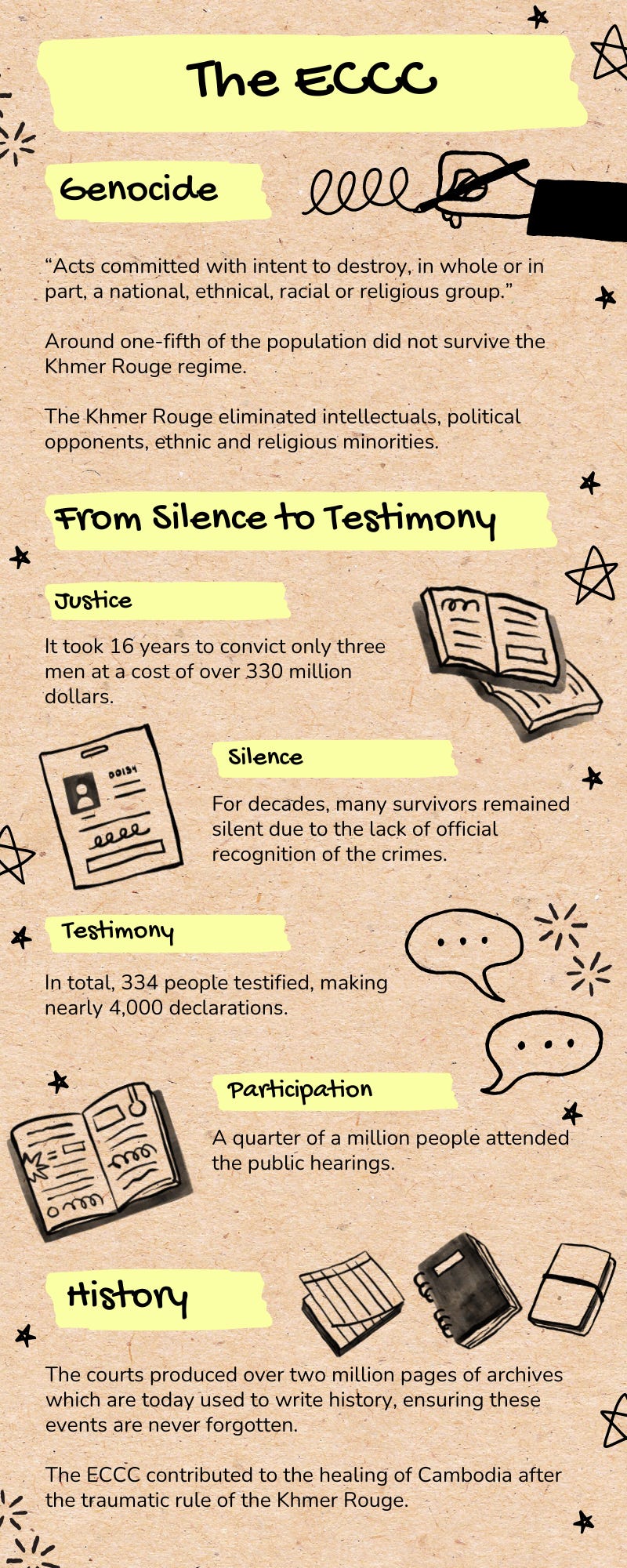
The Extraordinary Chambers in the Courts of Cambodia (ECCC) were established in 2006 to punish those most responsible for the crimes committed. The courts were created 30 years after the Khmer Rouge regime. It took 16 years to convict only three men at a cost of over 330 million dollars. This might seem like a failure. But the ECCC are widely considered to be successful. The courts prosecuted surviving Khmer Rouge leaders. The ECCC also helped Cambodians to recover from trauma by breaking the silence and establishing the facts of the crimes committed.
The Khmer Rouge was a radical communist movement. They claimed to transform Cambodian society into a classless agrarian utopia. Instead, they persecuted “intellectuals”, including doctors, teachers, and lawyers. Anyone wearing glasses or who could speak a foreign language was targeted for being “intellectual.” The Khmer Rouge also eliminated political opponents, ethnic and religious minorities. The ECCC controversially only applied the label “genocide” to the crimes committed against the Vietnamese and Cham Muslim minorities, excluding Chinese Cambodians. Raphael Lemkin legally defined genocide as “acts committed with intent to destroy, in whole or in part, a national, ethnical, racial or religious group.”
During the two trials, five Khmer Rouge leaders were prosecuted, but only three were sentenced. Duch was sentenced to life in prison for war crimes and crimes against humanity. He was the commander of the notorious S-21 prison where 14,000 were interrogated before being killed. Only seven people are known to have survived S-21. Many Cambodians died from imprisonment during the rule of the Khmer Rouge. Khieu Samphan and Nuon Chea were found guilty of genocide, war crimes, and crimes against humanity in the second trial. They were sentenced to life in prison. Nuon Chea was the movement’s chief ideologue and Khieu Samphan was Cambodia’s president. The ECCC was the first court to find a former head of state guilty of the crime of genocide.
Many escaped justice. The former Minister of Foreign Affairs Ieng Sary died before his trial ended. His wife, the former Minister of Social Affairs Ieng Thirith, escaped justice after being diagnosed with dementia. Some culprits were not even prosecuted because justice came too late. Pol Pot, the highest-ranking Khmer Rouge leader, died before the ECCC was even created. He never faced accountability. But the courts sent a strong message. No matter how much time has passed, those responsible for the worst crimes must be held accountable.
The ECCC were unique hybrid courts. Cambodian and international judges and lawyers enforced both domestic and international laws. However, this created tensions. The international co-prosecutor wanted to investigate a further five suspects, but this was blocked by Cambodian judges.
These courts fell victim to interference by political manipulation of the Cambodian government. The government was uncooperative in an attempt to shield officials who were members of the Khmer Rouge from prosecution. Hun Sen was a Khmer Rouge soldier and the Prime Minister at the time. He could have faced prosecution if the tribunal expanded its reach to low-ranking officials. Hun Sen argued that “going after any more than just the top leaders of the Khmer Rouge risked opening up wounds in Cambodian society.”
For decades, the population did not talk about the genocide. The older generation struggled to speak about their experience under the rule of the Khmer Rouge. They remained silent due to the lack of official recognition of the crimes. Some officials like Khieu Samphan even denied the crimes. He claimed that he was “not aware of the heinous acts committed by other leaders.” As a consequence, the younger generation knows little about the Khmer Rouge rule in a country where two-thirds of the population is under 30. In particular, the children of the 620,000 Cambodian refugees often know little about what happened to their ancestors.
The ECCC helped the country heal by breaking the silence. The court gave victims the opportunity to participate directly in the proceedings. During Duch’s trial, 22 victims testified, including some of the seven known S-21 survivors. For example, Chum Mey stated “I, who come to attend [the court hearings] every day, consider this court historic. I am already 79. And that I have been trying to do so is for the younger generations not to follow the path of the regime which ruled for three years, eight months and twenty days.” Many like Chum Mey waited 30 years for the opportunity to testify about the crimes committed.
Justice did more than punish. The population was given the opportunity to participate in the ECCC’s work. The proceedings occurred in the country where the crimes took place. The courts were built in the capital. The population could thus visit the site using buses commissioned by the ECCC. In total, a quarter of a million people attended the public hearings.
The ECCC improved the understanding of this period of Cambodian history. The courts led campaigns to educate school children about the Khmer Rouge regime and the courts’ work. Cambodian schools only began teaching students about the Khmer Rouge period after the tribunal’s creation.
The courts also contributed to the writing of the history of the Cambodian genocide. Most archives were destroyed by the Khmer Rouge regime in an effort to erase and rewrite history. Very few images exist to document the crimes, as the Khmer Rouge rejected modernity. No image was taken of the many executions. Films like The Missing Picture by Rithy Panh thus use clay figurines and a few archive images to tell the story of the Khmer Rouge period. Many S-21 prisoners were tortured into writing confessions in an attempt to rewrite history. Schools, universities, and tribunals were destroyed. As a result a large part of the population was illiterate. This complicates the writing of the history of the genocide.
Historians contributed to the ECCC’s creation and proceedings. For example, Ben Kiernan was one of the first to write the history of the Khmer Rouge regime. He also created the Documentation Center of Cambodia (DC-Cam) which collects data on the Khmer Rouge regime’s crimes. Historians like David Chandler participated in the legal proceedings. In total, 334 people testified, making nearly 4,000 statements. The courts produced over two million pages of archives in Khmer, French, and English. These are today used to write the history of the Khmer Rouge period.
The ECCC contributed to the healing of Cambodia after the traumatic rule of the Khmer Rouge. This highlights the important role that justice can play in reconciling post-conflict communities. The courts did more than punish some of those most responsible for the genocide. Testimonies helped break the silence. The ECCC produced archives used to write history, ensuring these events are never forgotten.
Sources -
Extraordinary Chambers in the Courts of Cambodia
A day at the Khmer Rouge Tribunal (English)
Khmer Rouge | Facts, Leadership, Genocide, & Death Toll | Britannica
Cambodian genocide | Description, Killing Fields, & Facts | Britannica
Former Khmer Rouge leaders begin genocide trial - BBC News
Khmer Rouge: What did a 16-year genocide trial achieve?
In Cambodia, the Khmer Rouge Trials Come to an End - The New York Times
In an Interview, Pol Pot Declares His Conscience Is Clear - The New York Times
From the archive, 11 December 1979: Deposed Pol Pot gives interview in the jungle
DOCUMENTATION CENTER OF CAMBODIA
After 16 years and 3 convictions, an international tribunal closes down in Cambodia
Khmer Rouge Tribunal - The Advocates for Human Rights
A Tribunal for Cambodia - United States Holocaust Memorial Museum
Bringing the Khmer Rouge to Justice: The Challenges and Risks Facing the Joint Tribunal in Cambodia

In this episode Laura discusses the post conflict experience of Cambodia following the Genocide. She is a Citizen journalist with us on a placement organised with Oxford University Career Services.
Thank you for reading an A4R 🎨 Post. Don’t forget to try out gaming art NFT’s here. Every purchase scales our impact and pays our bills.


