

Twenty years after the invasion, Iraq’s state remains a formal shell while actual trust resides in informal networks: family, tribe, and clergy. The muhasasa system solidified sectarianism, hollowing out public institutions. Yet, the Tishreen protests reveal a new generation demanding a state that recognizes them as citizens, not categories.
Backstory
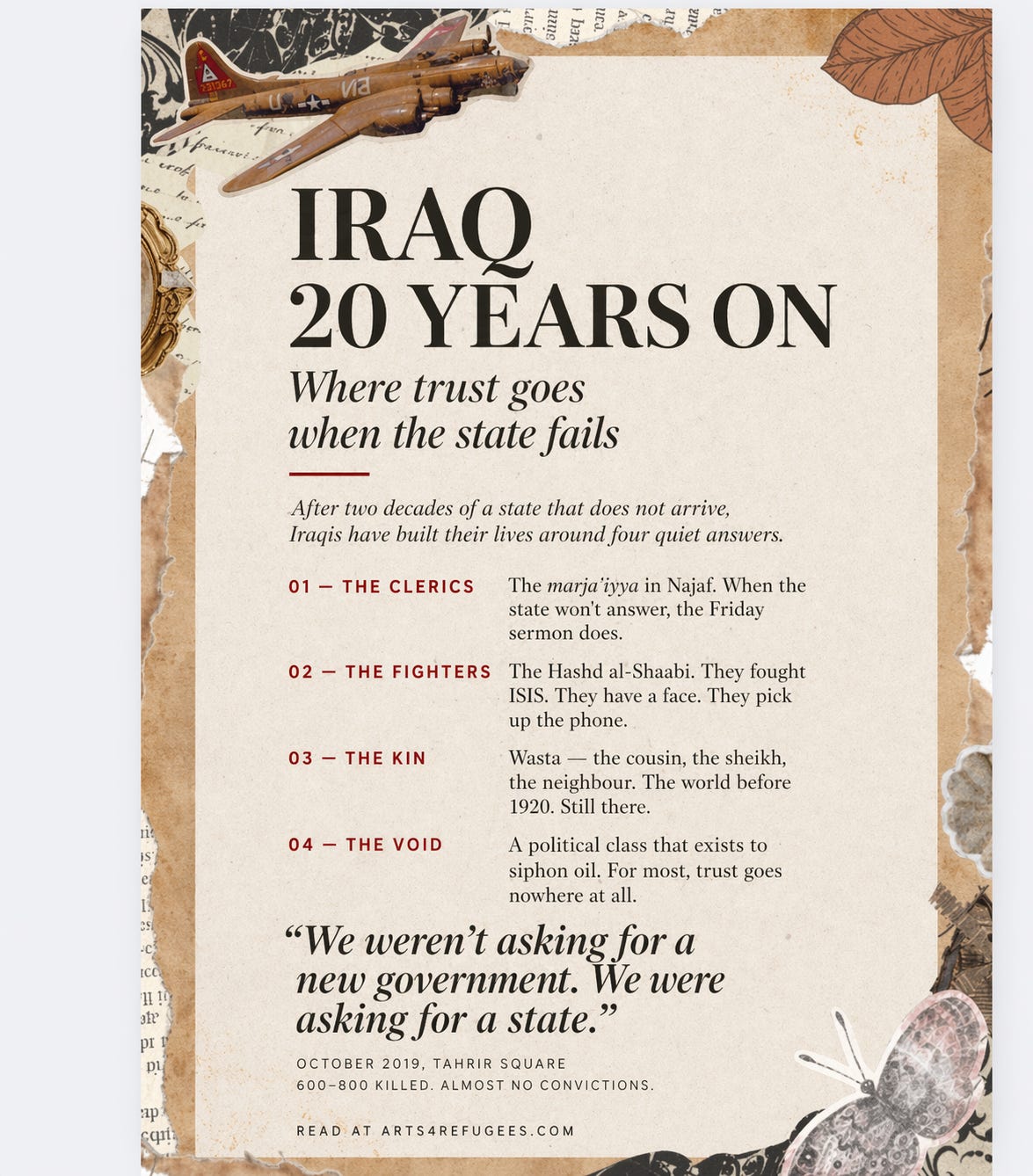
Iraq 20 Years On: Where Trust Goes When the State Fails
In a tea house in Baghdad’s Karrada district, a civil servant in his fifties rolls a cigarette and shrugs when asked whether he trusts his government. The question, he says, is the wrong one. It isn’t that he ‘distrusts’ the state, a distrust would imply he once expected something of it. He expects things of his cousin, his neighbourhood, his sheikh, and, quietly, of the marjaʿiyya (the senior shia cleric establishment) in Najaf. The state is something that happens to him.
Consider how that shapes a life. When seeking a job, you call a relative; when feeling unsafe, you call a neighbour; for paperwork, you pay a fixer. You don’t know whether the electricity will be on tonight or whether the checkpoint on your street answers to the government or to the militia.
More than twenty years after the US-led invasion, which was meant to give Iraqis a state they could finally believe in, it is tempting to read that weary shrug as the bruise of a single catastrophic war. But the longer you sit in Iraq, the clearer it becomes that the post-2003 collapse of public trust is less a wound than the exposure of an older scar, one that asks uncomfortable questions about whether the Iraqi state has ever, in any serious sense, been socially legitimate in the eyes of the people it claims to govern.
The state that wasn’t built to be trusted
Iraq as a political unit was assembled in 1920 out of three Ottoman provinces — Basra, Baghdad and Mosul — by British officials whose primary concern was not social cohesion, but rather imperial strategy. this founding moment, described as a “nation-building” project that denied its own history: a centralised state was imposed on a population whose actual social worlds ran through tribe, sect, city quarter, and religious authority. (Dodge,2003)
Think about what that means day-to-day. Your grandfather’s village had a sheikh who settled disputes. Your mother’s neighbourhood had a cleric who knew every family. Then an unfamiliar clerk insists those ties do not count and your marriage, land and sons schooling mustb be registered in a ledger. You nof and go back to calling the sheikh.
The Hashemite monarchy, the series of coups that followed, and eventually the Ba’ath Party each inherited that basic problem. Saddam Hussein’s regime is often remembered as ferociously coercive, but coercion is what a state reaches for when it cannot rely on legitimacy. Where the Ba’ath could not command belief, it commanded obedience. The social contract was not trust but fear. Underneath the fear, Iraqis continued to turn to family, tribe, mosque and bazaar for security, welfare and dispute resolution.
This matters for the story of 2003, because the Americans who arrived in Baghdad believed they were liberating a people from a dictator. They were, in fact, removing the fear that had been doing the work of legitimacy.
The moment the lid came off
In the spring of 2003, a young soldier in the Iraqi army woke up to learn he no longer had a job. The stroke of an American pen had dissolved his army. Down the street, a primary school teacher who had joined the Ba’ath Party in 1984 because that was the only way to teach primary school was told she could not return to her classroom. Overnight, two working adults had their identities rewritten from soldier and teacher into something smaller- ex-regime, suspect.
These were the Coalition Provisional Authority’s two founding decisions — dissolving the Iraqi army and expelling Ba’ath Party members from public life, and scholars agree they were catastrophic (Dodge, 2012). Hundreds of thousands of armed men returned home without salaries and experienced civil servants were purged, hollowing out state capacity. What the CPA could not see was that it was not simply removing a regime, it was dismantling the thin scaffolding on which a very fragile public order rested.
In its place came the muhasasa ta’ifiyya — the sectarian apportionment system that divided ministries among Shia, Sunni and Kurdish elites according to quotas. (Dodge, 2018) In practice, this meant that getting a job at the Ministry of Oil depended less on your qualifications than on which party held the ministry that year, and whether your cousin knew someone in it. It meant that rebuilding a hospital in Basra depended on which faction’s budget line it fell under. It meant that when a young Iraqi applied for a government role, the first relevant question was not “what credentials do you have?” but “who are your people?”.
The political scientist Fanar Haddad (2011) pointed out that before 2003, Iraqi political discourse barely used the language of sect at all. The muhasasa did not simply acknowledge sectarian difference; it made sect the primary currency of political life. The post-2003 state was not designed to earn legitimacy from Iraqis as citizens. It was designed to distribute resources among elites who claimed to represent them as Sunnis, Shia or Kurds. The citizen — the figure to whom a modern state is supposed to be accountable — was structurally absent from this deal.
Where trust went
If trust could not settle in the state, it had to settle somewhere. The last twenty years are, in many ways, the story of where.
Some of it went to the marjaʿiyya — the senior Shia clerical establishment based in Najaf, and particularly to Grand Ayatollah Ali al-Sistani. When the CPA initially proposed writing Iraq’s constitution without direct elections, it was a fatwa (a legal opinion or ruling by a senior cleric) from Sistani, not a lawsuit or a parliamentary revolt, that forced a reversal. (Chandrasekaran, 2003). The political scientist Patel (2022) argues that Iraqis turned to the mosque in part because the mosque offered something the state did not: a legitimate institution with clear leadership, rooted in a social world they recognised as their own. When your electricity cuts out for the ninth time that week, and your MP is unreachable, and a Friday sermon in Najaf tells you the government must do better, it is the sermon you remember. The mosque became the group chat, the union, the local councillor, the trusted news source all folded into one.
Some of it went to the militias. The Popular Mobilisation Forces (al-Hashd al-Shaabi) were formed in 2014 to fight ISIS after the Iraqi army collapsed at Mosul — a collapse that was itself the clearest possible verdict on the state’s ability to command loyalty from its own soldiers. (Mansour and Jabar, 2017). The Hashd won that war. For many Iraqis in Shia-majority areas, the militia that fought ISIS in their name is a more tangible protector than the Ministry of Interior will ever be. It has a face, and it picks up the phone.
And some of it — perhaps most of it — went nowhere. It dissolved into the everyday conviction that the political class is a closed extractive club, that jobs come through wasta (connections) rather than merit, and that the state’s main function is to siphon oil revenue into the pockets of the people already running it.
Tishreen: the generation that wanted a state
This is why the Tishreen protests of October 2019 matter so much, and why they are so easily misread from the outside.
Tishreen was not a sectarian movement. It was largely Shia in its geography, Baghdad and the southern provinces, but its demands were the opposite of sectarian. Young Iraqis poured into Tahrir Square demanding jobs, services, an end to corruption, and the dismantling of the *muhasasa* system itself. (EPIC, 2021)
Many of the protesters were part of a generation that had grown up entirely after 2003. They demanded — jobs, dignity, a future. They had wanted to study engineering, open cafes, make films, move abroad and come back: a quiet list of ambitions any 20 year old carries demands not so different from those of young people elsewhere. What is different is the system they are making those demands of.
A graduate in Manchester who cannot find work blames the economy, or their degree, or the government of the day, and votes. A graduate in Basra who cannot find work knows that the job exists, that it has been promised to someone’s nephew, and that voting will not change it. The grievance is recognisable. The wall it meets is not.
What the Tishreenis were asking for, in the end, was something Iraqis have rarely had the chance to ask for: a state that relates to them as citizens rather than as members of a sect. They were asking for the legal-institutional relationship that had never actually existed.
The response was telling. Around 600 to 800 protesters were killed and tens of thousands injured, with state security forces and militia-linked paramilitaries both implicated. (International Crisis Group, 2021). Four years on, Amnesty International (2023) reported that virtually none of those responsible had been held to account. The protesters had made, for a moment, the most Iraqi demand imaginable, to be a state, and the answer came back in live ammunition.
Twenty years on
Ask a displaced Iraqi family in Jordan, or a Kurdish teenager in Erbil, or a Baghdadi student whose cousin was killed in Tahrir Square, what their relationship to the Iraqi state is, and you will very rarely hear the vocabulary of rights, laws and obligations that political theory tells us should anchor modern citizenship. You will hear the vocabulary of kinship, faith, neighbourhood, and survival. That is not evidence of some innate Iraqi incapacity for statehood. It is evidence of a century-long pattern in which the formal state has consistently failed to make itself legible to, or answerable to, the people living inside its borders.
The uncomfortable conclusion is that the post-2003 collapse of public trust in the Iraqi state is not a deviation from a healthier past. It is the continuation, under new management, of a relationship that has always been thinner than the map suggested.
The wants of these young Iraqis are not exotic. They want to feel safe, to be understood, not flattened into a sect. They should be entitled to a say in their future, and their names should mean more than the box it sits in on a government form. This list is the same list anyone reading carries around. The difference is what it costs to want it.
The people who shrug in Karrada tea houses are not cynics. They are waiting, with the patience of people who have waited before — waiting for a system that recognises them not as categories, but as citizens.
Bibliography
Amnesty International. “Iraq: Four Years After Tishreen Protests, No Justice for State and Militia Violence.” 28 September 2023. https://www.amnesty.org/en/latest/news/2023/09/iraq-four-years-after-tishreen-protests-no-justice-for-state-and-militia-violence/.
Chandrasekaran, Rajiv. “How Cleric Trumped U.S. Plan for Iraq.” *Washington Post*, 26 November 2003. https://www.washingtonpost.com/archive/politics/2003/11/26/how-cleric-trumped-us-plan-for-iraq/e82c7c68-ff47-4201-8f2c-26ec4a6999e7/.
Dodge, Toby. *Inventing Iraq: The Failure of Nation Building and a History Denied*. New York: Columbia University Press, 2003.
Dodge, Toby. *Iraq: From War to a New Authoritarianism*. London: International Institute for Strategic Studies / Routledge, 2012.
Dodge, Toby. “Tracing the Rise of Sectarianism in Iraq after 2003.” LSE Middle East Centre Blog, 13 September 2018. https://blogs.lse.ac.uk/mec/2018/09/13/tracing-the-rise-of-sectarianism-in-iraq-after-2003/.
Enabling Peace in Iraq Center. *The Long Game: Iraq’s “Tishreen” Movement and the Struggle for Reform*. Washington, DC: EPIC, 2021. https://enablingpeace.org/tishreen/.
Haddad, Fanar. *Sectarianism in Iraq: Antagonistic Visions of Unity*. London: Hurst & Co., 2011.
International Crisis Group. *Iraq’s Tishreen Uprising: From Barricades to Ballot Box*. Middle East Report No. 223. Brussels: International Crisis Group, 26 July 2021. https://www.crisisgroup.org/middle-east-north-africa/gulf-and-arabian-peninsula/iraq/223-iraqs-tishreen-uprising-barricades-ballot-box.
Mansour, Renad, and Faleh A. Jabar. *The Popular Mobilization Forces and Iraq’s Future*. Carnegie Middle East Center. Beirut: Carnegie Endowment for International Peace, 28 April 2017. https://carnegieendowment.org/research/2017/04/the-popular-mobilization-forces-and-iraqs-future.
Patel, David Siddhartha. *Order Out of Chaos: Islam, Information, and the Rise and Fall of Social Orders in Iraq*. Ithaca, NY: Cornell University Press, 2022.
In this episode Mace discusses the Iraqi expereince of rebuolding their country 20 years on. She is a Citizen journalist with us on a placement organised with Department of War Studies, King’s College, London.
Thank you for reading an A4R 🎨 Post. Don’t forget to try out gaming art NFT’s here. Every purchase scales our impact and pays our bills.


