


Thirty Years After Genocide: How Rwanda and Bosnia Rebuild Safety, Identity, and Belonging
Introduction
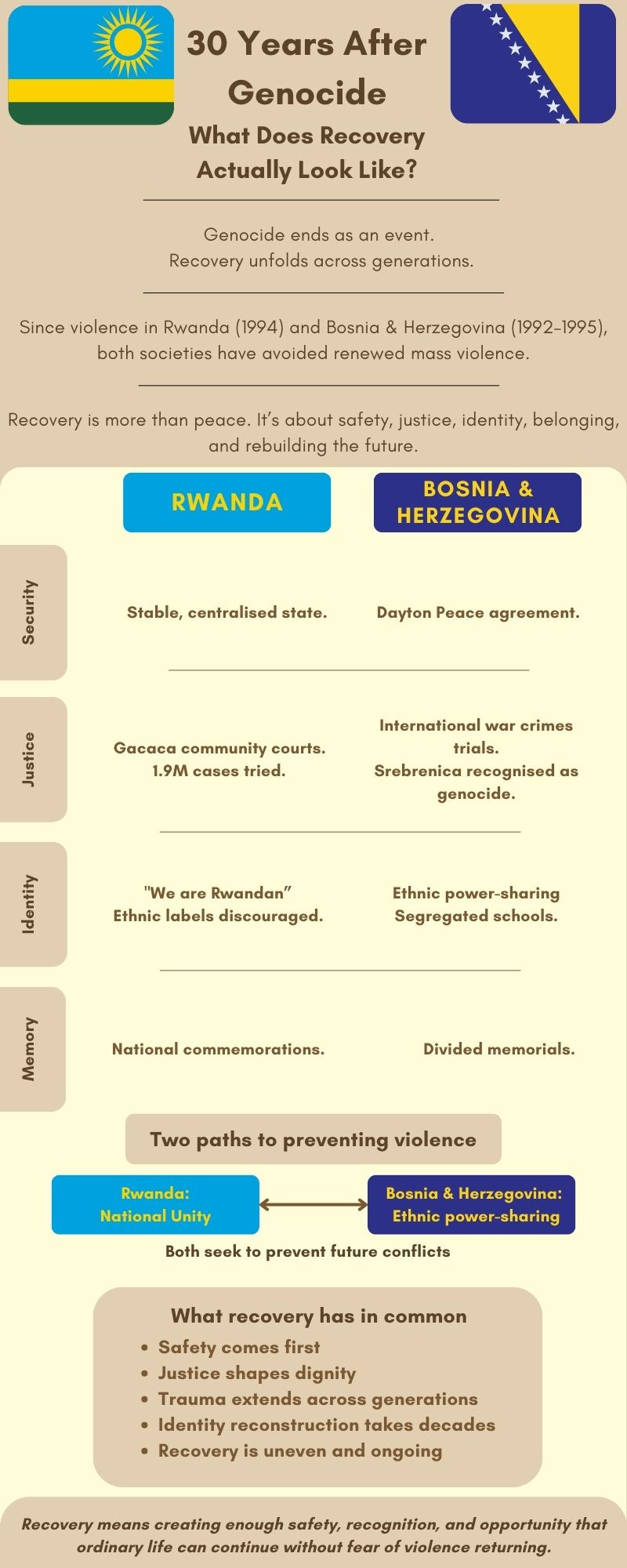
In 1994, genocide devastated Rwanda. A year later, the war in Bosnia and Herzegovina ended after atrocities that included the massacre in Srebrenica. The violence in both places is well documented and internationally recognised. Courts delivered rulings. Memorials were built. Peace agreements were signed.
What receives less attention is what comes after the formal end of violence. Genocide does not only destroy lives; it damages trust, fractures identity, and erodes the basic sense that society is safe. Rebuilding is not only political or economic. It is social and psychological. It is about whether people feel secure in their neighborhoods, whether justice feels credible, and whether younger generations can imagine a future not defined entirely by inherited trauma.
Three decades later, Rwanda and Bosnia offer two distinct, still evolving approaches to recovery. Both have avoided renewed mass violence. Both continue to grapple with the harder task of rebuilding belonging and dignity.
Rwanda: Security, Justice, and National Identity
In Rwanda, the immediate priority after 1994 was restoring order. The government consolidated control, dismantled armed groups, and reestablished state authority. Today, the country is widely perceived as stable. Public security is strong, institutions function, and infrastructure has expanded significantly. For many citizens, daily life feels predictable in ways it did not during years of instability.
From a human needs perspective, restoring physical safety was foundational. Without it, reconciliation and development would have been impossible. But Rwanda’s strategy extended beyond security. Leaders also sought to address the social conditions that had enabled genocide, particularly the politicisation of ethnic identity.
Official discourse emphasises unity. Citizens are encouraged to see themselves first as Rwandan. Public references to ethnic categories are discouraged in political life. The aim is preventive: reduce the divisions that once proved catastrophic. Many Rwandans born after 1994 describe their identity primarily in civic rather than ethnic terms.
Justice became another pillar of rebuilding. Alongside international prosecutions, Rwanda created the Gacaca court system, a community-based process designed to handle the enormous number of genocide-related cases. Survivors and accused perpetrators faced each other in local proceedings. Confession and testimony were central, and reduced sentences were sometimes granted in exchange for truth-telling.
Gacaca remains debated. It was faster and more locally embedded than conventional courts, and it processed a vast number of cases. At the same time, it placed heavy emotional burdens on survivors and did not always meet international standards of due process. Still, it made accountability visible. Justice unfolded within communities rather than at a distance.
Memory in Rwanda is also structured and highly visible. Annual national commemorations mark the genocide, and memorial sites are maintained across the country. Remembrance is framed as a civic responsibility and a safeguard against denial. The message is clear: what happened will not be forgotten.
Yet Rwanda’s centralised model has prompted debate about political space and dissent. Critics argue that reconciliation narratives are shaped largely from above and that political opposition is constrained. Supporters counter that strong state direction has been necessary to preserve stability in a society once pushed to the brink.
Three decades on, Rwanda presents a complex picture. Security is robust. Economic growth has been notable. Women hold a significant share of parliamentary seats. But trauma persists, particularly among survivors who continue to require psychological support. Recovery here has meant prioritising order and unity, even as questions about political openness remain.
Bosnia and Herzegovina: Peace Within Division
Bosnia’s post-war path followed a different logic. The 1995 Dayton Agreement ended the conflict but established a highly decentralised political system. Power is shared among Bosniaks, Croats, and Serbs through a layered structure of entities, cantons, and rotating leadership positions. The design was intended to prevent domination by any one group and to guarantee representation for all.
In its most basic aim, the agreement succeeded. Large-scale violence has not resumed. International peacekeeping forces gradually reduced their presence as conditions stabilised. For many citizens, safety now means the absence of war and the predictability of daily life.
But the same framework that preserves peace also reinforces division. Ethnic identity remains embedded in political institutions. In some areas, students from different communities attend separate classes, sometimes within the same building. Historical narratives can vary depending on which curriculum they are taught.
Unlike Rwanda’s effort to minimise ethnic categories, Bosnia’s system formalises them. Identity is not sidelined; it is built into the state. This creates a paradox. The structure protects groups from marginalisation, but it can also limit the development of a cohesive national identity.
Justice for war crimes has taken place largely through international and national courts. Convictions related to atrocities, including those committed in Srebrenica, established legal recognition and accountability. Yet acknowledgment at the community level is uneven. Competing narratives about responsibility and victimhood persist in some regions.
Memorialisation reflects this fragmentation. Commemorations and memorial sites exist, but they are often associated with specific communities rather than a shared national narrative. Memory is present, but it is plural and sometimes contested.
At the local level, however, daily life is often more integrated than political discourse suggests. In mixed urban areas, people share workplaces, universities, and social spaces. Civil society groups promote interethnic dialogue and youth initiatives aimed at building trust. Many young Bosnians express greater frustration with economic stagnation and political gridlock than with neighboring communities.
This generational dimension is significant. Those born after the war did not experience the violence directly, though they inherit its memory through family stories and public commemorations. For some, identity is flexible and evolving. For others, it remains closely tied to group affiliation. High rates of emigration suggest that economic opportunity and personal autonomy weigh heavily in how young people assess their future.
Bosnia’s recovery has therefore focused on sustaining coexistence within a divided political framework. It manages differences rather than attempting to dissolve it. Peace here is pragmatic, not transformative.
Shared Patterns, Diverging Strategies
Both Rwanda and Bosnia show that rebuilding begins with restoring security. Without physical safety, deeper recovery cannot take hold. The absence of renewed mass violence over three decades is itself a significant achievement.
Both also demonstrate that justice matters beyond punishment. Whether through Rwanda’s community-based Gacaca courts or Bosnia’s reliance on international tribunals, formal acknowledgment of wrongdoing helps restore dignity and affirm truth. Yet neither approach fully resolves trauma or erases contested narratives.
The sharpest contrast lies in identity reconstruction. Rwanda has pursued national unity and reduced the public salience of ethnicity. Bosnia has institutionalised ethnic pluralism as a safeguard against renewed conflict. Each strategy responds to the same fear of recurrence, but through opposite means.
In both societies, trauma extends beyond the generation that experienced the violence directly. Psychological research suggests that fear, grief, and silence can shape families and collective memory for decades. Recovery is not confined to treaties or courtrooms. It unfolds in classrooms, neighborhoods, and homes.
Conclusion
Thirty years is long enough for new institutions to take root and for children born after violence to reach adulthood. It is not long enough to erase the social and psychological consequences of genocide.
Rwanda and Bosnia do not offer a single template for recovery. Instead, they reveal how rebuilding after mass violence is uneven, contested, and deeply human. It requires creating conditions in which people feel safe enough to participate in public life, to express identity without fear, and to imagine a future not wholly defined by trauma.
Genocide ends as an event. Its aftermath becomes part of everyday life. The true measure of recovery is not the absence of tension, but the presence of enough stability, recognition, and agency that ordinary life can continue without the threat of violence returning.
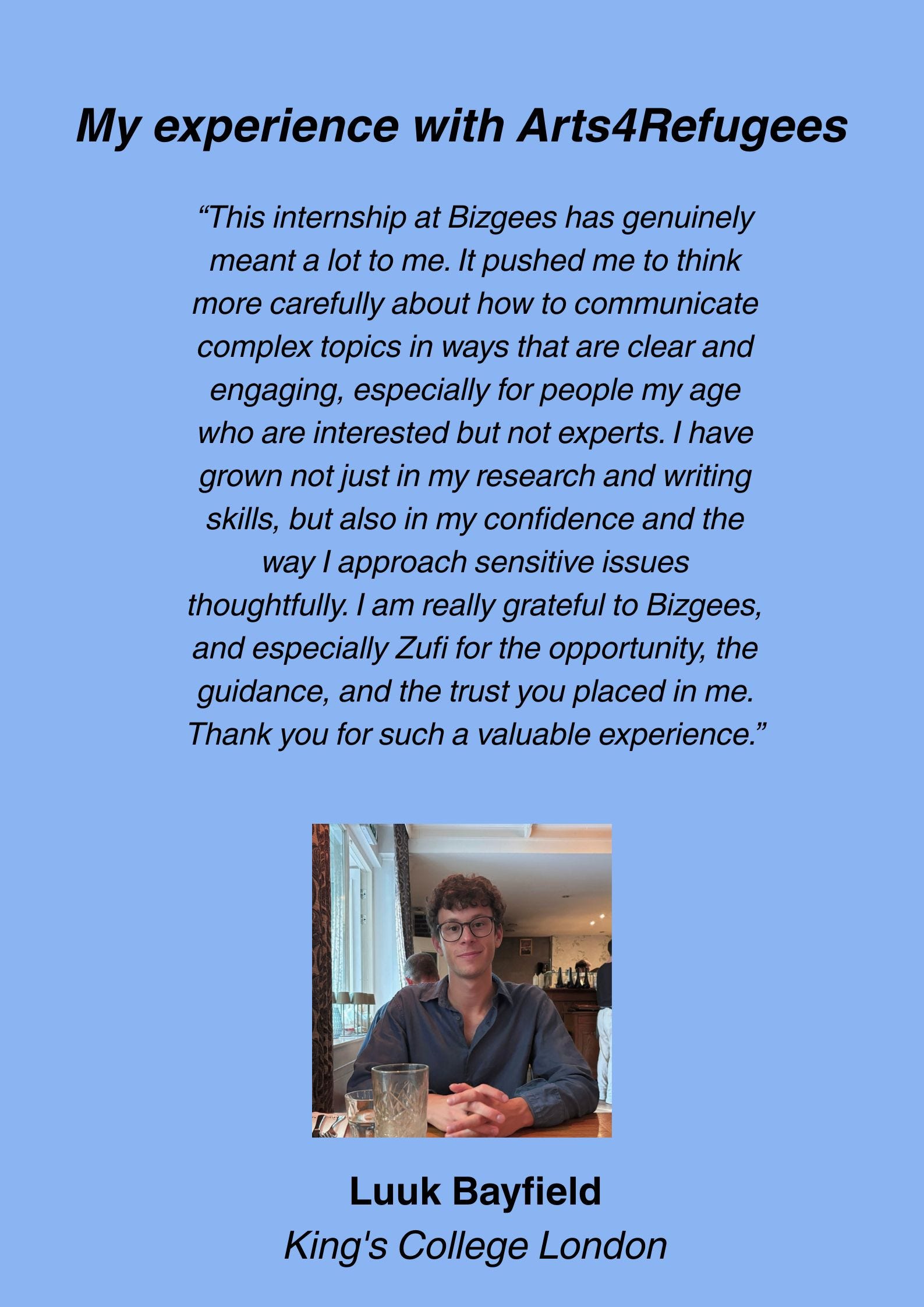
In this episode Luuk discusses the post conflict experience of Bosnia and Rwanda. What the situation on the ground is decades down the road with a focus on Safety and Identity. He is a Citizen journalist with us on a placement organised with Department of War Studies, King’s College, London.
Thank you for reading an A4R 🎨 Post. Don’t forget to try out gaming art NFT’s here. Every purchase scales our impact and pays our bills.


