
After the 1974 division of Cyprus, identities among Greek Cypriot and Turkish Cypriot communities were shaped through inherited memories, education and imagination. Yet since the border reopened in 2003, young people’s encounters, friendships and shared spaces have begun reshaping belonging, showing identities can evolve beyond conflict’s legacy for future generations.
Backstory
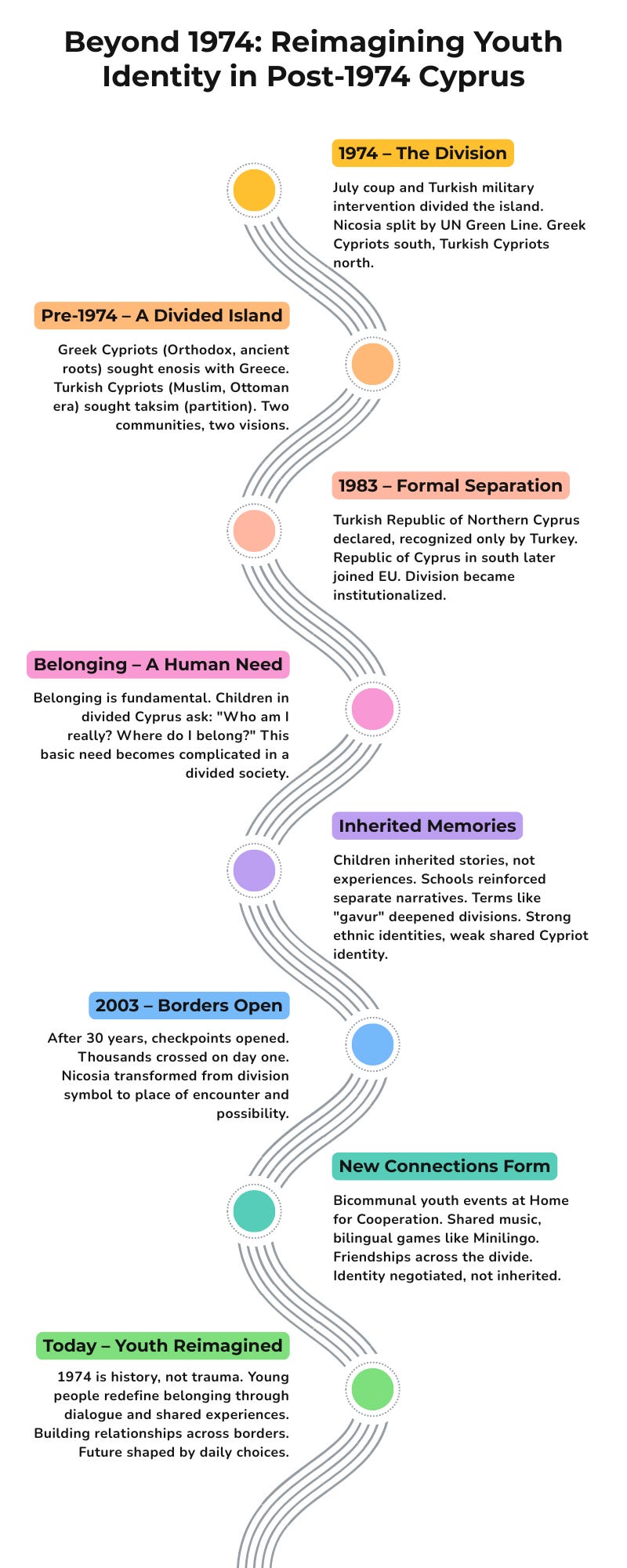
Beyond 1974: Reimagining Youth Identity in Post 1974 Cyprus
Growing up in a divided home, she has never seen the other side. Most children find a sense of belonging in everyday routines, schoolyards, neighborhood games, and shared celebrations that help them understand their origins. She moves like a shadow between stories she did not choose but inherited. Surrounded by tales of separation she cannot fully grasp, she feels something in her home is still unfinished. A single question haunts her: Where do I truly belong?
Cyprus has been divided along ethnic lines for a long time. On one side are the Greek Cypriots. They have lived on the island since ancient times and mostly associate with the traditions of the Greek Orthodox Church. On the other side are the Turkish Cypriots, whose ancestors arrived during the Ottoman rule starting in the sixteenth century. Most are Muslim. Although they share the same island, the two groups gradually developed different political goals and cultural identities. Over time, they became like distant friends—close enough to see each other daily, yet unable to imagine a shared future.
The biggest disagreement between them was about how Cyprus should be governed. Many Greek Cypriots favored enosis, the unification with Greece, while many Turkish Cypriots preferred taksim, the partition of the island. These conflicting views affected political life throughout the twentieth century and set the stage for the crisis that began in 1974. What started as a constitutional dispute turned into a conflict that reshaped the island’s geography, politics, and emotional landscape.
In July 1974, a coup by the Cypriot National Guard, supported by the military junta in Greece, overthrew President Archbishop Makarios III. The coup aimed to push Cyprus closer to union with Greece. In response, Turkey invoked its rights under the Treaty of Guarantee and launched a military intervention. Turkish forces moved into the northern part of Cyprus, eventually taking control of about one-third of the territory.
The capital city, Nicosia, became physically divided by what is now known as the Green Line, a buffer zone managed by the United Nations that separates the two sides. Although a cease-fire was reached with international help, tensions remained high. Fighting resumed within weeks, and Turkish forces pushed further into the north. The island has stayed divided ever since.
In 1983, the northern part of the island declared itself the Turkish Republic of Northern Cyprus. To this day, it is recognized only by Turkey. The southern part, governed by the Republic of Cyprus and made up mainly of Greek Cypriots, is recognized as the legitimate government of the entire island and later became a member of the European Union. Shared land became divided by borders, languages, flags, and political systems. Cyprus was not just geographically split; it was emotionally divided too.
Imagine hearing these stories from your parents and grandparents, picturing the other side you have never seen. How would you see yourself in such a setting? A sense of belonging is seen as a basic human need, yet children growing up in Cyprus negotiate their identities daily. Who are they really?
For many young Cypriots, the events of 1974 exist only as inherited memories, not lived experiences. The conflict belongs to history, but its meanings still influence the present. Instead of learning about the division through personal experiences, they hear about it through stories shared at dinner tables, school textbooks, and national commemorations. In this way, identity is not just lived; it is passed down. These inherited tales shape how children view themselves and the people on the other side of the island.
Maria grew up hearing such stories. Turkish Cypriots were often described to her as enemies, sometimes even as dangerous outsiders. Schools reinforced identities through national narratives, focusing heavily on Greek history and culture, which deepened her connection with the Greek Cypriot community (Anagiotos and Schied, 2013). Similarly, Turkish Cypriot children heard tales that emphasized differences and threats. Language also reflected these divides. Terms like gavur were historically used to refer to non-Muslim “others,” deepening the separation between communities (Mertan, 2011).
As a result, many children strongly identified as either Greek Cypriots or Turkish Cypriots, while the idea of a shared “Cypriot” identity felt distant or abstract. Identity seemed set, inherited, and unchangeable. But this began to shift in 2003 when a political decision unexpectedly opened new possibilities.
Thirty years after the division, Turkish Cypriot leader Rauf Denktash eased restrictions on movement across the buffer zone (Chrisafis, 2003). For the first time in decades, people could cross the previously closed border. What once seemed permanent suddenly became reachable.
On the first day the checkpoints opened, thousands crossed the divide. Some searched for homes they had been forced to leave long ago. Others wanted to see if the “enemy” they had imagined truly existed. Many approached with hesitation; many left in tears.
Nicosia gradually started to change. It was no longer just a symbol of division but also a place for encounters. Streets that were once marked by barriers slowly became places to meet. For many children and young people, these first crossings were emotional and surprising. The “others” they met did not feel completely foreign. They felt oddly familiar.
At bicommunal youth events organized in places like the Home for Cooperation, young people started to find unexpected similarities. One participant discovered that he and his supposed enemy both listened to the same Cypriot songs (Anagiotos and Schied, 2013). Others laughed together while playing bilingual games like Minilingo, which mixed Turkish and Greek words (Home For Cooperation, n.d.). Maria herself later joined a study-abroad program, forming lasting friendships with Turkish Cypriot classmates (Anagiotos and Schied, 2013). Through shared conversations, routines, and experiences, the assumptions she carried since childhood began to change.
These encounters did not erase differences. Language, religion, and political views still mattered. Yet they created space for something new: the idea that identity could be negotiated instead of just inherited. Young people started to see themselves not just as part of separate communities but also as individuals who could shape their relationships with one another.
Today, Cyprus remains physically divided, but more young people are becoming active in redefining what identity means on the island. Their interactions across the divide encourage them to question the stories they inherited from earlier generations. Instead of viewing the past as fate, they explore new ways to belong.
For them, 1974 is no longer a personal trauma but a historical reference point. This distance does not lessen its significance but allows for reinterpretation. Without direct memories of displacement or violence, younger Cypriots are sometimes more open to imagining coexistence. Their experiences suggest that identity can change through contact instead of remaining stuck in conflict.
Unlike their parents, today’s young Cypriots are learning to navigate identities that balance both difference and connection. They are discovering that belonging does not require choosing one side over the other. Instead, it can arise from dialogue, shared experiences, and everyday interactions across boundaries that once seemed unmovable.
Maria’s story reflects this broader change. Her search for belonging is both personal and generational. Like many young Cypriots, she manages inherited memories while creating new meanings for herself. For her generation, the answer to “Where do I belong?” may not be entirely defined by the borders drawn in 1974. Instead, it may lie in the relationships they are building across those borders.
In this sense, the future of Cyprus is shaped not only by discussions among political leaders. It is also quietly influenced by the daily choices of young people who are learning to see each other in a new light (Dizdaroğlu et al., 2026). Through friendship, curiosity, and shared spaces, they are gradually redefining what belonging means on a divided island. In doing so, they remind themselves—and perhaps the world—that identities formed by conflict can also be reshaped through connection.
Bibliography
Anagiotos, Christos and Fred M. Schied. “Learning of National Identity in Areas of Conflict:The Case of Greek-Cypriot Young Adults in Cyprus.” New Prairie Press (2013) :7-12
Chrisafis, Angelique. “Dazzled Cyprus fears a false dawn.” The Guardian. Published 3 May, 2003. https://www.theguardian.com/world/2003/may/03/cyprus.angeliquechrisafis [acessed 21 April 2026]
Dizdaroğlu, Cihan., Özen, İlhan Can., and Şenyuva, Özgehan. “Navigating From Negative to Positive Peace: A Quantitative Analysis of Youth Attitudes in Cyprus.” Alternatives Global Local Political (2026)
Home For Cooperation, “Minilingo!Bilingual Cards game.” (n.d.) https://www.home4cooperation.info/our-work/minilingo-bilingual-memory-game/
Mertan, Biran. “Children’s perception of national identity and in-group/out-group attitudes: Turkish-Cypriot school children” European Journal of Developmental Psychology, 8(1)(2011): 74–86
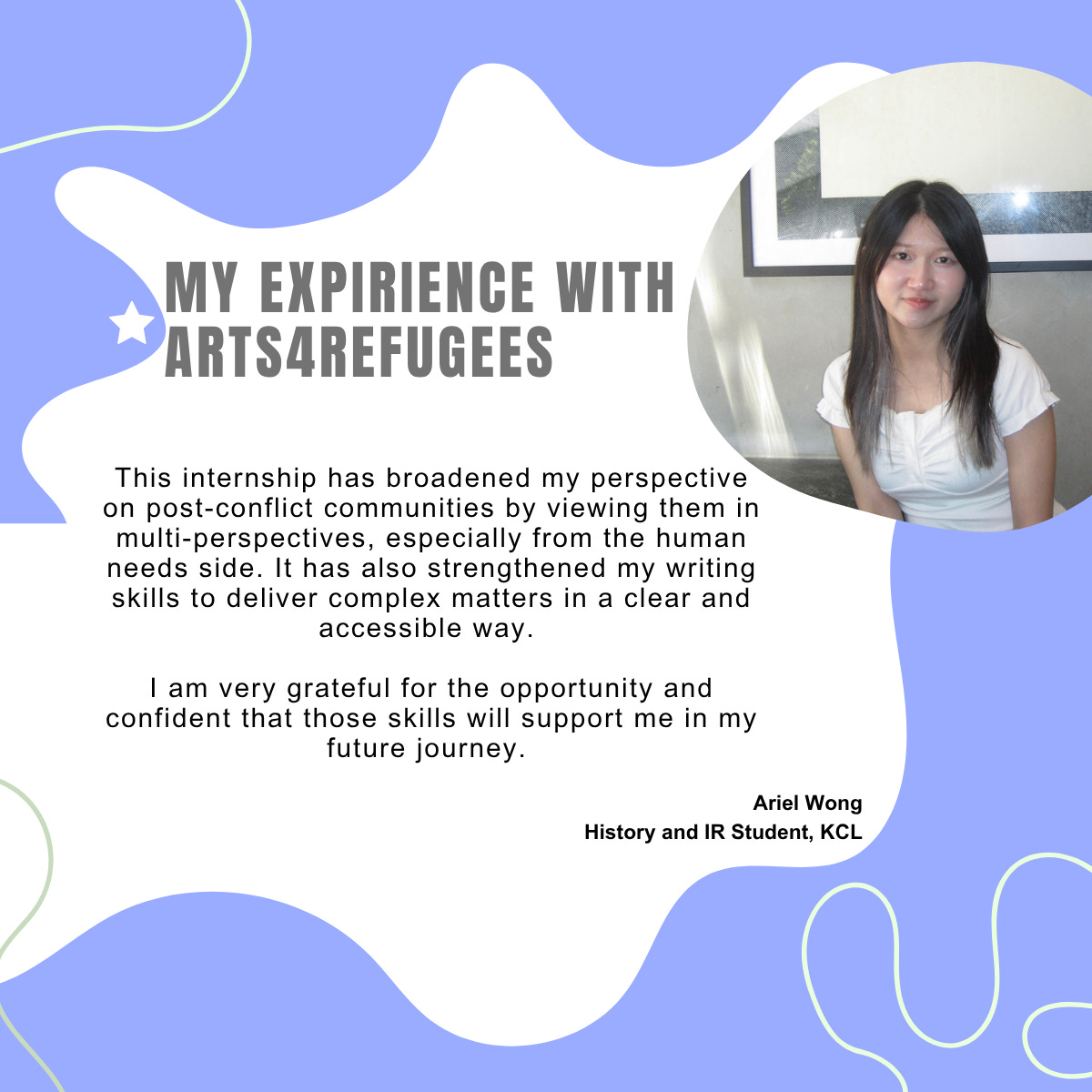
In this episode Ariel discusses the Cypriot expereince of rebuolding identity now that North and Sputh Cyprus have opened their brders to one another. She is a Citizen journalist with us on a placement organised with Department of War Studies, King’s College, London.
Thank you for reading an A4R 🎨 Post. Don’t forget to try out gaming art NFT’s here. Every purchase scales our impact and pays our bills.


