


After escaping the Lord’s Resistance Army, Grace Akallo and Evelyn Amony faced a new war: stigma. Communities often reject former abductees and their children. Yet, both women reclaimed their lives through education and advocacy. Their journey proves that survival is only the start; true peace requires belonging and understanding.
Backstory
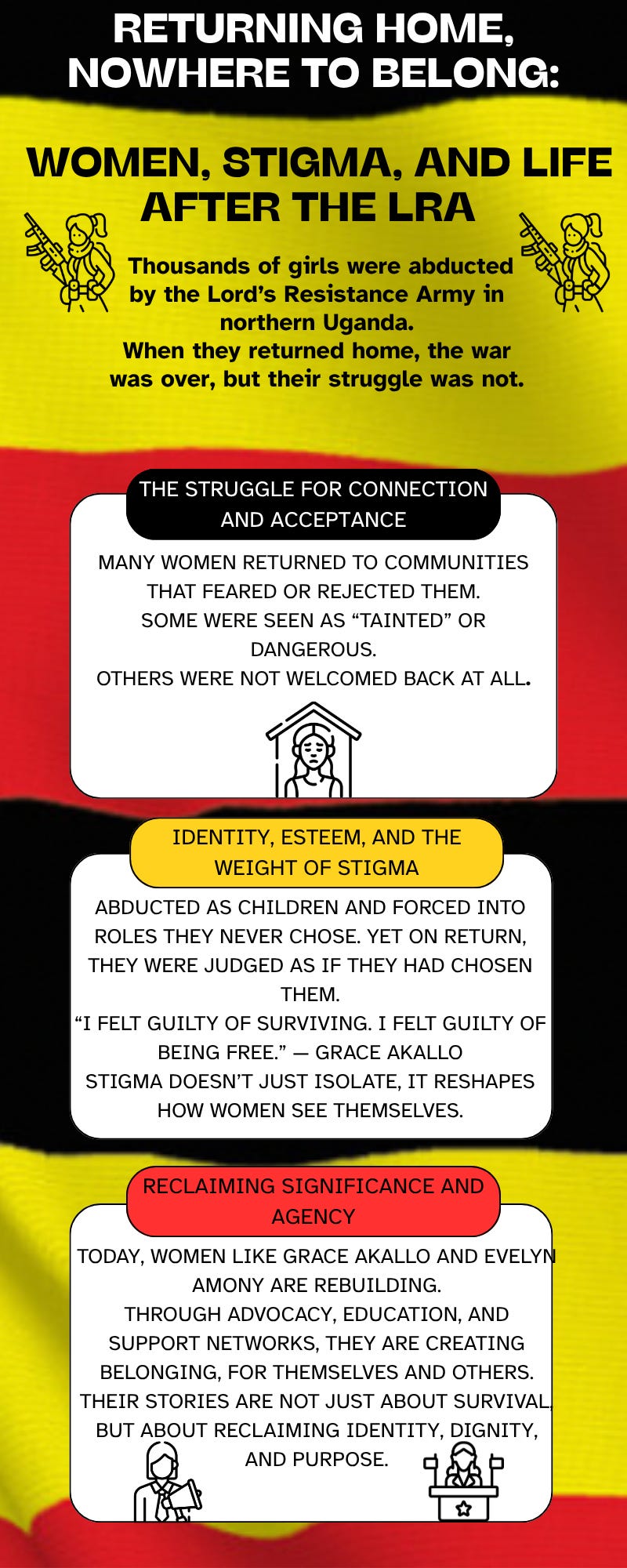
Returning Home, Nowhere to Belong: Women, Stigma, and Life After the LRA
When Grace Akallo returned home, she was free- but not at peace.
Abducted at 15 when Lord’s Resistance Army (LRA) soldiers broke into her school dormitory in northern Uganda, she was forced into a world of violence that no child should ever know. For seven months, she lived under constant threat, enduring beatings, torture, and witnessing the brutal killing and punishment of those who disobeyed orders. Like many other abducted children, she was forced to participate in violence, a reality that would follow her long after her escape.
Yet returning home did not mark the end of her suffering. Instead, it marked the beginning of a different kind of struggle- one defined not by physical captivity, but by stigma, isolation, and the challenge of rebuilding a life.
Uganda’s conflict with the LRA largely ended in the mid-2000s. But for many women who were abducted, forced into marriage, and returned with children born in captivity, the war’s impact continues to shape their ability to meet fundamental human needs: to belong, to be understood, to feel valued, and to build a meaningful identity. Through the experiences of women like Grace Akallo and Evelyn Amony, it becomes clear that the most enduring consequences of conflict are not only physical or economic, but deeply social and psychological.
The Struggle for Connection and Acceptance
For many returning women, the most immediate challenge is not survival, but belonging.
Communities in northern Uganda, themselves deeply traumatised by years of violence, often struggle to accept those who return from the LRA. Former abductees are sometimes viewed with suspicion or fear, associated with the violence they were forced to enact. In some cases, they are believed to be “contaminated” or even possessed by evil spirits. This stigma is particularly acute for women, who are often judged not only for their association with the LRA, but also for having been subjected to sexual violence.
Grace Akallo recalls the profound isolation she experienced upon returning. “I used to isolate myself a lot,” she explains, not only because of the abuse she endured, but because of the guilt she carried. “I felt guilty of surviving. I felt guilty of being free.” Her words reflect a painful reality, that freedom can come with emotional burdens that make connection extreamly difficult.
For women who return with children born in captivity, the barriers to acceptance are even greater. These children, often fathered by LRA commanders, can become symbols of the conflict itself. Families and communities may accept the returning woman, but reject her children or, in some cases, reject both. The result is a profound disruption of one of the most basic human needs: the need for love, connection, and social belonging.
The Need for Understanding
Closely tied to belonging is the need to be understood, not just as a returnee, but as a victim of coercion.
Evelyn Amony’s story illustrates how this need is often unmet. Abducted at just 11 years old, she was forced into marriage at 14 to Joseph Kony, the leader of the LRA. “You have no choice, you must be my wife,” she recalls being told. During her years in captivity, she bore three of his children.
When she returned home, however, her community did not see her simply as a survivor. Instead, she was often defined by her association with Kony. The stigma she faced was starkly illustrated when, following her mother’s death, a neighbour refused to attend the funeral prayers, saying: “I will not attend prayers for Margaret because her daughter is Kony’s wife.”
This moment captures the failure of understanding that shapes many women’s experiences. Despite being abducted as children and subjected to extreme coercion, they are often judged as if they had agency in their circumstances. The label of “wife”, even when forced, can overshadow their identity as victims, leaving them misunderstood and marginalised.
Identity, Esteem, and the Weight of Stigma
The lack of acceptance and understanding has profound consequences for identity and self-worth.
For many returning women, the question becomes: who am I now?
The transition from child to abductee, from forced “wife” to survivor, disrupts any stable sense of identity. What makes this harder is not just what they have been through, but how they are seen when they return. Many women find themselves defined by their time in captivity. Their identities become tied to experiences they never chose, shaping how they are treated, and over time, how they come to see themselves.
Grace Akallo’s reflections reveal the internal impact of this disruption. Her feelings of guilt and isolation speak to a deeper struggle for esteem: the need to feel valued, worthy, and accepted within society. Without this, rebuilding a sense of self becomes incredibly difficult.
Education, for Akallo, became a pathway toward reclaiming that sense of worth. “School was the best place I could be,” she explains. “Education gives hope. I have a hope of a future… I’ll be looked at as a contributing member of society.” Her words highlight how meeting the need for esteem is not only about external acceptance, but about creating opportunities to rebuild confidence and purpose.
For Evelyn Amony, the challenge of identity is equally complex. As a former “wife” of Kony and a mother, her identity is shaped by experiences that carry both personal trauma and social stigma. Yet her story also shows that identity is not fixed, it can be renegotiated and reclaimed.
Reclaiming Significance and Agency
While stigma and exclusion dominate many accounts of return, they are not the end of the story.
Both Akallo and Amony demonstrate that it is possible to move beyond survival and reclaim a sense of significance, another fundamental human need. This is not simply about rebuilding a life, but about finding meaning and purpose in the aftermath of trauma.
Grace Akallo has become a powerful advocate for former child soldiers, founding United Africans for Women and Children Rights. Her work is driven not by a desire to dwell on her own suffering, but by a commitment to others who continue to endure similar experiences. “Those girls are still suffering,” she says. “They are still being rejected… and then I sit down and I mourn? No.” Her refusal to remain in victimhood reflects a profound assertion of agency.
Similarly, Evelyn Amony has transformed her experiences into advocacy through the Women’s Advocacy Network, which supports survivors of conflict-related sexual violence. By sharing her story, including in her memoir, she challenges the stigma that once defined her. “Even if you’ve gone through painful experiences… you shouldn’t be defined by those experiences,” she states. “You can still do a lot to change the lives of others.”
In doing so, both women not only rebuild their own sense of identity and purpose, but also create spaces of belonging and understanding for others.
Beyond Survival
The stories of Grace Akallo and Evelyn Amony reveal that the end of conflict does not necessarily mean the restoration of peace, at least not in the lives of those who lived through it. For many women returning from the LRA, the struggle shifts from physical survival to meeting deeper human needs: to belong, to be understood, to feel valued, and to lead meaningful lives.
These needs are not secondary. They are fundamental. And when they are unmet, the consequences of conflict continue long after the violence has ended.
Yet these stories are not only about loss. They are also about resilience, agency, and the possibility of transformation. In reclaiming their voices, their identities, and their purpose, women like Akallo and Amony challenge the narratives that once confined them.
They are no longer defined solely by what was done to them. Instead, they are shaping what comes next.
References:
Amony, E. (2015) I Am Evelyn Amony: Reclaiming My Life from the Lord’s Resistance Army. Madison: University of Wisconsin Press.
Annan, J., Blattman, C., Mazurana, D. and Carlson, K. (2011) ‘Civil war, reintegration, and gender in Northern Uganda’, Journal of Conflict Resolution, 55(6), pp. 877–908.
Baines, E. (2017) Buried in the Heart: Women, Complex Victimhood and the War in Northern Uganda. Cambridge: Cambridge University Press.
Denov, M. and Lakor, A.A. (2017) ‘When war is better than peace: The post-conflict realities of children born of wartime sexual violence in Northern Uganda’, Child Abuse & Neglect, 65, pp. 255–265.
United Nations (2013) Former child soldier Grace Akallo speaks to UNifeed. Available at: https://media.un.org/unifeed/en/asset/u130/u130730c
United Nations Women (2016) I Am Evelyn Amony: A memoir of war, rape and survival. Available at: https://www.unwomen.org/en/news/stories/2016/6/i-am-evelyn-amony-a-memoir-of-war-rape-and-survival
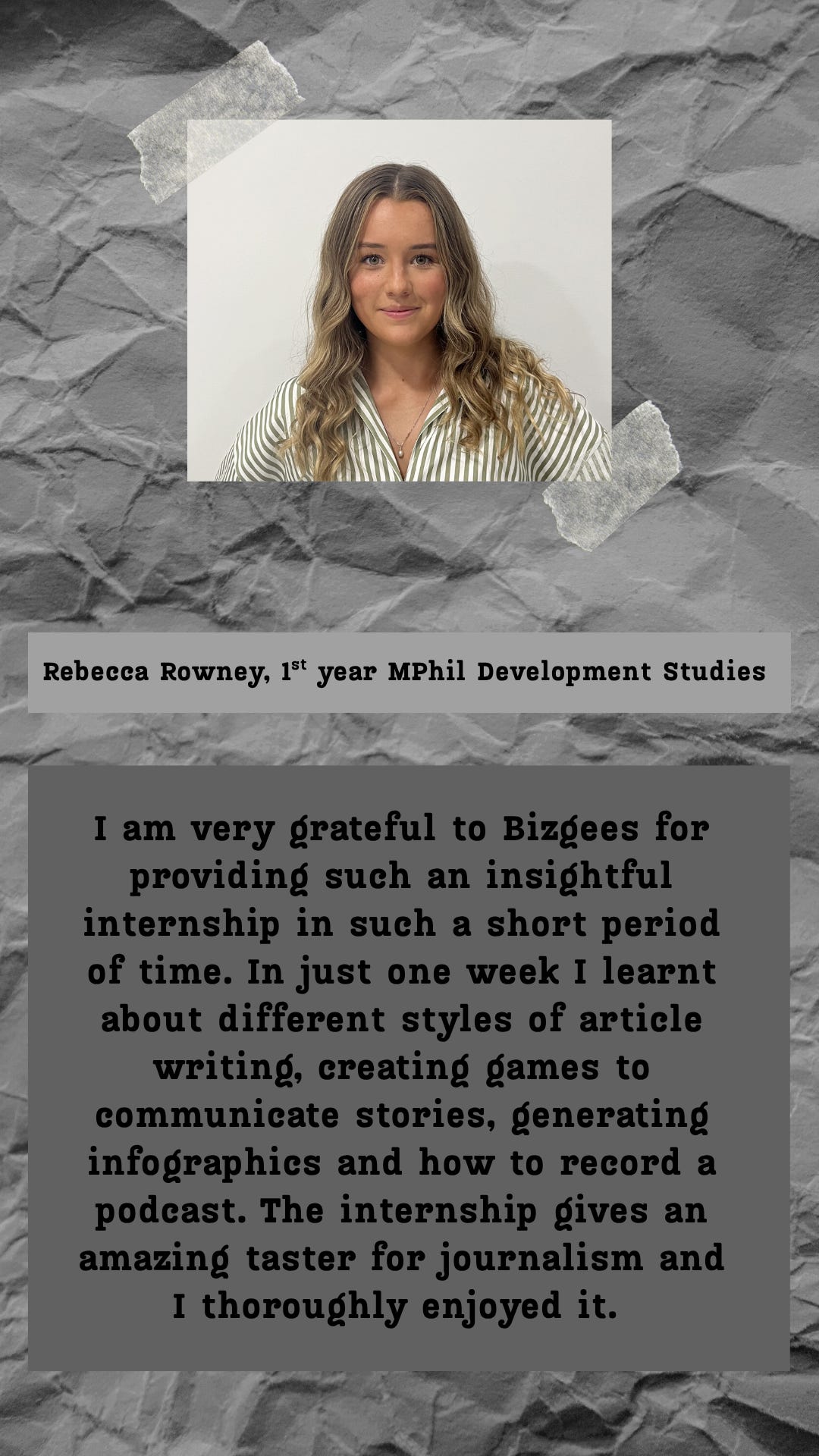
In this episode Rebecca discusses the post conflict experience of women’s expereince of war during the Lord’s Resistannce Armay in Uganda. She is a Citizen journalist with us on a placement organised with Oxford University Career Services.
Thank you for reading an A4R 🎨 Post. Don’t forget to try out gaming art NFT’s here. Every purchase scales our impact and pays our bills.


