


Northern Ireland’s Troubles are dormant, but were they ever truly gone? Remnants of the Irish conflict and its impact upon mental health.
The Troubles in Ireland officially ended with the signing of the Good Friday Agreement in April 1998. This agreement marked the end of nearly 30 years of violence within Northern and the Republic of Ireland. However, some argue that this supposed peace was not actually effective, seeing as the government largely failed to implement institutions to aid the citizens of Ireland to cope with the trauma and adversity of the post-conflict environment. Despite the official end of the conflict, the blatant presence of remaining violence within the nation, brings about questions such as: has the conflict truly ended or just gone dormant? Does the lack of followthrough risk a revival? Have the bandaids of the Good Friday Agreement done enough to heal the scars?
I have always had a large personal interest within this conflict due to my Irish heritage. I have grown up with the knowledge that the Troubles crumbled Ireland and damaged its people with it, leaving Ireland in both physical and mental rubble. A society reduced to rubble and the scares of a previous conflict left a negative imprint upon many people indefinitely, especially from a psychological standpoint. Although the Republic of Ireland has managed to increase their economic and social prosperity by robust policies such as large tax breaks for big businesses, bringing in a surplus of revenue to the economy, Northern Ireland still carries the burden of a 30-year long conflict nonetheless. During the war and some of the post-war period, Northern Ireland was not able to industrialise and develop as most Western nations would, leaving them behind in many categories within the international stage. This also left them lacking essential elements within their society, such as mental health aid and healthcare provisions for those who would have been directly or indirectly involved within the conflict.
The Troubles and its post-conflict community tend to be overlooked, seeing as the issue was not considered as fatal or wide-spread as other conflicts with its 3,600 death, compared with other issues such as the Rawandan genocide or the genocide in Bosnia and Herzegovia with 800,00 and 33,000 respectively. However, “insignificant” these numbers may seem in comparison with such wide-spread and brutalistic conflicts, the severe impact that The Troubles had and still has upon the Irish community is in no way minimised. The above numbers do not accurately represent the trauma that this conflict had upon past communities and still has upon present ones. An example of this can be found within the case of 18 year old John and his brother. These boys were reportedly held at gunpoint and taken by paramilitaries during the time of the Troubles. They were later beaten and tortured for a minimum of 8 hours. The boys reported that a multitude of other citizens and army patrols continued to circulate the area, likely at least somewhat aware of the malice that was occurring in the only somewhat secluded house that they resided in for those 8 hours. Nonetheless, no one came to their aid. During the period of 1968 to 1998, events such as kneecapping, kidnapping, torture and bombings became heavily normalised within Irish society. This led to average citizens being subjected to brutalistic events without causing all that much uproar from the local community, due to the increasing frequency of these events and a shared sense of hopelessness. It must be noted that even though these activities significantly diminished with the ending of The Troubles, the Northern Irish government’s inability to bounce back from the conflict and re-build essential institutions left many victims without hope of solace or the ability to receive mental health attention that they so direly needed. This can once again be seen within the case of John and his brother, who received no medical or psychological attention after thir endured torture.
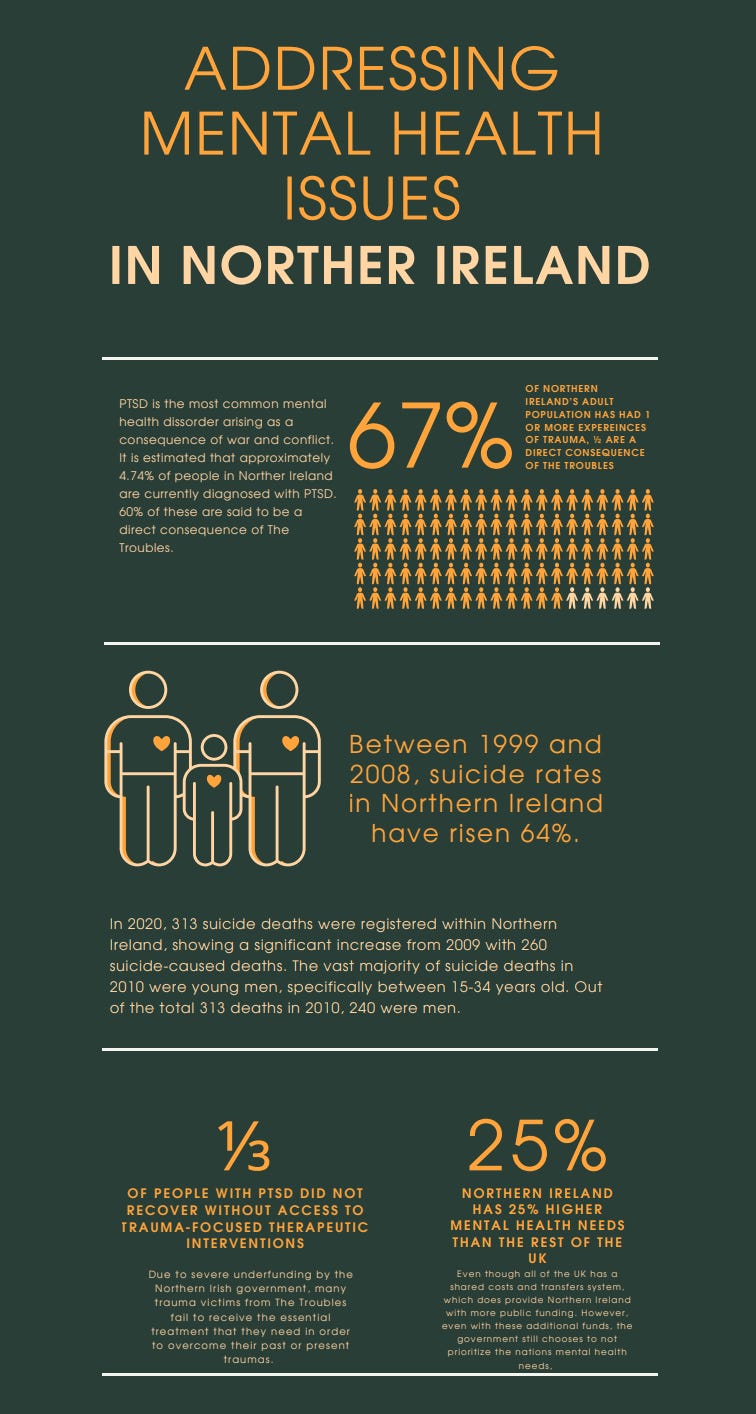
Northern Ireland is estimated to have approximately 25% higher mental health issues, compared to the rest of the UK. This statistic can be largely attributed to the fact that approximately ⅔ of Northern Ireland’s adult population have one or more traumatic experiences, with The Troubles being the root cause for half of these. There is a trend seen within Northern Ireland, where young men and poorer communities are impacted significantly more by the lasting impacts of The Troubles. It is largely known that violence and aggression have been prevalent themes embedded within Irish society as a result of the brutalities of the Troubles. However, what is not so commonly acknowledged is the gender dimension of the lasting impacts of the conflict. Men are four times more likely to have PTSD, depression, and anxiety than women within this case scenario. This is predominantly because of the fact that men are more likely to be victims of intimidation, punishment, beatings, and assault by paramilitary groups. Violence is still ingrained within Northern Irish society despite the principle that conflict is “absent”. There are still a multitude of people who are forced to reside in areas of chronic, long-term violence and as a consequence, the levels of suicide within the nation have skyrocketted. This is a country that has supposedly removed itself from the active state of conflict and implemented the necessary elements in order to lead themselves towards a lasting peace, but the truth is that despite however convincing all of these “robust” agreements may seem, they all share a commonality in their negligence to address the needs of the post-conflict community and the trauma that has been imposed upon them till this day.
Presently, Ireland has had numerous agreements and conferences with the intent of diminishing the tension between all parties directly involved within The Troubles; Northern Ireland, the Republic of Ireland, and England. Examples of such are the Good Friday Agreement (1998), Stormont Agreement (2014), and the Northern Ireland Protocol (2023). These agreements, along with the multitude of others that accompany them give the impression that institutions have been implemented to effectively deal with this conflict, but the reality is that the institutions and commitments tied with conventions such as the Stormont Agreement have yet to be implemented by the Northern Irish government. An example of this can be seen in 2016 with the United Kingdom government’s reluctance to release the information collected on the conflict by the Historical Investigation Unit created by the latter agreement, as a means of protecting themselves from public backlash, which consequently prevented the conflict’s victims from reaching further justice. Due to the government’s negligence to adhere to their promises, civil society has increasingly taken it upon themselves to lead equity initiatives, such as ‘Relatives for Justice’ (RfJ), which is an NGO providing survivors of The Troubles and their relatives with legal and therapeutic support.
The mental health of Northern Irish citizens has been diminished by the government’s negligence to provide them with the necessary resources to heal. It was stated by Maureen Hetherington in the paper titled ‘Possibilities: Mental Health in post-Agreement Northern Ireland’ that ‘justice is critically important to victims and survivors’ that many victims will not allow themselves to heal until they feel that justice has been sufficiently served, for if not they may carry guilt by moving on from the situation if they cannot deem that their relatives and other loved ones who were largely impacted by the conflict have been ‘avenged’. This prolonging of the conflict mentality means that the ideologies, heartbreak, and normalities associated with the conflict also remain prominent within Northern Irish society. All of this is accompanied by a large resentment from the Northern Irish people, as they hold their government largely responsible for their inability to heal.
It must also be acknowledged that the issues so far addressed do not only impact Northern Irish society, but also the economy. The spike in mental health troubles have led to a significant financial burden being placed upon the nation. It has been estimated that approximately 3.4 billion pounds per year is spent on health and social care, unpaid carers, and lost productivity, due to those who are unable to work for periods of time as a consequence of debilitating mental health issues. These costs from Northern Ireland also burden the rest of the UK, seeing as they have a system where costs and transfers are shared across all four nations. This issue has led to a UK-wide productivity deficit and larger public spending demands. This government funding gap also leads to further defunding of essential mental health services not just within Northern Ireland, but also the whole of the UK, which perpetuates the struggle of acquiring attention for mental health needs and contributes to further a rise in the levels of mental health issues.
It is crucial to prioritise mental health and overall social rehabilitation within post-conflict communities. Because, as demonstrated here, the result of a negligence to do so is a struggling population who are still forced to endure elements of active conflict within a supposedly post-conflict environment. Stories of violence and corruption such as John’s existed almost 30 years ago during the times of The Troubles, but what is seldom acknowledged is that there are still many equally impactful stories also being created at this moment due to present violence and somewhat “latent” conflict within Northern Irish society.

In this episode Ava discusses the post conflict experience of Northern Ireland and the mental health issues the communties are facing there. She is a Citizen journalist with us on a placement organised with Department of War Studies, King’s College, London.
Thank you for reading an A4R 🎨 Post. Don’t forget to try out gaming art NFT’s here. Every purchase scales our impact and pays our bills.


