

AT A GLANCE - This article examines how Libya's 2020 ceasefire failed to deliver safety for ordinary citizens. Through the 2025 Tripoli clashes, the 2023 Derna floods, and the experiences of migrants and women, it shows that conflict's consequences - violence, neglect, and vulnerability - never stopped.
Backstory
Peace on Paper: The Daily Fight for Survival in Libya
In the Ain Zara area of Tripoli, a 21-year-old women was killed after a shell fell on her family’s house. She was the only female child, surrounded by brothers and due to be wed within the coming months. Upsettingly, this is not a lone story. Brothers Salem and Nagib al-Tajouri were killed in similar fashion that same week whilst other innocent citizens were targeted on the streets and fatally injured (Human Rights Watch, 2025.).
This may seem like a description of a war-torn country, entrenched in conflict but this is in fact a description of Libya’s Capital between 12 and 14 May 2025 – five years after a ceasefire was signed (UN, 2020.).
For the citizens of Libya, peace was never anything more than a promise on paper.
The Failed Ceasefire
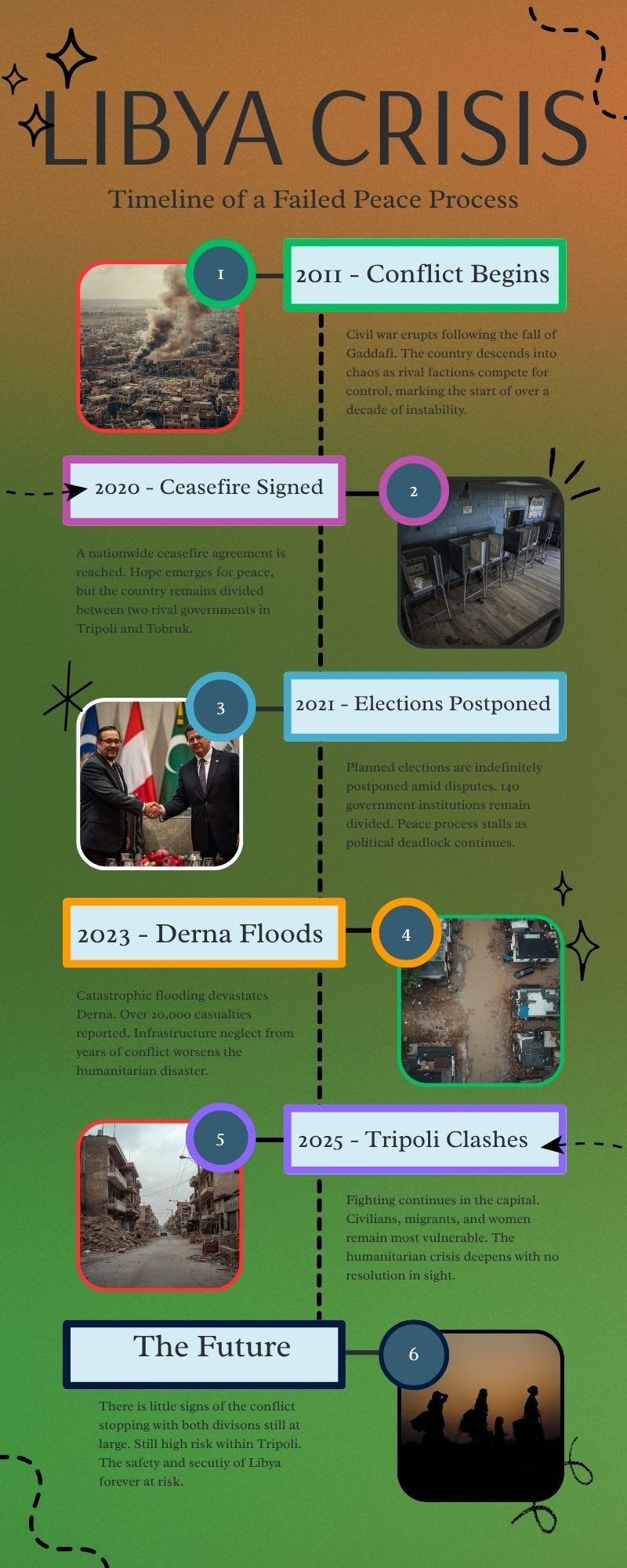
Libya has been in a state of turmoil since 2011, where there was an armed revolt against dictator Muammar Gaddafi which resulted in his death of October that same year (Reuters, 2025). Since then, the country has been in turmoil with the rise of rival factions: The Government of National Accord based in Tripoli and the House of Representatives based in Tobruk. After 6 years of regional rivalry, a ceasefire was signed on 23 October 2020, promising a return to democracy with planned elections in December 2021 (Brooke-Holland, 2024.).
There were high hopes for the agreement with Acting Special Representative of the Secretary-General, Stephanie Williams saying:
“I hope that this agreement will contribute to ending the suffering of the Libyan people and enabling the displaced, both outside and inside the country, to return to their homes and live in peace and security.” (UN, 2020.)
This was not the case.
The promised 2021 elections never took place. The interim government overstayed its mandate, reigniting tensions between east and west due to their lack of legitimacy. Within little over a year of the agreement being signed, it had already unravelled and with it, any prospect of the safety it had promised.
The Daily Realities
The 2025 Tripoli clashes provide a valuable insight into how perilous Libya still truly is for the average citizen. Dr Mustafa Fetouri, Tripoli native, writes:
“Residents live under the constant threat of sudden, brutal clashes that have become part of their daily routine for years now. The sprawling capital stands precariously on the edge of renewed violence.” (Fetouri, 2025.)
After the death of militia leader, Abdulghani Kikli, rival factions started to jostle for control over Tripoli, leading to the city being plunged into conflict in May 2025. This meant that again the innocent population had to fear for their lives, even though peace had been promised. Many residents came forward, describing the heavy gunfire that echoed around their neighbourhood whilst others reported seeing “red lights in the sky.” The situation became so precarious that the government enforced a lockdown to make sure residents weren’t caught in the crossfire (Reuters, 2025.).
Dr Fetouri’s writing also highlights something much harder to measure mental trauma. Residents now must live with constant fear of conflict, forever wondering if themselves and their loved ones will survive to live another day. Security, both mentally and physically, is sadly more of a hope than a guarantee.
The lack of unity in Libya hasn’t only made the country more prone to violence but has also deeply hampered the way the country responds to issues, with the 2023 Derna Floods being a devastating example.
In September 2023, Storm Daniel crossed the Mediterranean and wreaked havoc on the coastal city of Derna. The storm had destroyed old dams which exacerbated the flooding, causing the estimated death of 2000 people and a further 5000 people to go missing on the first day (England, 2023.). This is a harrowing tragedy mostly caused by environmental issues, but most of the blame can be placed on the country’s continued conflict. The dams in Derna were built in the 1970s and were in massive need of refurbishment, but the continuance of violence meant no focus could be placed on renovation of infrastructure. It has been estimated that, across the multiple days, 20,000 may have perished. The ongoing rivalry doesn’t just mean more conflict, but it also means the abandonment of other pressing issues that could cause the deaths of thousands (Al-Atrush, 2025.).
The separate factions also made it highly difficult to coordinate effective responses. This is best put by Tim Eaton, Libya expert, who said:
“You still have something like 140 government institutions that are divided between the east and west, so you can just imagine how difficult it’s going to be to have what is clearly going to need to be a wide-ranging response.” (England, 2023.)
It also made it very difficult for the international community, Britain in particular, to provide aid as they don’t want to show preference to even faction, making it extremely difficult to help the guiltless citizens that deserve help. Journalist Alex Crawford understood the predicament and said:
“There’s got to be some sort of way of getting round this bureaucracy and tiptoeing through this minefield of politics because the actual Libyan people are crying out for aid.” (Baker, 2023.)
Libyans are at constant risk. Even after the ceasefire, conflict has been very present with many uninvolved citizens getting caught in the middle whilst others are forever traumatised. Even in areas when there is very little conflict, their safety is still at jeopardy due to the very little focus there is on things such as infrastructure. There is no assured safety in Libya.
The Most Vulnerable Groups
Not all groups within Libya are treated the same, with migrants, asylum-seekers and refugees experiencing extreme levels of abuse. Many escape to Libya, hoping to escape war torn countries like South Sudan to either, reach Europe or to start a new life in Libya. Instead, many fine themselves trapped in human trafficking schemes whilst young girls and women find themselves facing sexual violence and exploitation. A Kenyan national labelled George outlined his experience:
“They would call our families using different telephone numbers, asking them for money. There was a boy who rebelled — he was beaten and killed. We were told we would be beaten until our people paid the ransom. If they didn’t, they would kill us, abandon us, or throw us into the desert.” (Headly, 2026.)
Having already been touched upon, the rivalling governments makes women much more vulnerable to sexual crimes and even death. Women find themselves prone to the violence of armed groups who are supposed to protect them, meaning there is a lack of people to turn to for help. This has led to increased rates of femicide with the deaths of Khansa Al-Mujahid, Amani Hajja and another unidentified woman in quick succession (Alatrash and Holleis, 2025.).
Libya is riddled with various systemic issues such as abuse of migrants and unfair treatment of women but due to the discord between the East and the West, these issues are put to the side and neglected. These groups already live in apprehension but due to things they can’t control they have to worry further. Their little security is only decreased further.
Conclusion
The ceasefire in 2020 was supposed to make Libya safer and ensure the safety and security of everyone who resides in the country. It has failed to do that as citizens again find themselves at the mercy of conflict. Whilst innocent residents die in Tripoli due to aimless shells, residents in Derna find themselves at risk of being drowned. Migrants find themselves at risk of being trafficked whilst women find themselves increasingly susceptible to sexual crimes.
The agreement has done very little, and peace was nothing more than a promise on paper.
Bibliography
Al-Atrush, Samer. “‘All should resign’: Derna disaster unleashes wave of anger in Libya.” Financial Times, September 15, 2023. https://www.ft.com/content/7cd8d5f0-39a9-4594-b021-e80dcada5ace?syn-25a6b1a6=1.
Alatrash, Islam., Holleis, Jennifer. “Femicides in Libya spark calls for tougher laws.” DW, January 12, 2025. https://www.dw.com/en/libya-femicides-laws-womens-rights-feminism-violence-un/a-74970845.
Baker, Tim. “Libya floods: Civil war makes it ‘incredibly difficult’ to get help to flood victims in divided country, Cleverly says.” Sky News, September 17, 2023. https://news.sky.com/story/libya-floods-civil-war-makes-it-incredibly-difficult-to-get-help-to-flood-victims-in-divided-country-cleverly-says-12963322.
Brooke-Holland, Louisa. “Libya: Political developments since 2011.” House of Commons Library, October 1, 2024. https://researchbriefings.files.parliament.uk/documents/CBP-10103/CBP-10103.pdf.
England, Andrew. “Libya flooding leaves hundreds feared dead.” Financial Times, September 11, 2023. https://www.ft.com/content/a05f7b93-7a67-4c76-adac-288f7874c4a1?syn-25a6b1a6=1.
Fetouri, Dr Mustafa. “The excruciating wait: Tripoli on the brink of a war that may never happen.” Middle East Monitor, September 12, 2025. https://www.middleeastmonitor.com/20250912-the-excruciating-wait-tripoli-on-the-brink-of-a-war-that-may-never-happen/.
Headly, Anthony. “Libya: A pattern of systematic human rights violations and abuses against migrants.” OHCHR, February 17, 2026. https://www.ohchr.org/en/stories/2026/02/libya-pattern-systematic-human-rights-violations-and-abuses-against-migrants.
Human Rights Watch. “Libya: Civilians Caught in Militia Clashes.” Human Rights Watch, May 20, 2025. https://www.hrw.org/news/2025/05/20/libya-civilians-caught-militia-clashes.
Reuters. “Armed clashes erupt in Libya’s Tripoli after reported killing of armed group leader.” Reuters, May 13, 2025. https://www.reuters.com/world/africa/armed-clashes-erupt-libyas-tripoli-after-reported-killing-armed-group-leader-2025-05-12/.
Reuters. “Libya’s crisis: A timeline of events since the 2011 uprising.” Reuters, May 14, 2025. https://www.reuters.com/world/africa/how-libyas-years-crisis-unfolded-after-2011-uprising-2024-08-28/.
United Nations. “UN salutes new Libya ceasefire agreement that points to ‘a better, safer, and more peaceful future’.” UN News, October 23, 2020. https://news.un.org/en/story/2020/10/1076012.
In this episode Richan discusses the Libyan expereince post 2020 ceasefire and how it failed to deliver peace and security for the ordinary citizens there. He is a Citizen journalist with us on a placement organised with Department of War Studies, King’s College, London.
Thank you for reading an A4R 🎨 Post. Don’t forget to try out gaming art NFT’s here. Every purchase scales our impact and pays our bills.


