

Sierra Leone’s civil war has left generations of child soldiers struggling to reclaim their childhoods. The country grapples with different issues in its attempt, notably a lack of equipment and economic ability to truly support its traumatised children. Can a classroom truly heal what war has broken, and what lies ahead for Sierra Leone's children?
Backstory
Sierra Leone: When the Classroom Becomes the Road Back
Mohamed Sidibay was five years old when a militia attacked his village, killed his family, and forced him to become a soldier for the Revolutionary United Front. He spent the next five years moving with his regiment. Sidibay was a child with a gun and nowhere to call home. When the war ended and his freedom was secured, life was all but bliss. What was waiting for him after 5 years of war as a child was a pure void: “I didn’t have a home. I didn’t have food, and I didn’t have a family” (UNICEF USA, 2024). What he did have, eventually, was a school. Today, he is studying law at Fordham University in New York. His goal for the future is to return to Sierra Leone and help build the judicial system his country never had. His story is certainly not typical. But it does however give us insight into the possibilities education can offer for a generation of children who lost everything to a war they never chose to fight and were obligated to witness unfold.
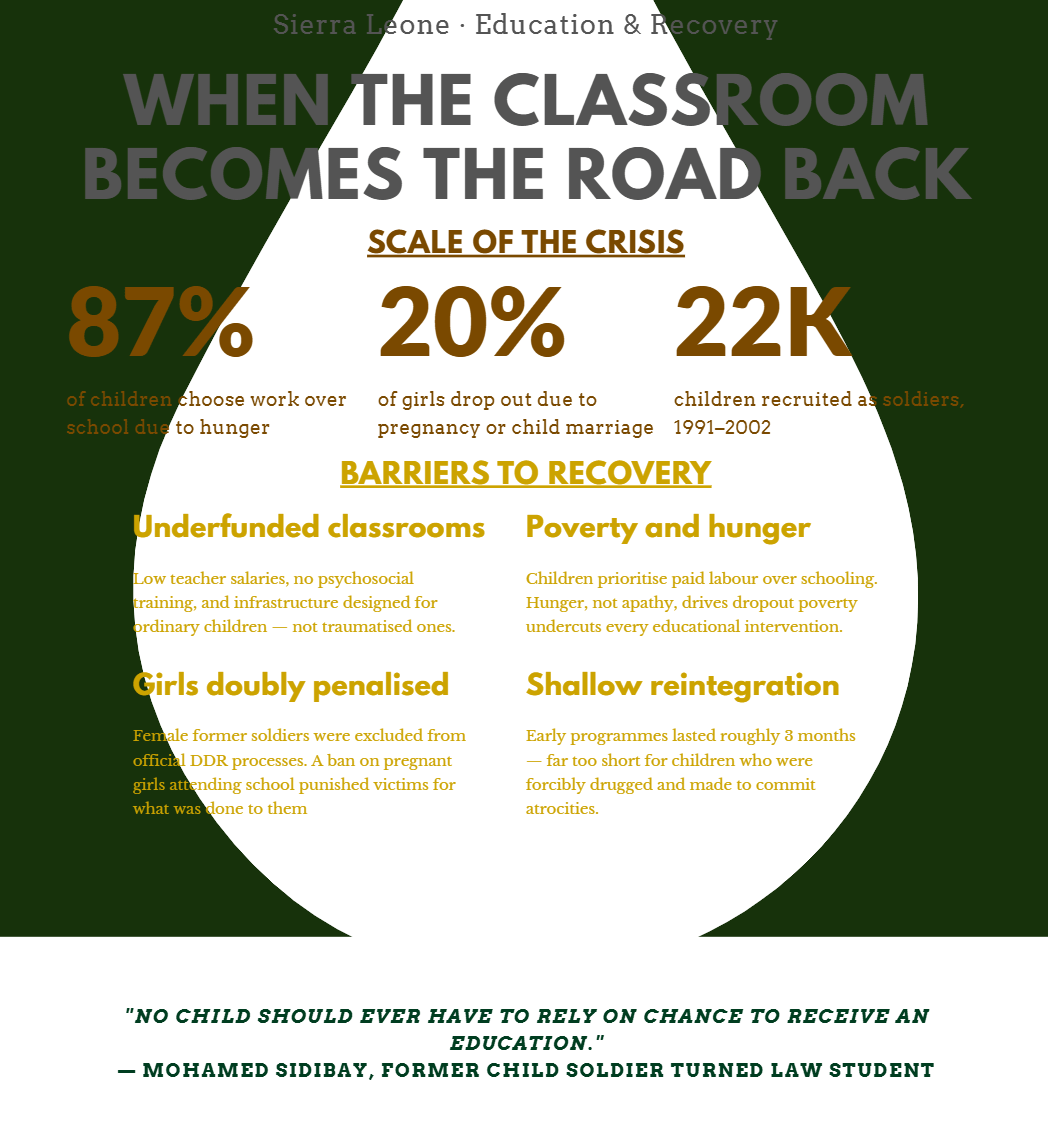
Sierra Leone endured one of the most brutal civil conflicts in modern African history. Between 1991 and 2002, an estimated 15,000 to 22,000 children of all ages were taken from their families and forced to serve in different military groups (Betancourt et al., 2008). These young children were taken as fighters, as domestic labourers, as sexual slaves. The RUF took away their childhood and cut them off from their families and communities. This in turn led to these young victims to commit atrocities against innocent loved ones. This was notably true as a strategy of indoctrination with the goal of making these children unable to escape and unable to return anywhere (Betancourt et al., 2010). The war ended in 2002. However, for those children, the war is still on-going. The return to society is one that is a constant battle and negotiation.
Education is placed as a main topic at the negotiation table. Community members in post-war Sierra Leone understood this instinctively. One adolescent in Kono put it: “We were accepted because we were sent to school” (Betancourt et al., 2008). The reason for that was that education symbolically signaled that the child has decided to choose a different route; a route for the future of Sierra Leone itself. It offered routine where there had been chaos, relationships where there had been isolation, and a sense of forward movement where trauma had created stagnation.
However, the assumption that school enrollment would straightforwardly heal what the war had broken turned out to be far more complicated. Sierra Leone’s secondary schools serve a cohort of youth whose lives were deeply affected by the war, yet very few offer teacher salaries that attract quality teaching, let alone the time, training, or staff to provide psychosocial support for traumatised children (Betancourt et al., 2010). Classrooms designed for ordinary children were asked to absorb children with PTSD, depression, and histories of violence without any structural adaptation. The result was that the protective power of education was consistently weaker than hoped. As one researcher put it: “If you go through a war, you’re traumatised, and three months is not enough to help you as much as you need as a young person. If you were drugged the whole time, literally drugged the whole time, and forced to do terrible atrocities; there’s a lot to work through” (Elkhaili & Sempijja, 2025). Three months was roughly the duration of many early reintegration programmes.
The situation was particularly acute for girls. Female former child soldiers were systematically underrepresented in the official Disarmament, Demobilisation, and Reintegration process. Partly because many had been taken as so-called “bush wives” rather than as fighters and were as such not formally classified as combatants (Wikipedia, 2025). Girls who returned were often seen as impure and cast away, which led to them facing lives of shame and social exclusion (Betancourt et al., 2010). The same school which should have offered rehabilitation instead excluded those who needed rehabilitation the most. This was exacerbated through the policy that banned pregnant girls from attending class, on the grounds that their presence would humiliate them or encourage pregnancy in others (Broken Chalk, n.d.). Sierra Leone’s education ministry upheld this ban for years, effectively penalising girls twice: first for what was done to them during the war, then for its biological consequences. They blamed the victim for being one.
Two decades later, the education system still bears the weight of what conflict broke. The sector continues to face resource shortages which leads to inadequate teacher training and high dropout rates (ST Foundation, 2025). The war’s long shadow is also rendered more noticeable due to the crises that followed it; notably the Ebola epidemic of 2014 to 2016 that closed schools for months, which in turn traumatised a new generation of children and further disrupted a system still rebuilding from conflict (ST Foundation, 2025). To add on to this, the barriers that prevent children from completing their education are not only institutional. In fact, adolescent pregnancy and child marriage rates in Sierra Leone are among the highest globally, resulting in an estimated 20% of girls dropping out of school (Girls’ Education Challenge, n.d.). Around 87% of Sierra Leonean children choose to work rather than attend school, stating they would “rather work and get paid than sit in school and be hungry” (Broken Chalk, n.d.). Poverty and hunger, not apathy, are driving the dropout rate.
There are reasons to hold onto hope. The government’s Free Quality School Education programme has driven meaningful increases in enrolment. When the National Policy on Radical Inclusion in Schools was announced, enrolments rose by 33.9% within a single year (Corus International, 2024). Local chiefs in some districts have begun imposing fines on families who keep girls out of school and are tackling child marriage as a barrier to completion (ChildFund International, 2025). And the story of Mohamed Sidibay, as exceptional as it may be, demonstrates what becomes possible when a child is given the chance to pursue an education on their own terms, at their own pace, without shame (UNICEF USA, 2024).
But the gap between enrolment and completion, or the gap between what is access and what is really recovery, remains wide. What Sierra Leone’s experience teaches is that education alone cannot carry the burden of reintegration. In fact, it should be carved into a wider scale. Communities should be willing to accept returning children and encourage them. Teachers should be trained to be able to hold trauma. And systems should be built around the children so as to not punish them for what they could not control. As Sidibay himself said: “No child should ever have to rely on chance to receive an education” (UNICEF USA, 2024).
That is the standard Sierra Leone is still working toward. The classroom is still one of the best remedies for what the war might have caused, even more so 20 years later. The question at hand is whether the classroom in question is good enough and designed properly enough to be a real remedy.
Reference List
Betancourt, T.S., Simmons, S., Borisova, I., Brewer, S.E., Iweala, U., and de la Soudière, M. (2008). “High Hopes, Grim Reality: Reintegration and the Education of Former Child Soldiers in Sierra Leone.” Comparative Education Review, 52(4), 565–587. https://dash.harvard.edu/entities/publication/73120378-e974-6bd4-e053-0100007fdf3b
Betancourt, T.S. et al. (2010). “Sierra Leone’s Former Child Soldiers: A Follow-up Study of Psychosocial Adjustment and Community Reintegration.” Child Development, 81(4), 1077–1095. https://pmc.ncbi.nlm.nih.gov/articles/PMC2921972/
Borgen Magazine (2024). “Children No Longer: Healing Child Soldiers in Sierra Leone.” https://www.borgenmagazine.com/children-no-longer-healing-child-soldiers-in-sierra-leone/
Broken Chalk (n.d.). “Educational Challenges in Sierra Leone.” https://brokenchalk.org/educational-challenges-in-sierra-leone/
ChildFund International (2025). “Defying Stereotypes: Male Leaders Champion Girls’ Education in Sierra Leone.” https://www.childfund.org/stories-and-news/2025/october-2025/defying-stereotypes-male-leaders-champion-girls-education-in-sierra-leone/
Corus International (2024). “Tech for Development: Sierra Leone’s Path to Educational Excellence.” https://corusinternational.org/blog/2024/tech-development-sierra-leones-path-educational-excellence
Elkhaili, S. and Sempijja, N. (2025). “The Role of Education in Reintegrating Ex-Child Soldiers: The Case of Sierra Leone.” Cogent Education, 12(1). https://www.tandfonline.com/doi/full/10.1080/2331186X.2025.2466307
Girls’ Education Challenge (n.d.). “Sierra Leone.” https://girlseducationchallenge.org/countries/country/sierra-leone
ICRC — IHL in Action (n.d.). “Demobilizing Children from Armed Forces and Armed Groups in Sierra Leone: 2001–2002.” https://ihl-in-action.icrc.org/case-study/sierra-leone-demobilization-child-soldiers
Night Watch Newspaper (n.d.). “No Free Quality Education in Sierra Leone.” https://nightwatchnewspaper.com/no-free-quality-education-in-sierra-leone/
ST Foundation (2025). “Sierra Leone.” https://www.stfoundation.org/sierra-leone/
UNICEF USA (2024). “A Former Child Soldier Tells How UNICEF Aided His Transition to Peace.” https://www.unicefusa.org/stories/former-child-soldier-tells-how-unicef-aided-his-transition-peace
Wikipedia (2025). “Child Soldiers in Sierra Leone.” https://en.wikipedia.org/wiki/Child_soldiers_in_Sierra_Leone
In this episode Nicolas discusses life for child soliders in Sierra Leone after the civil war is over. He is a Citizen journalist with us on a placement organised with Department of War Studies, King’s College, London.
Thank you for reading an A4R 🎨 Post. Don’t forget to try out gaming art NFT’s here. Every purchase scales our impact and pays our bills.


