


In a village in eastern Rwanda, thirty women sit in a circle turning banana leaves into beach bags. Some of them are genocide widows. Others are married to the men who killed those widows' families. Their cooperative is called Twiyubake, meaning "to rebuild ourselves" and it has been running for more than fifteen years. What it reveals is quieter, and stranger, than the usual story of Rwandan recovery.
Backstory
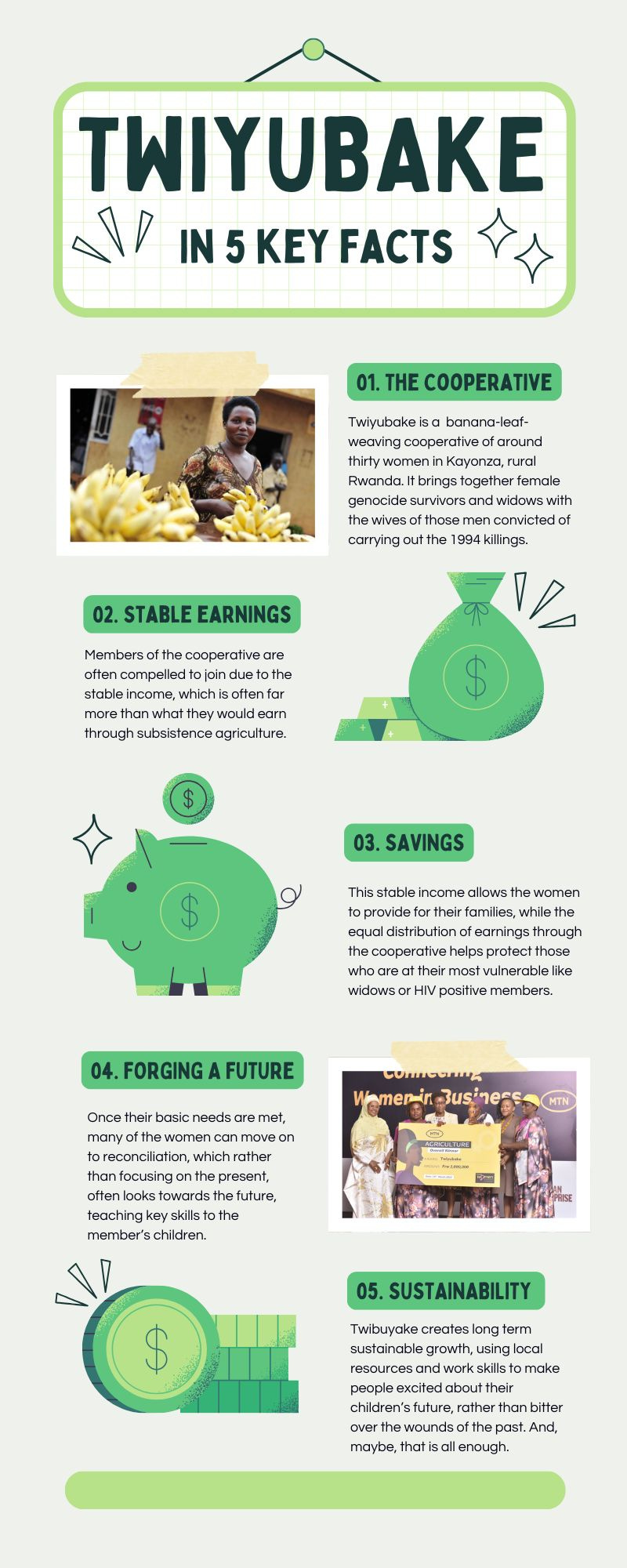
Weaving a country together: Rwanda and Twiyubake
If you have heard anything about Rwanda, it is probably one of two things. Either the 1994 genocide, an event that lasted a hundred days and left roughly 800,000 dead, with such extreme violence it is known globally and still remembered today. Or, maybe you heard the other story, the comeback: the gleaming Kigali skyline, the drone deliveries, the “African Singapore” headlines, the tech-hub marketing. Both stories are true. Neither of them tells you what it feels like to share a table with your enemy’s wife every morning for fifteen years, and slowly stop thinking of her that way.
That is what Twiyubake is. The underlying social stitches that continue to help Rwandan society come together.
What the cooperative actually does
Twiyubake is located in Kayonza, in Rwanda’s Eastern Province. It is a banana-leaf-weaving cooperative of around thirty women, partnered since 2008 with the fair-trade nonprofit Indego Africa. The women harvest banana leaves, often picking them by hand from local plantations, dry them in the sun until they take on shades of brown and black and bone-white, sometimes dye them indigo or pink, and then weave them into baskets, stacking boxes, summer beach bags and simple decorative jewellery. The products are then sold internationally, appearing throughout internet marketplaces like Saks.com and in collaborations with European designers.
The members first met in 2007 through Prison Fellowship Rwanda, an organisation that works on reconciliation. The Kinyarwanda word Twiyubake translates as “to rebuild ourselves.” Indego Africa’s co-founders describe the group plainly: female genocide survivors and widows working side-by-side with the wives of imprisoned génocidaires; Those men convicted of carrying out the 1994 killings.
Now, the first thought of many when hearing “post-conflict reconciliation” is to think of an UN panel, speeches, legalese, and, in general, the careful art of speaking a lot but saying very little that it seems so many public figures have mastered. But Twiyubake is special, and it is worth our collective attention. So, let us do a brief exercise to try to grasp just how unique and how much of an achievement the cooperative is.
Imagine something bad, irreversibly so, happened to someone you deeply care about. Now imagine the person responsible is in prison, and their spouse, the same one who made their dinner, raised their kids, shared their bed, lives in your village. You pass each other on the path to the market. Her children went to school with yours before everything happened. You are both poor. You are both trying to feed your family, and thrive in what you come. And someone from a nonprofit comes and says: we have a plan where the two of you sit next to each other every day and weave baskets. Not as a short term thing to take some pictures, get paid, and leave. But as a job.
That is the ask. And the remarkable thing is that many women said yes, and are still saying yes more than fifteen years later, because the alternative –subsistence farming on land that barely feeds anyone, the nearest wage-earning work hours away– was worse than the daily proximity of someone they had every reason to hate.
Now, the easy version of this story is just this. Forgiveness. A warm, tidy narrative where trauma melts into friendship and everyone ends up working together towards a brighter future. This, however, is not what the women themselves describe.
When Belancilla Kangondo, one of Twiyubake’s artisans, was interviewed about her life before the cooperative, she did not talk about forgiveness first. She talked about money. Before she joined, she was farming for the equivalent of around 43 cents a day while her husband was imprisoned for genocide-related activity. What Indego Africa and the cooperative gave her, she said, was the ability to renovate her house, get electricity instead of kerosene lamps, build a second house to rent out, eat regularly and save at a bank.
It is not hard to imagine many who just wanted her to say reconciliation. But Belancilla is saying something more honest and important: Only when safety and survival were in place did the harder work of living alongside former enemies become something you could carry.
This is a part I think we, as Gen Z audiences, understand better than most others. We are less afraid than ever to talk about mental health, about “capacity,” and not being able to process anything when we are burnt out and broke. It is easier for us to see, in our bones, that you cannot grieve or forgive or grow on an empty stomach and an unpaid rent bill. Here, Twiyubake is that insight made literal. The weaving doesn’t just happen to be a metaphor for the sticking together of a new society; Instead, it provides the income that makes reconciliation possible.
Beyond macroeconomic numbers
On paper, Rwanda’s official recovery is astonishing. GDP grew by 8.9 percent in 2024. Around 1.5 million Rwandans have been lifted out of poverty between 2017 and 2024. Life expectancy has more than doubled since the genocide. The government talks about reaching middle-income status by 2035.
But if you travel past the capital Kigali, the picture changes. The vast majority of people living below the poverty line live in rural areas, where poverty affects nearly one in three people, or almost twice the urban rate. Most of the new jobs the economy has created are informal, low-paid, and lack stability or social security, especially for youth and rural workers. Women in rural Rwanda earn significantly less than men and are also less likely to hold formal-sector work.
Kayonza, where Twiyubake is based, is rural and the people there are not riding the Kigali boom. After the genocide, Rwanda’s population was 70% female, but most of these women lacked any formal education or knowledge of large scale businesses or export markets, which is why organisations like Indego Africa are such an important part of the ecosystem, because beyond reconciliation, Twiyubake is also about inequality, poverty, and how to try to even out the increasingly large differences between rural and urban environments. No statistic, regardless of how much you squint at it, will tell you these stories of the cooperatives.
If you take anything away from this article, please make it be that these are people who come together because they have the same needs, even though they live in very different realities. The women of Twiyubake want what most of us want: a stable income, a sense of dignity, to be more than the worst thing that happened to them, to have some say in what their lives look like next. The circumstances are hard to fully empathise with for most, but their needs are not.
If you watch some of the interviews with the cooperative’s members (Which I very much recommend!) there is a moment when you notice something shift. When explaining why they joined, most women quickly stop talking about survival and start talking about their children’s futures. Marie Josee Numukobwa, the cooperative’s treasurer, has six children and has passed through leadership programmes including Goldman Sachs’ 10,000 Women initiative. Jacqueline Musabimana, the president, has started mentoring younger women who come in through Indego Africa’s vocational training, helping respond to Rwanda’s 63 percent youth underemployment rate by handing skills down a generation.
That shift, from “I need to survive today” to “I am building something my children will inherit” is what true, durable recovery looks like from the inside. It isn’t reached through big policy announcements. It is reached through a 43-year-old woman teaching a 20-year-old how to braid a banana leaf into a handle, in a workshop named after the word for rebuilding ourselves, in a country that still, thirty-one years on, is figuring out what that means.
Twiyubake will not fix Rwanda. But, it was never trying to. What it does is smaller and, I think, more effective: it gets people to look beyond immediacy, it gives them a chance to grow and, in the process, creates a sustainable cycle where, at the end of the day, you are sitting next to someone you never planned to sit next to, and picking up another leaf, and getting on with the day. Maybe, that is all enough.
Bibliography:
Brunner, Jeryl. 2015. “Three Women Who Survived Rwanda’s Genocide Share Their Stories of Hope and Transformation.” Parade, April 7, 2015. https://parade.com/387901/jerylbrunner/three-women-who-survived-rwandas-genocide-share-their-stories-of-hope-and-transformation/.
Co-operative News. 2016. “Women-Led Co-ops in Rwanda Help to Rebuild the Country.” Co-operative News, June 6, 2016. https://www.thenews.coop/106036/topic/democracy/women-led-co-ops-rwanda-help-rebuild-country/.
Indego Africa. 2015. “#MakersMonth: The Beauty of Banana Leaf.” Indego Africa Blog, July 8, 2015. https://indegoafrica.org/blogs/blog/makersmonth-the-beauty-of-banana-leaf.
Indego Africa. 2016. “Youth Empowerment: Banana Leaf Weaving.” Indego Africa Blog, May 26, 2016. https://indegoafrica.org/blogs/blog/bananas-for-banana-leaf-empowering-youth-through-banana-leaf-weaving.
In this episode Nicolas discusses life for child soliders in Sierra Leone after the civil war is over. He is a Citizen journalist with us on a placement organised with Department of War Studies, King’s College, London.
Thank you for reading an A4R 🎨 Post. Don’t forget to try out gaming art NFT’s here. Every purchase scales our impact and pays our bills.


