

AT A GLANCE - Mostar’s Stari Most bridge, destroyed during the 1990s Bosnian conflict, was rebuilt by 2004 and symbolizes resilience. Though physically restored, the city remains ethnically divided post-war, with visible scars—bullet holes, ruins, mosque destruction—still present. Yet activists like Irma Baralija and local artisans champion Mostar’s multicultural identity, showing enduring commitment to unity despite lasting demographic and political fractures.
‘A Rainbow Arch As High As The Sky’: The Bridge Holding Together A Community.
Put ‘Mostar’ into any social media search bar – like I did – and you’ll find yourself drawn into a visit images of the beautiful Stari Most, arching above the glittering waters of the Neretva river. Each year hundreds of daring tourists attempt to jump from it into the freezing waters below, seduced by the stunning scenery and the adrenaline rush of a 24-metre drop. It makes a great clip for your Instagram, and completing it earns you a page in the special book of those who have made the leap. But don’t forget that the ‘Old Bridge’ also stands proudly as a symbol of the city to which it gave its name; it represents not only the beauty of the city but the character it is determined to show in the face of disaster. Barely over 30 years ago, Mostar was under siege, its streets ravaged by conflict, its people catching pigeons to stay alive, and its bridge in pieces on the riverbed.
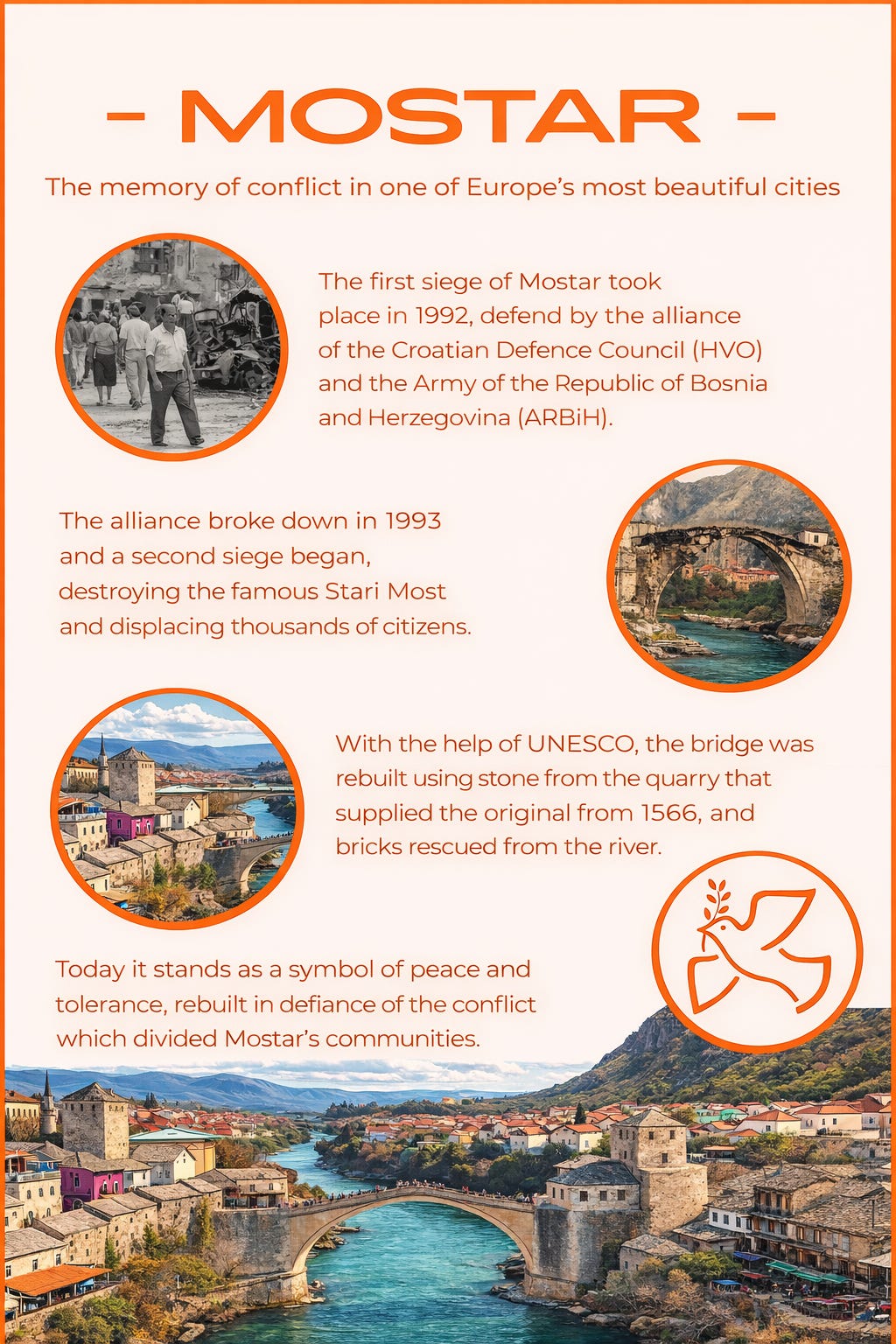
The fall of Yugoslavia in 1990 catalysed a complex conflict between the various ethnic, national, and religious groups in the Bosnian ‘melting pot’: Bosnian Serbs, Croats, Bosniaks, Muslims, Jews and Orthodox Christians. Mostar itself fell under siege first in the summer of 1992, defended by the Croatian Defence Council and the Army of the Republic of Bosnia and Herzegovina against the Yugoslav People’s Army. Once this was lifted, the fragile alliance between Bosniaks (a majority Muslim Bosnian population) and Croats broke down, and another year of violence fell upon the East of the City. Many Muslim families were forced to flee across the river, streets and buildings scarred by bombs and bullets. A community once characterised by cohabitation was broken up by atrocity, and the bridge which had stood as a symbol of this connection crumbled into the river under the weight of artillery fire.
When the conflict ended Mostar began, gradually, to rebuild. Tanks had destroyed three quarters of the housing in the West of the city and much of its infrastructure – it would be no small feat to restore it. International support was significant and UNESCO itself was part of the appeal to rebuild the bridge, launched as soon as fighting stopped in 1994. Works were completed in 2004, and it attained status as a world heritage site the following year. The city had voted to restore the ‘Ottoman Necklace’ in its original style rather than construct a new bridge, its bricks even cut from the stone of the same quarry which had provided for the original in 1566. The decision to do so reflected a commitment, despite disaster, to the values of unity and friendship which the Stari Most had stood for. Architecture had for hundreds of years reminded the people of Mostar of its tolerance and cultural diversity, and would do so again.
Yet the stones were undeniably very clean, very white, and very new. The city could be repaired, but the community could not simply go back. The war had forced its residents to flee, and altered the once diverse makeup of its municipalities; areas that once held slight Croat or Bosniak majorities became almost entirely made up of one group or the other. Many of the refugees never made it back; the International Crisis Group noted that “the narrow Bosniak plurality of 1991” had “become a substantial Croat majority”. Most of Mostar’s mosques were destroyed in the fighting, disfiguring a beautiful skyline once dotted with minarets and providing a definite example of how the built environment itself reflected the demographic shift. Even when reconstructed, the location of those buildings would remind its citizens of how they had been divided.
Today, the memory of war lingers both in the memory of those who lived through it and in the physical spaces they occupy. Those clips of excited bridge-jumpers don’t show the walls pockmarked by bullet holes, the houses reduced to rubble, or the fact that if you were to wander from a path in the mountains surrounding the city you might come across a stray landmine. The legacy of war might be buried under the ground, but the memory of it is not. For most of the population the war is a lived experience, and one they won’t shy away from – its memory grows more important as time passes, because the world cannot be allowed to forget. Signs of what happened remain because they’re important, not because they’ve been neglected. You could, for instance, walk through the Old Town and buy yourself a toy tank or a keyring made of replica bullets, just as a light-hearted souvenir. There’s a reason for that.
Mostar itself is a particularly powerful example of the undying desire for a united community growing from the ground up, its people committed to upholding its multiethnic identity despite political conflict. There were no elections in the city between 2008 and 2020, because there could be no agreement between the Bosnian Croat ethnic-oriented Croat Democratic Union (HDV) and the Bosniak ethnic-oriented Party for Democratic Action (SDA) over a new electoral system. What changed in 2020? As a mother and a Master’s graduate, Irma Baralija sued the state of Bosnia and Herzegovina, winning a judgement that forced the parties into the design of new democratic law. Baralija is a brilliant representative of the will of Mostar’s citizens not to be divided along ethno-national or religious lines, and to instead define themselves by their tolerance and commitment to cultural diversity.
This isn’t something you need to be involved in politics to see; go to Mostar for yourself and any tour guide will proudly tell you how their city is the stunning outcome of both Eastern and Western heritage. Better yet, they might take you to a little copper workshop in the Old Town which sits on the Neretva’s bank, just a stone’s throw from the Stari Most. Its owners will show you, amongst their other work, a particular style of copper plate featuring that famous bridge which has come to symbolise their city. On one end of sit the spires of a mosque, on the other the tower and crucifix of an orthodox church. Above the bridge flies a dove with an olive branch: the mark of peace. Bosnia and Herzegovina is decades removed from a war that rocked the nation, but not so far removed that the man who made the plate couldn’t look down the street and picture it lined with rubble and sandbags. It is the resilience of love for the diverse community shown by this man, by Irma Baralija, and by those like them that ensure that those scars of war remind the world of the need for peace.
So be drawn into a visit by the stunning scenery of Mostar’s famous bridge, see it for yourself, see the bullet holes and broken buildings. Hear both the pride with which its people describe the multicoloured history of its amazing architecture, and their reminder of the importance of remembering a war not yet distant in memory. Take in the history you can see around you, and have a go at leaping from the bridge, if you’re sure.
https://theroamingrenegades.com/mostar-discovering-scars-war-rocked-bosnia/
file:///C:/Users/Fin/Downloads/Rebuilding_Mostar_Urban_Reconstruction_in_a_War_Zo..._----_(12_Conclusions).pdf
https://www.re-thinkingthefuture.com/city-and-architecture/a6453-rebuilding-the-city-mostar/
https://whc.unesco.org/en/story-mostar-bridge/
https://www.dailysabah.com/life/historic-mostar-bridge-defies-war-celebrates-20-years-rebuilt/news
Bollens, Scott A. (2007). Cities, Nationalism and Democratization. London and New York: Routledge. ISBN978-1-134-11183-1.
In this episode Finabr discusses the post conflict experience of Mostar. He highligts life after the war there. He is a Citizen journalist with us on a placement organised with Oxford University Career Services.
Thank you for reading an A4R 🎨 Post. Don’t forget to try out gaming art NFT’s here. Every purchase scales our impact and pays our bills.


