


After the fall of Bashar al-Assad, over a million Syrians returned home, but return is fraught with hardship. War has devastated infrastructure and the economy, while years abroad have reshaped identities. Many refugees feel torn between two “homes,” facing pressure from host countries yet uncertainty in Syria, making return a complex, often temporary, and deeply personal decision.
Backstory
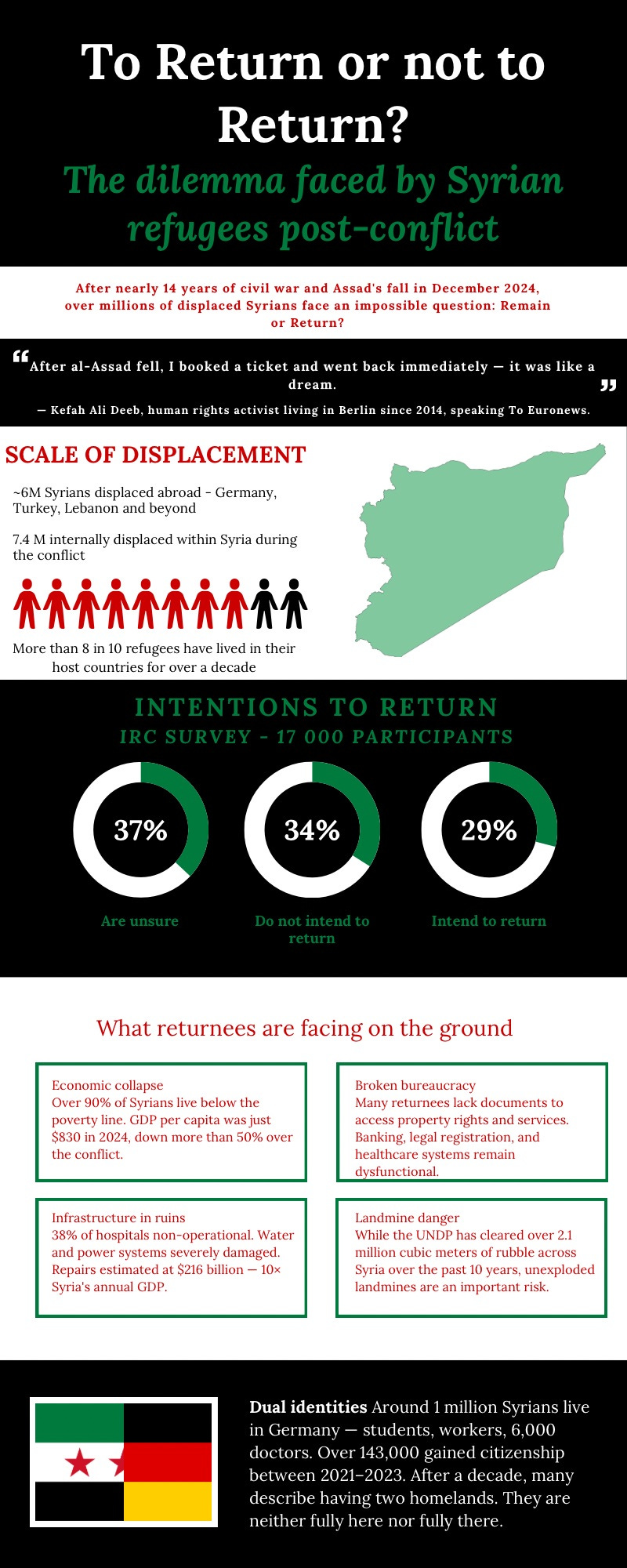
To Return or not to Return? The dilemma faced by Syrian refugees post-conflict
When Khalid al-Shatta stepped off a plane in Damascus in early 2025 — thirteen years after fleeing with his wife and infant son — he described a feeling that most of us would struggle to name. “The moment Syria was liberated, we made our decision,” he told Al Jazeera (AJLabs, 2025). And when he finally arrived, he felt like he had never left. But there was one difference, he added: a new sense of belonging to the country, the nation, the land. After thirteen years, home no longer felt like home by default. It had to be chosen.
That feeling — the act of choosing a place that was once simply yours — sits at the heart of what is happening to Syria right now. Since the fall of Bashar al-Assad in December 2024, over one million Syrians have returned from neighbouring countries and beyond, joining nearly two million internally displaced people who have made their way back to their areas of origin (UNHCR, 2026). It is one of the largest return movements in modern history. But a return movement is not a resolution. For the millions caught between a country that displaced them and the countries that never fully accepted them, the question of where they belong has become the defining human challenge of post-conflict Syria — and it does not have a clear answer.
Home is not what they left it
The war has scattered Syrian people all over. 7.4 million Syrians are internally displaced, and approximately 6 million are abroad, living in countries such as Germany, Türkiye, and Lebanon. Imagine, after years of being forcibly separated from your home, you finally have the opportunity to return. A no brainer, right? Surely anyone would jump at the occasion to come back to their own house, their own community, their own country.
For Syrian refugees it is not so simple.
The nearly 14 year bloody civil war has left Syria devastated. Cities, roads, hospitals, houses, schools have been destroyed. Infrastructure essential to survival such as water management systems and power plants are damaged or missing. The World Bank estimates reconstruction will cost $216 billion — nearly ten times Syria’s annual economic output (Group, 2025). Syria’s economy has contracted by more than 50% during the conflict. Gross National Income per capita was just $830 in 2024, and over 90% of the population lives below the poverty line (Afaghani, 2025). Jobs exist, but wages are often insufficient to sustain a family. Entire neighbourhoods are now rubble. What would once be a Syrian person’s must familiar environment is unrecognisable.
Return, in this context, is not a singular action but involves a long process of rebuilding.
Remain or return?
For those who did choose to return, the experience has been genuinely mixed. “It’s an amazing period, I’ve never experienced the same freedom,” said Osama Mufdi, a Syrian entrepreneur who returned from Europe to open a charity and new business in Damascus (Holyoke, 2025). His experience captures something real: there is genuine energy and opportunity in the new Syria, a sense of freedom that many returnees describe as unlike anything they experienced under Assad.
However, most refugees are unwilling to make a permanent move back to Syria.
Research from the International Rescue Committee (2026), who conducted three rounds of surveys among 17 thousand Syrian refugees in 4 countries, shows that only 29% of respondents said they intended to return. 34% said they had no intention of going back at all and 37% were unsure. There is still little urgency for many people who are thinking about going back; only 9% of those who aim to go back, aim to do so immediately, and 16% to do so within six months. The fact that more than half (56%) of respondents were uncertain about when they would return suggests a significant level of reluctance or reliance on outside variables like better situations in Syria or modifications to the conditions in the host nation. Barriers to return include having suitable accommodation, which only 10% of respondents said to have. Being able to live with the dignity accorded by basic services and infrastructure was said to be the most important aspect, as it was cited by 72%.
Dual identities
What the return debate underplays is the identity dimension – the fact that more than a decade of displacement has changed people in ways that are not easily reversed. Indeed, over 80% of refugees in have lived in their host countries for over a decade (International Rescue Committee, 2026). These people had no choice but to rebuild their lives, working new jobs, building new relationships, learning new languages, ways of communicating, everything. Some became citizens of their host countries; between 2021 and 2023, 143,000 Syrians obtained German citizenship (McGuinness, 2024). Anas Modamani, who arrived in Germany at seventeen, captures this complexity perfectly when he speaks of having “two accessible ‘Heimaten’” (homelands)—a sense of belonging to both Berlin and Damascus (Connolly, 2025).
Indeed, someone who has lived in Berlin for a decade, raised children there, navigated the language, built friendships, experienced both welcome and hostility — that person does not simply “return.” They arrive as someone new, in a place that has also changed, and they have to figure out whether those two changed things still fit together.
Many of the people who did go back to Syria, did so on a temporary basis, and reserve the the possibility of leaving if conditions in Syria worsen. These are generally people with dual nationalities and who have the means to travel back and forth. Kefah Ali Deeb, a human rights activist living in Berlin since 2014, told Euronews; ““After al-Assad fell, I booked a ticket and went back immediately,” saying for her, “it was like a dream” (Holyoke, 2025). However, Ali Deeb did not stay, despite wanting to, deciding to monitor the situation in Syria before moving back, recalling her husband saying “Everything now is chaotic” (Holyoke, 2025). However, the decision to stay or not in Europe may soon be out many non-citizen refugees’ hands.
The political pressure from host countries
In Europe, right-wing governments are leveraging Syria’s political transition to push refugees out. Minister President of Bavaria Markus Sköder, said “If the reason for asylum disappears, then there is no longer any legal basis to stay in the country” (McGuinness, 2024).
The rise of the Alternative für Deutschland (AfD) AfD, with its explicit claim that “Islam does not belong in Germany,” created an atmosphere in which Syrian integration is publicly contested. When Assad fell, the push to return became part of the political campaign. Within hours of Damascus changing hands, AfD co-leader Alice Weidel announced that anyone celebrating the new Syria “clearly no longer has any reason to flee” and “should return immediately.” (McGuinness, 2024). Chancellor Friedrich Merz’s government hardened migration policy and entered talks with Syria’s interim president about the terms of return.
Syrians are caught between a country that cannot yet fully receive them and host countries that no longer want to fully keep them. And this is before accounting for the economic reality that many Syrians in Germany are, right now, lifelines to family members still inside Syria — sending remittances that substitute for the absence of functional public services. When those remittances stop because someone is pressured into a premature return, the family on the other end loses their safety net.
The final word
Khalid al-Shatta chose to return and felt, finally, like he belonged somewhere. Ali Deeb wants to return and cannot yet bring herself to. Anas Modamani is somewhere in between. They are all, in their own way, doing the hardest possible human thing: figuring out where home is, when home was taken away fourteen years ago and neither the place they left nor the place they fled to has fully held them since.
Bibliography
Afaghani, R. (2025). From Crisis to Recovery: Securing Peace and Stability in Syria and Beyond. [online] UNDP. Available at: https://www.undp.org/syria/blog/crisis-recovery-securing-peace-and-stability-syria-and-beyond.
AJLabs (2025). How many Syrians have returned home one year since the fall of al-Assad? [online] Al Jazeera. Available at: https://www.aljazeera.com/news/2025/12/8/how-many-syrians-have-returned-home-one-year-since-the-fall-of-al-assad.
Connolly, K. (2025). The Syrian refugee whose selfie with Angela Merkel changed his life. [online] the Guardian. Available at: https://www.theguardian.com/world/2025/jan/04/anas-modamani-syrian-refugee-selfie-angela-merkel.
Group, W.B. (2025). Syria’s Post-Conflict Reconstruction Costs Estimated at $216 billion. [online] World Bank. Available at: https://www.worldbank.org/en/news/press-release/2025/10/21/syria-s-post-conflict-reconstruction-costs-estimated-at-216-billion.
Holyoke, G. (2025). Syrians in Europe weigh up going home one year after al-Assad’s fall. [online] euronews. Available at: https://www.euronews.com/2025/11/28/syrians-in-europe-weigh-up-returning-home-one-year-after-al-assads-fall.
International Rescue Committee (2026). Syrians on the Move: Regional Refugee Intentions Briefing - Executive Summary | The IRC. [online] Syrians on the Move: Regional Refugee Intentions Briefing - Executive Summary. Available at: https://www.rescue.org/report/syrians-move-regional-refugee-intentions-briefing-executive-summary.
Jenna Le Bras (2026). Turkey’s economy hit as Syrians return home. France 24. Available at: https://www.france24.com/en/turkey-s-economy-hit-as-syrians-return-home.
McGuinness, D. (2024). Germany’s one million Syrians at centre of fierce political debate over future. BBC. [online] 11 Dec. Available at: https://www.bbc.com/news/articles/cy7kxn6p878o.
Osseiran, N. (2025). Hard homecoming: Syrian refugees return to a devastated land. Thomson Reuters. 5 Jun.
UNHCR (2026). Syria Factsheet - January 2026. [online] Available at: https://www.unhcr.org/sites/default/files/2026-03/syria-factsheet-january-2026.pdf.
Vollmer, R., Dinçer, O.B., Şahin-Mencütek, Z. and Engelberth, S. (2024). The Politics of Syrian Refugee Return in Germany: Balancing Rhetoric and Reality. [online] Bicc.de. Available at: https://bicc.de/Cosmos/Peacebits/The%20Politics%20of%20Syrian%20Refugee%20Return%20in%20Germany.
In this episode Maud discusses the Syrian refugee returnee expereince of rebuolding their country and their identities. She is a Citizen journalist with us on a placement organised with Department of War Studies, King’s College, London.
Thank you for reading an A4R 🎨 Post. Don’t forget to try out gaming art NFT’s here. Every purchase scales our impact and pays our bills.


